Articles › AI and drug development
Article · AI and drug development · 2 November 2026
Sixty billion dollars, zero approved drugs. Where does AI pay off in pharma?
By Christian Soschner, 26 years building companies
Picture a biotech CEO on a grey November evening in Vienna. Rain on the window, a cold coffee, a board meeting at nine tomorrow morning.
Slide seven of her deck says “AI-driven pipeline” in large blue letters. She likes that slide, and her investors liked it too, because it helped close the last round.
Then she imagines the question every good board member asks sooner or later.
“How many AI-discovered drugs has the FDA approved so far?”
She deletes the slide. She puts it back. She deletes it again.
The answer is zero.
Since 2019, about $60 billion has gone into AI drug discovery. Around 175 AI-originated programs have entered human trials, and the FDA has approved none of them (MedCity News).
When I posted those numbers on LinkedIn in September, the comments came in fast, and a few came with elbows out. More than 60 of them arrived, from medicinal chemists, clinicians, regulatory writers and a protein designer at Google DeepMind. They turned a provocation into a better argument. What follows is that argument, with credit to the people who made it better.
“Shouldn’t this post wait another three years?”
That was the first reply, from Alexander Goldberg, a chemist working at the edge of AI and biotech. His point: if a drug needs a decade in the clinic, counting approvals today is like grading a marathon at kilometre five.
John Overington, who helped build some of the field’s best-known drug databases, added that none of the 175 programs has even been filed for approval yet. Malte Clausen, a former BCG partner, reminded everyone that the first AI-designed molecule only entered human trials in January 2020.
Fair hits. A drug takes longer to grow up than most startups take to go public.
I still think approvals are the right scorecard, because a molecule cures nobody on a slide. The label “AI-discovered” promises better medicines, and better medicines are counted at approval, on the day a doctor can write the prescription.
Is the post ahead of its time, then? I don’t think so. AI has been part of drug discovery for years, and its promise has always been the same: better drugs, faster. Yet the pipeline is far from overflowing, even with drugs close to approval.
The program closest to the finish line shows how far away that line still is. Insilico Medicine’s rentosertib, for a lung disease called idiopathic pulmonary fibrosis, is the one where AI picked both the target and the molecule. Insilico dosed the first patient in GENESIS-IPF-3, its Phase III trial, in September 2026. The lead investigator expects three to four years from the start of Phase III to a possible approval, if all goes well (Insilico Medicine).
That puts the first fully AI-discovered drug at around 2029 or 2030. I’ll check the scorecard again every year until then.
Top marks in the entrance exam
The most useful number in the whole discussion came, again, from Malte Clausen.
Think of AI-designed molecules as students who ace the entrance exam. Phase I asks one question: is this safe? A BCG analysis found that by December 2023, 21 of 24 AI-discovered molecules had passed Phase I. That’s 80 to 90%, against a historical 40 to 65% (Drug Discovery Today).
Phase II asks the harder question, whether the drug works, and there AI molecules passed 4 out of 10 times. That’s in line with the 30 to 40% everyone else achieves.
The finals are still the finals. AI picks molecules that pass the safety test more often, but it has not yet picked better medicines.
One narrow door
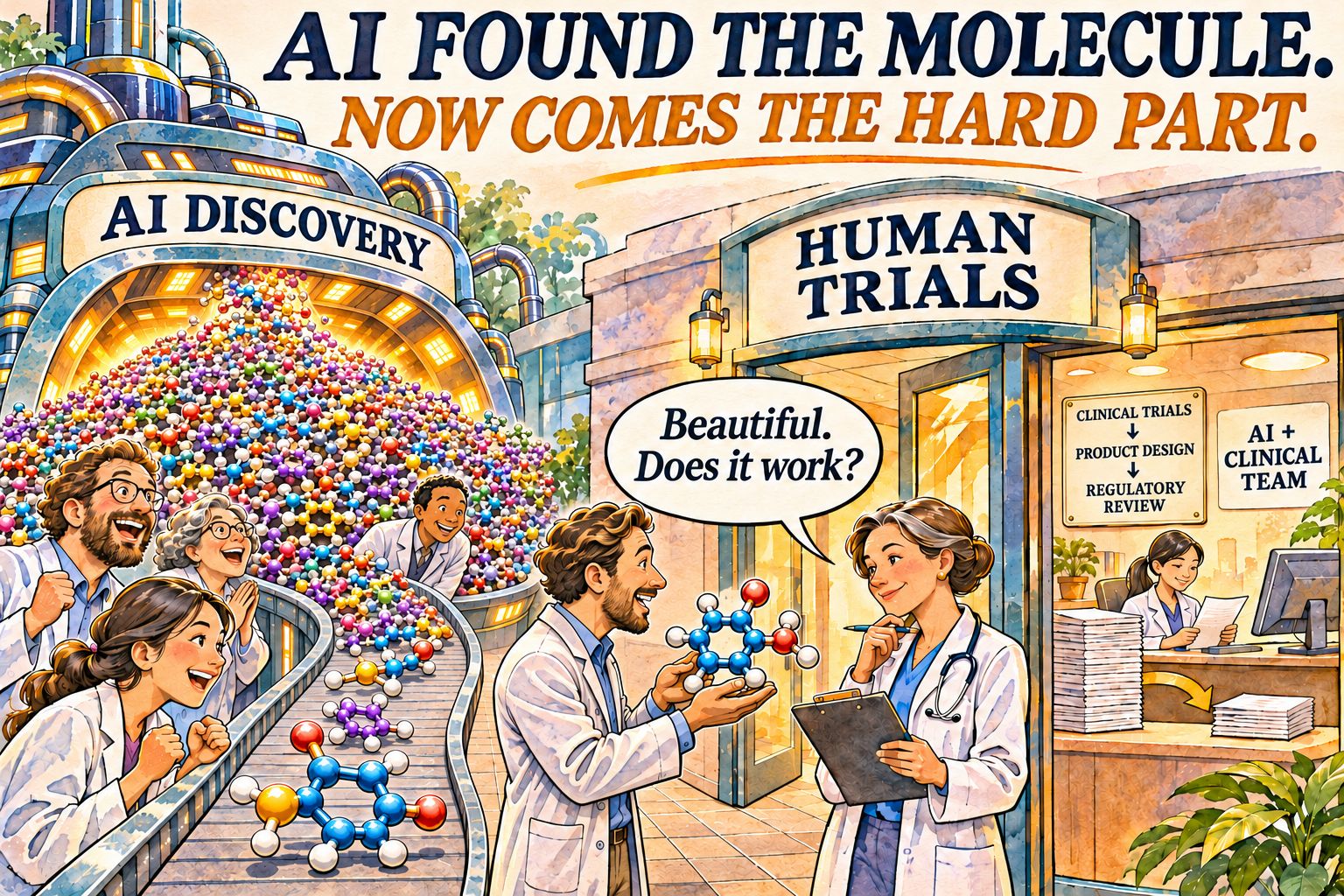
Imagine the day biopharma overflows with AI-designed candidates, each one beautiful on the screen. Every single one still has to pass through the clinic, one patient, one site and one data point at a time. That bottleneck existed long before AI arrived, and prettier molecules leave it as narrow as it ever was.
No candidate gets through by announcing itself.
“Tremendous molecule. The most beautiful molecule anyone has ever seen, believe me. Everybody says so.”
The clinic has heard every pitch before, and it believes only patient data.
Where the decade hides
Ask anyone who has run a clinical trial where the months went. Nobody says, “We were waiting for a molecule.”
BIO measured 10.5 years from the first human dose to approval, and only 7.9% of candidates that start Phase 1 reach the market. Phase 2 is the cliff: fewer than three in ten make it across (BIO).
Jonathan Young, a medicinal chemist, put it in one line in the comments: faster molecule design speeds up the fastest and cheapest step in development. Oscar P., who runs translational research at Delcath, finished the thought: designing a molecule is the easy part, and measuring what it does in humans is the real work.
The rest of the time goes on everyday human things:
- Data the developer doesn’t have. Dan Housman, CTO of Graticule, pointed out that good trial design needs data that lives outside the developer’s firewall. His fix is real-world data, research networks and new ways for hospitals and pharma to run studies together (his piece).
- People who keep leaving. Amy Sehnert, MD, named the study coordinator shortage. Screening and enrolling a patient is still one person talking to another.
- Plain automation. Stephanie Kainrath reminded everyone that templates, structured data and clean pipelines solve a lot of it, no language model required.
- And the honest question. Andrea Splendiani of IQVIA noted that even basic hospital scheduling offers huge gains. What has been stopping anyone from taking them?
Months into minutes
The twist is this: the most valuable AI in pharma this year may never design a molecule. It writes the clinical study report.
- Bristol Myers Squibb gave more than 30,000 employees access to Claude in May, from the research bench to clinical development. Trial documentation and clinical study reports were among the first jobs (Fierce Pharma).
- Novo Nordisk signed in September, and Reuters reported that the model writes trial reports there, and that patient documents which took months now take minutes (Reuters).
- Genentech works with Anthropic’s lab automation tools.
- Anthropic built its own wet lab near San Francisco and plans preclinical programs in rare diseases that pharma finds too small to fund. Eric Kauderer-Abrams, who leads life sciences there, said the final test is still in real lab work, and will be for a while (Reuters).
Roy Eisenhandler, who has written regulatory documents himself, confirmed it from experience: turning trial data into reports was where software helped first.
Expect much more noise around this in the coming weeks: Anthropic filed its public S-1 on 26 October 2026, and every investor deck in AI will soon have a pharma slide.
Faster only counts if the file stands up
Lucile Brunin, who builds regulatory dossiers for a living, made the point regulators will make. Speed counts only if a person can still show who decided what, on which data, when the authority asks. Mary Gress said it shortest: the prize is better development decisions, and speed matters when evidence and judgment keep pace.
Constance Höfer asked the question every R&D head should answer before the first pilot: where do your company’s R&D questions go once they leave your firewall?
What I would do on Monday morning
My advice to management teams hasn’t changed: spend less energy on discovery, and put AI to work in preclinical and clinical development.
The value chain is long, and AI can help almost everywhere on it:
- Product concepts that fit an acute patient need and a real market, found faster
- Clinical timelines tightened through protocol design, site selection, enrollment and documents
- Regulatory approval reached sooner, with cleaner submissions
- Formulation work that improves safety, efficacy and usability at the same time
Start where your own months disappear. Write down where the time goes between the first human dose and the filing. Fix the longest delay first, and build a file the regulator can follow from day one.
Sylvia E. of CDD Vault left the most hopeful comment in the thread: today’s AI is a different tool from the AI of 2019. Whole workflows will reorganise around it, and the pieces are already moving.
Back to slide seven
The CEO keeps slide seven, but she changes the title.
It no longer says “AI-driven pipeline.” It says how many months AI took out of the road to her Phase 2 readout.
That’s a slide a board will love.
If your next financing depends on a clinical readout, which month between today and that readout could AI give back to you?
Your Next Move
If that question is on your desk before a board meeting or a financing round, start with one prepared hour on that decision.
See Your Next MoveQuick answers
- Has AI discovered an approved drug yet?
- No. About 175 AI-originated programs have reached human trials since 2019, and none is approved. The first could come around 2029 or 2030.
- Do AI-designed drugs do better in trials?
- In Phase I, yes: 80 to 90% pass, against a historical 40 to 65%. In Phase II, they perform the same as other drugs so far.
- Where does AI save time in pharma today?
- Mostly in clinical and regulatory documents, trial reports and lab automation.
- Where does the time in drug development go?
- Into the clinic: about 10.5 years from the first human dose to approval.
Sources
Original post and discussion
Christian Soschner on LinkedIn, September 2026: “Sixty billion dollars. Zero approved drugs.” The post and its 60+ comments this article grew from. Read the post
AI drug discovery: money, programs, approvals
MedCity News, June 2026, on $60 billion, about 175 programs and zero approvals. medcitynews.com
Insilico Medicine, September 2026, first patient dosed in the GENESIS-IPF-3 Phase III trial of rentosertib. insilico.com
Clinical success rates and timelines
Jayatunga et al. (BCG), Drug Discovery Today, 2024, on how AI-discovered molecules perform in Phase I and Phase II. sciencedirect.com
BIO, Clinical Development Success Rates 2011–2020. bio.org
Pharma agreements and Anthropic’s life-sciences work
Fierce Pharma, 20 May 2026, on the Bristol Myers Squibb agreement. fiercepharma.com
Novo Nordisk press release, 16 September 2026. biospace.com
Reuters on Novo’s use of Claude for trial reports. finance.yahoo.com
Reuters, 18 September 2026, “Anthropic quietly sets up biology lab as it ramps AI drug program”. investing.com
Anthropic, PBC, Form S-1, SEC EDGAR, 26 October 2026. sec.gov
From the discussion
Dan Housman, Graticule, “AI in pharma: what I learned at the TD Cowen Health Care Conference”. graticule.life
Thank you to everyone named above for making this article better in the original LinkedIn discussion.
This article is for information only and is not investment advice or a recommendation to buy or sell any security. The author may hold positions in the companies discussed.