Articles › Biopharma deals
Article · Biopharma deals · 4 November 2026
$358 million for the right to wait. What Boehringer’s China deal means for Europe’s biotech companies
By Christian Soschner, 26 years building companies
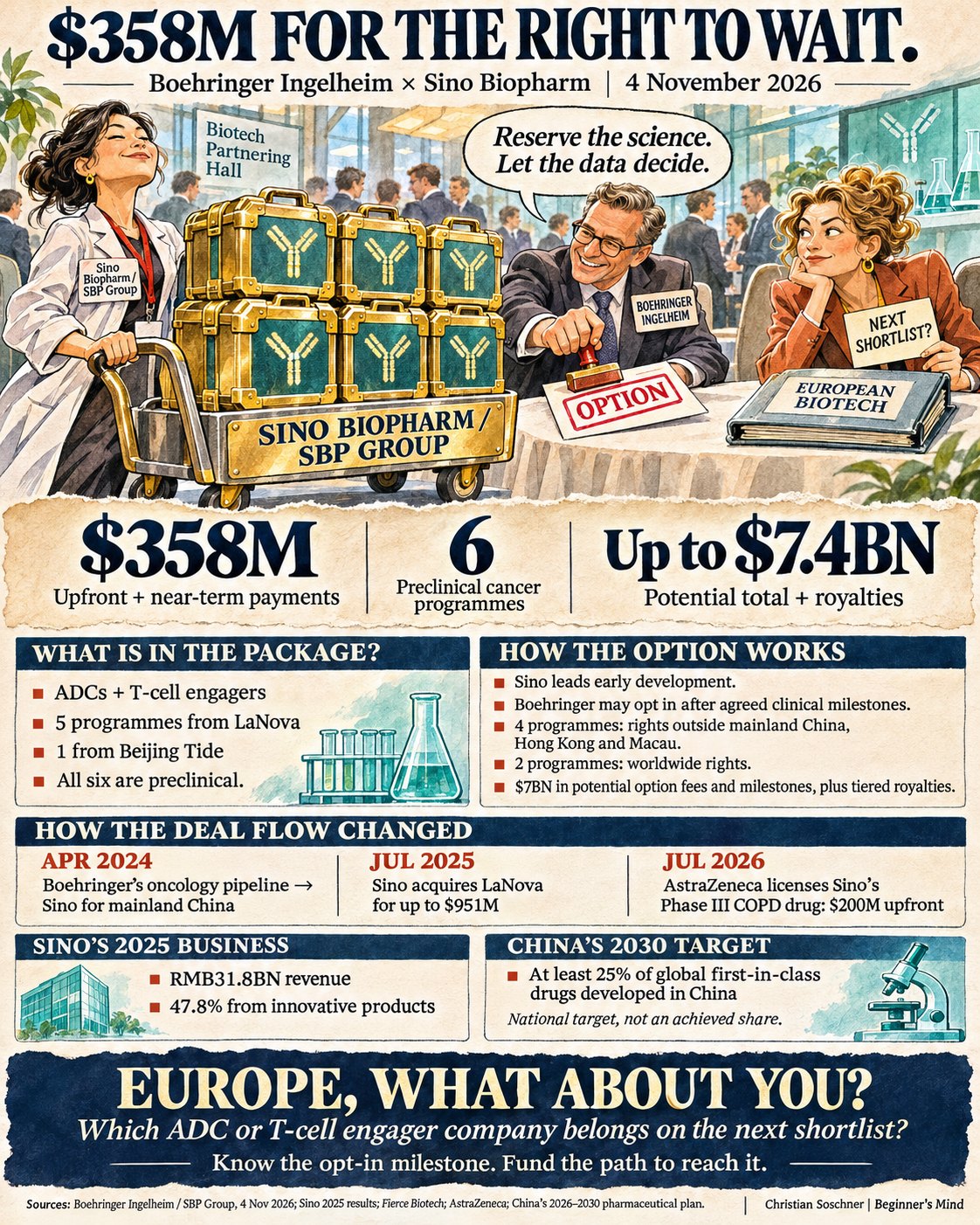
Six cancer programmes. No patient has received any of them. And $358 million is already committed.
Boehringer Ingelheim agreed today to pay Sino Biopharmaceutical $358 million in upfront and near-term payments for options on those six programmes. Sino is also eligible for up to $7 billion in option, development, regulatory and sales milestones, plus tiered royalties, which takes the headline value to as much as $7.4 billion (Boehringer Ingelheim and SBP Group; Pharmaceutical Technology).
In July, AstraZeneca paid the same group $200 million upfront for TQC3721, a drug for chronic obstructive pulmonary disease that is already in Phase III (Pharmaceutical Technology).
The gap between those two cheques is the story.
Somewhere in Munich tonight, a biotech CEO reads both numbers twice. His suitcase lies open on the bed, and his calendar for BIO-Europe in Cologne next week shows the meeting he has chased since spring: thirty minutes with the oncology scouting team of a large pharma company.
His company has one T-cell engager, a clean preclinical data package and cash for eighteen months. His deck opens with the molecule, because the molecule is what his team is proudest of.
The price of a molecule that has never met a patient
Most commentary on China licensing deals tells a story of discount shopping. In that story, Western pharma companies pick up late-stage Chinese assets for a fraction of what a comparable Western asset would cost.
This deal points the other way. The arithmetic is simple. Divide $358 million by six and Boehringer commits about $60 million per programme. None of these molecules has left the laboratory yet. AstraZeneca’s money in July bought a drug with years of clinical data behind it, whereas Boehringer’s buys a place at the front of the queue.
The price per stage tells you what a buyer believes. A company pays late-stage money for early-stage science when it expects that science to reach patients sooner than its own laboratories could.
From local seller to exporter of science
Sino Biopharm listed in Hong Kong in 2000 and grew into one of China’s largest drugmakers by selling medicines inside China, mostly through its Chia Tai Tianqing unit. In 2025 it reported revenue of RMB 31.83 billion. Innovative products contributed RMB 15.22 billion of that, or 47.8%, after growing 26.2% in a single year.
The group spent RMB 6.32 billion on research and development, close to a fifth of revenue, and ended the year with 39 innovative oncology candidates at the clinical-trial application stage or beyond (Sino Biopharm 2025 results).
For most of its history, the deals ran in one direction. Western science came into China, and Sino sold it there.
The April 2024 agreement with Boehringer followed that pattern. Sino took on the joint development and commercialisation of Boehringer’s oncology pipeline in mainland China. The package included brigimadlin, the HER2 inhibitor zongertinib and BI 764532, a DLL3 T-cell engager (BioSpectrum Asia). Zongertinib has since reached Chinese patients as Hernexeos, one of four innovative products approved for Sino in 2025.
GSK took the same road in May 2026, when it gave Chia Tai Tianqing the China launch of bepirovirsen, its hepatitis B drug. One extra clause deserves a second look: GSK may review Sino’s early-stage pipeline for collaborations outside China (GSK).
That clause marks the turn.
In February 2026, Sino licensed rovadicitinib to Sanofi worldwide in a deal worth up to $1.53 billion. In July, AstraZeneca took TQC3721 outside China.
Then came today. Boehringer, the partner that once brought its own pipeline to Sino, now licenses Sino’s ADCs and T-cell engagers for the rest of the world.
At up to $7.4 billion, the new agreement is worth more than three times the AstraZeneca deal.
The LaNova arithmetic
Five of the six programmes come from LaNova Medicines, a Shanghai antibody company. Sino bought it in July 2025, paying up to $951 million for the 95.09% stake it did not already own. Because LaNova brought about $450 million of cash with it, the net payment came to about $501 million, according to Sino’s filing as reported by Fierce Biotech.
LaNova had already shown what its platform could sell. In 2023 it licensed a GPRC5D-targeting ADC to AstraZeneca in a deal worth up to $600 million. In November 2024, Merck paid $588 million upfront for LM-299, its PD-1xVEGF bispecific antibody.
Sixteen months after the acquisition, LaNova’s programmes anchor Sino’s largest licensing deal of the year. By my arithmetic, Boehringer’s $358 million equals roughly seven-tenths of the net price Sino paid for the whole company.
Paying to wait
The structure explains the price.
Sino runs early development on all six programmes. It bears the cost of the first clinical steps. Once agreed clinical milestones are met, Boehringer may exercise options for exclusive rights. For four programmes, those rights cover every market outside mainland China, Hong Kong and Macau, while for the other two they cover the whole world.
Chinese financial press reports the trigger as the completion of global Phase I trials (Futu News), although the companies have not published the milestones themselves.
In plain terms, Boehringer pays $358 million for the right to wait for the data, and then decides with human results in hand.
Patience has a price tag now.
The buyer gets breadth and time. It has six options across two of oncology’s busiest modalities, and the early spending stays on Sino’s books. The seller keeps the most research-intensive stage in house, close to its own laboratories, and collects money years before any product reaches a pharmacy.
Paola Casarosa, who leads Boehringer’s innovation unit, called the deal a way of “connecting innovation from China with our global research and development capabilities.” Boehringer opened a research and development centre in Shanghai in October.
The timing fits the year. In October, Roche agreed a deal worth up to $15 billion with Hansoh Pharma, the largest ADC agreement of 2026. T-cell engagers, meanwhile, are moving from blood cancers into solid tumours (Pharmaceutical Technology).
One in four
Behind the deal stands a national target. China’s five-year plan for its biomedical industry, published in September, sets a goal for Chinese companies to make and develop 25% of the world’s first-in-class drugs by 2030 (Pharmaceutical Technology). A GlobalData analysis put China-based companies at about 20% of all drugs in development worldwide in 2025.
The 25% is a goal, and first-in-class medicines are the hardest prize in drug development. Still, I think one in four is a clear bid for the front rank of drug invention.
Deals like this one show how such a bid gets financed, with early science developed in China and partners paying for global options before the data exists.
What it means for a European biotech
Europe already plays a leading part in this story. The buyer is Boehringer Ingelheim, a family-owned company from Ingelheim am Rhein, and its money now funds early cancer research in Shanghai.
For a European company pitching an ADC or a T-cell engager, the competition for a partner’s attention has changed. A single seller can now offer six programmes in one package, with early development already funded and run in house.
That is a new kind of rival.
Every large partner opens only a limited number of new oncology deals each year, and a package like this one fills a slot that a single-asset company was hoping to win.
Three questions help a European CEO prepare for that conversation.
- Which clinical milestone would trigger your option? Ask the partner directly, early in the conversation. Then build the development plan around the answer.
- Is the road to that milestone funded? Raise enough capital to reach it with a buffer. An option buyer pays at the milestone.
- What does the partner get beyond one molecule? A platform, a second programme or a faster route to the first patient. Each one strengthens a single-asset company’s case for the shortlist.
Europe, what about you? Name the European ADC or T-cell engager company you would put on Boehringer’s next shortlist. The comments on the original LinkedIn post are open.
Back to the suitcase
The CEO in Munich closes the alert and opens his deck.
He keeps the molecule. It moves to slide three. Slide one now names the clinical milestone a partner will want to see, the month he plans to reach it and the capital already in the bank to get there.
In Cologne, the scouting team will meet a CEO who has done the homework on their option before they asked.
Which clinical milestone would make your preferred partner exercise an option, and is the road to it funded?
Your Next Move
If that question is on your desk before a partnering meeting or a financing round, start with one prepared hour on that decision.
See Your Next MoveQuick answers
- What did Boehringer Ingelheim agree with Sino Biopharm?
- Options on six preclinical cancer programmes based on ADCs and T-cell engagers: $358 million in upfront and near-term payments, up to $7 billion in milestones and tiered royalties, for a total value of up to $7.4 billion.
- Where do the six programmes come from?
- Five from LaNova Medicines in Shanghai and one from Beijing Tide Pharmaceutical, both Sino Biopharm subsidiaries.
- When does Boehringer get the rights?
- When it exercises its options after agreed clinical milestones: four programmes for all markets outside mainland China, Hong Kong and Macau, and two worldwide.
- How does it compare with AstraZeneca’s deal with Sino?
- AstraZeneca paid $200 million upfront in July 2026 for TQC3721, a Phase III COPD drug, with up to $1.9 billion in milestones. Boehringer’s deal is worth more than three times as much in total.
- What is China’s 2030 target for new medicines?
- China’s five-year biomedical plan aims for Chinese companies to make and develop 25% of the world’s first-in-class drugs by 2030. It is a national target for 2030.
Sources
Original post
Christian Soschner on LinkedIn, 4 November 2026: “$358 million in upfront and near-term payments for six cancer programmes that no patient has received yet.” The post this article grew from. Read the post
The Boehringer Ingelheim and Sino Biopharm agreement
Boehringer Ingelheim and SBP Group announcement, 4 November 2026, via EuropaWire. news.europawire.eu
Pharmaceutical Technology, 4 November 2026, on the deal terms, the Roche and Hansoh agreement and the GlobalData pipeline share. pharmaceutical-technology.com
BioPharm International, 4 November 2026, on the upfront and near-term payments and the option structure. biopharminternational.com
Futu News, 4 November 2026, Chinese financial press on the option trigger. news.futunn.com
Sino Biopharm’s business and earlier deals
Sino Biopharm 2025 annual results, 26 March 2026, including the Sanofi licence for rovadicitinib. acnnewswire.com
Pharmaceutical Technology, 9 July 2026, on the AstraZeneca licence for TQC3721. pharmaceutical-technology.com
GSK, 11 May 2026, collaboration with CTTQ for bepirovirsen. investegate.co.uk
Fierce Biotech, July 2025, on Sino Biopharm’s acquisition of LaNova Medicines. fiercebiotech.com
BioSpectrum Asia, 10 April 2024, on the Boehringer Ingelheim and Sino Biopharm oncology partnership in China. biospectrumasia.com
China’s 2030 plan
Pharmaceutical Technology, 21 September 2026, on China’s five-year biomedical plan. pharmaceutical-technology.com
This article is for information only and is not investment advice or a recommendation to buy or sell any security. The author may hold positions in the companies discussed.