Articles › Advisory
Article · Advisory · 8 November 2026
How to make a big decision: my three-step method, now as a free handbook
By Christian Soschner. Your Next Move explained step by step, with the research behind each part.
On 9 June 2004, Jeff Bezos told Amazon’s senior team that slide decks were out of the company’s important meetings.
From then on, those meetings opened with a written memo of up to six pages, read in silence before anyone spoke. His reasoning was simple: nobody writes six pages of clear narrative without clear thinking.
I come back to that email whenever a leader books time with me. Most arrive with one question that has followed them for weeks: the board meeting in March, the round that has to close, the partner to approach first. Most also arrive with a calendar that leaves no room to think it through.
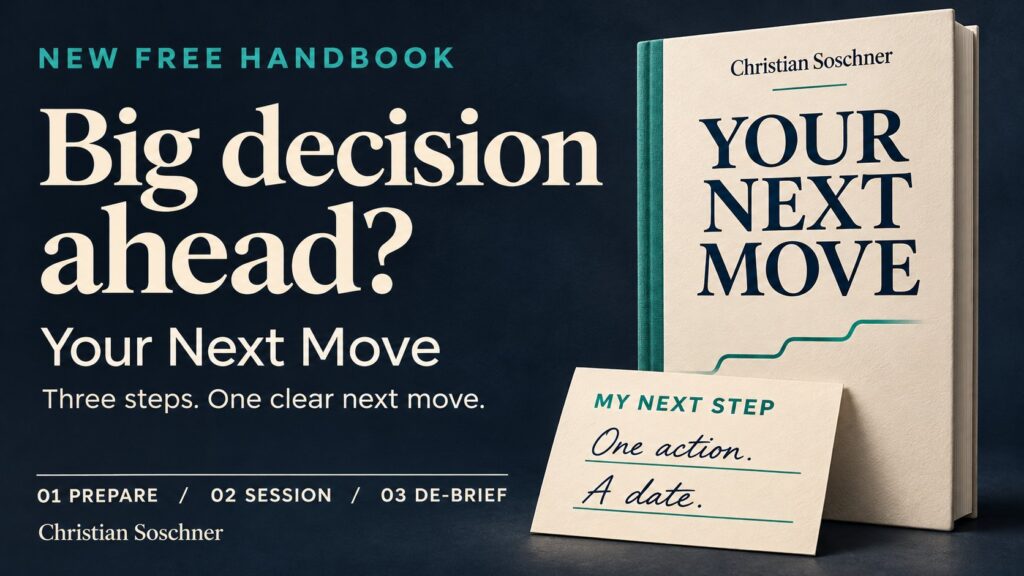
Today I am publishing the handbook that explains how I work with them. It describes Your Next Move, my three-step process, and the evidence behind each step. The download is free, with no email form in front of it.
Why one hour is not enough
A review of research in medicine found that patients forget between 40 and 80 percent of what their doctor tells them right after the visit (Kessels, 2003). Leaders face the same problem with advice. The insight from Monday’s call fades by the time Thursday’s crisis arrives.
For that reason I work in three steps instead of one hour, and each step does one job.
Step 1: your preparation
Within 24 hours of booking, you receive an onboarding letter and a preparation sheet with five to seven questions built around your situation, and you send your answers back two days before we meet. The questions ask for your goal, why it matters, what must not happen and the questions you want answered.
Writing it down is where the clarity starts. In studies at Yale, people rated their understanding of familiar things lower by a wide margin once they had to explain them step by step in writing (Rozenblit and Keil, 2002). A decision that feels clear in your head shows its open points on paper, and you find them before our hour, not in the middle of it.
Then comes the mirror check. I send you one paragraph that states your goal in my words, and you confirm or correct it before the session starts.
A good answer to the wrong question is the most expensive mistake in advice.
Step 2: our session
Sixty minutes on Zoom, in English or German, built on your answers and all of it about you:
- Minutes 0 to 5: your goal, confirmed.
- Minutes 5 to 15: your situation, the people involved and the real issue behind your questions.
- Minutes 15 to 40: questions that test the assumptions behind the decision and open options you did not have at minute zero.
- Minutes 40 to 52: your next move, the smallest step with the most leverage, with a date.
- Minutes 52 to 60: your close, in your own words.
The session follows the solution-building approach of Peter De Jong and Insoo Kim Berg. Your outcome comes first, then what works for you today, then the gap that remains. Where it helps, I add an outside view and tell you when I switch from asking to advising.
Your next move leaves the session as a plan in the form “if this happens, then I do that.” Across 94 tests with more than 8,000 participants, plans in this form had a medium-to-large effect on reaching goals (Gollwitzer and Sheeran, 2006).
Six exercises from my toolbox
The handbook opens my toolbox. I choose at most one exercise per hour, once your goal is clear. These six fit the decisions leaders bring to me most:
- Your priorities, ranked by you, when several issues compete for the same hour.
- The exception: was it always this way, or did it work at some point? What did you do then?
- The scale from 1 to 10, when progress feels vague and needs a measure you can return to.
- The Tetralemma, for a choice between A and B that keeps circling.
- The values square, when two things you value pull in different directions.
- The pre-mortem: it is six months from now and the plan did not work. What happened?
Step 3: your de-brief, within 24 hours
You receive my core observations, the one recommendation with the most impact and your next step with its date, together with the recording and the transcript of our session.
The U.S. Army has run after-action reviews for decades. A meta-analysis of 46 samples found that structured debriefs improved effectiveness by about 25 percent on average (Tannenbaum and Cerasoli, 2013). My observations name what works in your approach with the same care as the gap: people who review their successes improve more than those who study only their failures (Ellis and Davidi, 2005).
What the process promises
The research describes what tends to work for many people, never a guarantee for one person, and the handbook says so in plain words. It also marks the exercises whose support comes from practice rather than from controlled studies.
The promise itself is modest and firm. I do not solve every problem you bring. I listen, I prepare with you, and you leave with clarity on your goal and on the first step toward it, in writing.
Two ways to try it
Book Your Next Move. EUR 500, one fixed price for all three steps: your preparation, our 60-minute session and your de-brief with the recording and the transcript.
Book Your Next MoveOr start with a free 15-minute call. Meet me first and find out whether the fit is right for you.
Book a free 15-minute callBezos asked his team for six pages. You need a few written lines, one focused hour and one step with a date. Bring the question that has followed you for weeks.
Full references for every study cited here are in the handbook (PDF), and the method is also on the Your Next Move method page.