The show › EP 108
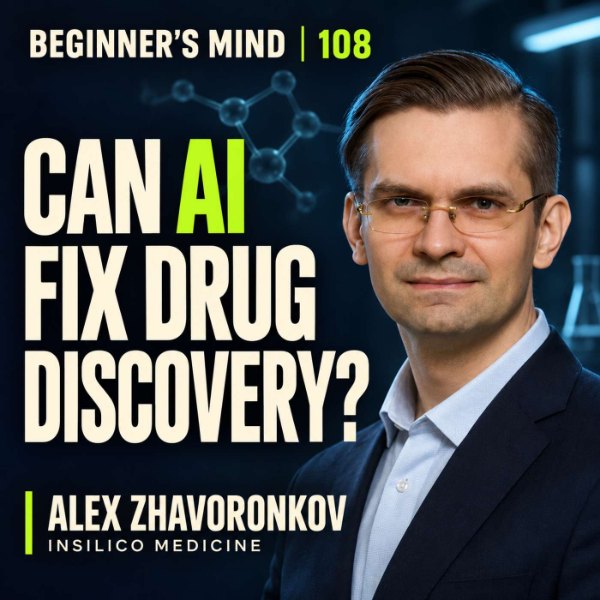
Can AI Fix Drug Discovery?
Alex Zhavoronkov, founder and CEO of Insilico Medicine, whose AI platform found both the target and the molecule of rentosertib, now in Phase III for idiopathic pulmonary fibrosis
About this conversation
In February 2023, Insilico Medicine had just received the Phase 1 data for the first drug it designed with generative AI against a novel target. Three and a half years later, that drug, rentosertib, is in Phase III for idiopathic pulmonary fibrosis.
Alex Zhavoronkov founded Insilico Medicine and leads it as CEO. The company finds targets and designs small molecules with its own AI platform, Pharma.AI, and builds much of its pipeline around diseases of aging. He joined me live from the World Government Summit in Dubai on 14 February 2023, between two meetings and without a quiet room.
We talk about how generative adversarial networks moved from handwriting to molecules; how Insilico nominated nine preclinical candidates in one year; why he ranks the probability of success above time and cost; how the antifibrotic reached Phase 1 in under three years; what regulators make of AI; and why he would test new drugs in regulatory races for rare diseases.
The conversation ends on aging, which he calls the most important disease in the world, and on synthetic patient data as the next big use of generative AI in medicine.
Questions in this conversation
- 04:21 Why does Alex Zhavoronkov call longevity the most impactful field in medicine?
- 08:22 How did generative AI move from images to drug molecules?
- 16:02 How many preclinical candidates did Insilico Medicine nominate in 2022?
- 23:36 By how much can generative AI raise the probability of success in drug discovery?
- 27:04 How did Insilico take its antifibrotic drug from target to Phase 1 in under three years?
- 31:09 How did Insilico use AI to find new targets for ALS?
- 38:09 How do regulators view AI-discovered drugs?
- 40:51 Can AI replace human clinical trials?
- 53:38 Why does Insilico operate across China, the Middle East and Canada?
- 57:51 What does Insilico’s robotic lab do?
Watch the full conversation
Plays on click. Only then does the video load from YouTube (youtube-nocookie.com). Privacy
Since this conversation
Where the drug from this conversation stands today.
- 10 September 2026 · First patient in Phase III
Insilico dosed the first patient in GENESIS-IPF-3 at Peking Union Medical College Hospital. The trial plans to enrol about 320 patients at 47 centres in China over 52 weeks. Insilico describes it as the world’s first Phase III trial of a drug discovered and developed with generative AI.
Source: Insilico Medicine
- 30 December 2025 · Listing in Hong Kong
Insilico Medicine listed on the Hong Kong Stock Exchange (stock code 3696). The offering raised HKD 2.28 billion, the largest biotech IPO in Hong Kong that year.
Source: BioSpectrum Asia
- June 2025 · Phase IIa results in Nature Medicine
In GENESIS-IPF, 71 patients with idiopathic pulmonary fibrosis took rentosertib or placebo for 12 weeks. At the highest dose, 60 mg once daily, forced vital capacity rose by a mean 98.4 mL, against a fall of 20.3 mL on placebo. Insilico reports that its generative AI found both the target, TNIK, and the molecule.
Source: Insilico Medicine via EurekAlert
What it means for the rest of the field: Sixty billion dollars, zero approved drugs. Where does AI pay off in pharma?
The questions, answered
Why does Alex Zhavoronkov call longevity the most impactful field in medicine?
Because adding one year of healthy life for everyone on the planet would create eight billion life years, more than any surgeon or doctor achieves in a career. Insilico works on two fronts: finding protein targets linked to the hallmarks of aging, and designing small molecules against them. Zhavoronkov also helped develop aging clocks, AI models that estimate biological age from many kinds of data.
“If you figure out a way to extend the life of people by just one year for everybody on the planet, you generate eight billion life years”
Alex Zhavoronkov
Watch from 04:21 on YouTube · Listen from 04:21 on Buzzsprout
How did generative AI move from images to drug molecules?
Through generative adversarial networks, which Ian Goodfellow introduced in 2014 to generate handwritten characters. Insilico applied them to molecules about a year later: you describe the properties you want, and the network designs a matching molecule. The company synthesized and tested its first AI-generated molecule in 2017, and by 2023 ten of the top 20 pharmaceutical companies had used its software.
“Just like with a picture or a handwritten character, you can describe the molecule you want, and the GAN will generate it for you with the desired properties”
Alex Zhavoronkov
Watch from 08:22 on YouTube · Listen from 08:22 on Buzzsprout
How many preclinical candidates did Insilico Medicine nominate in 2022?
Nine: eight internal and one for a partner. A big pharmaceutical company, in Zhavoronkov’s experience, nominates four to six small-molecule candidates a year, and a biotech spends around $100 million to reach a single preclinical candidate against a new target. Insilico reached 11 candidates in two and a half years, with just over $400 million raised.
“This acceleration in drug discovery is real. It’s not just blah blah futuristic.”
Alex Zhavoronkov
Watch from 16:02 on YouTube · Listen from 16:02 on Buzzsprout
By how much can generative AI raise the probability of success in drug discovery?
By at least 50% from target discovery to Phase 1, by his own conservative estimate; inside Insilico, more than 90% of programs reached a preclinical candidate and the clinic. Zhavoronkov ranks the probability of success above time and cost. He adds a strategic point: many pharma programs die when a company changes direction, which is why Insilico forecasts which targets big pharma will want years ahead.
“A 50% reduction in the probability of failure is my personal conservative estimate”
Alex Zhavoronkov
Watch from 23:36 on YouTube · Listen from 23:36 on Buzzsprout
How did Insilico take its antifibrotic drug from target to Phase 1 in under three years?
AI picked a novel target and designed the molecule. Insilico reached a preclinical candidate for idiopathic pulmonary fibrosis in under 18 months for about $3 million, ran a Phase 0 study in eight healthy volunteers in Australia and completed Phase 1 in 80 volunteers within about 30 months. The usual path takes five to six years or longer and close to a billion dollars. The drug is rentosertib, now in Phase III.
“To my knowledge, it is the first AI-generated drug to reach human clinical trials and go through phase one clinical trials.”
Alex Zhavoronkov
Watch from 27:04 on YouTube · Listen from 27:04 on Buzzsprout
How did Insilico use AI to find new targets for ALS?
It ran its PandaOmics software over large public data sets, including patient cells from the Answer ALS consortium, together with researchers from Harvard and MGH, Johns Hopkins, Tsinghua University and Mayo Clinic. The predicted targets were tested in a fly model from Mayo Clinic, and many of them rescued the disease phenotype. Insilico published the results openly, including existing drugs that could be repurposed.
“So AI can pick the targets and very rapidly demonstrate strong rescue, moderate rescue and mild rescue.”
Alex Zhavoronkov
Watch from 31:09 on YouTube · Listen from 31:09 on Buzzsprout
How do regulators view AI-discovered drugs?
With interest, above all in Asia. In 2023 China’s NMPA was in active discussions with Insilico, and Zhavoronkov had given a talk at the FDA. He wants regulators to use InClinico, Insilico’s tool that predicts whether a drug moves from Phase 2 to Phase 3; at the time it was sold to hedge funds and banks.
“The ability to very rapidly predict success or failure, and also interpret it, I think that’s key to the financial industry, but also to the regulators.”
Alex Zhavoronkov
Watch from 38:09 on YouTube · Listen from 38:09 on Buzzsprout
Can AI replace human clinical trials?
No. Pretty much no medicine works 100%, and many medicines that seem to work do so for the wrong reason. Zhavoronkov wants regulators to run a few races instead: rare diseases with poorly understood biology, AI used end to end, fast clinical studies and a quick approval, as a benchmark for larger diseases. COVID showed, in his view, that regulators can compress clinical work into a year and a half.
“You need to do human clinical trials for sure.”
Alex Zhavoronkov
Watch from 40:51 on YouTube · Listen from 40:51 on Buzzsprout
Why does Insilico operate across China, the Middle East and Canada?
To reach the best talent and the best infrastructure. Insilico built an AI team of about 40 in Abu Dhabi, partly with talent that left Europe after Russia invaded Ukraine, and it hires AI specialists in Montreal and Toronto and computational chemists in Taiwan. In China it runs experiments through contract research organizations, often at two labs in parallel for redundancy.
“For an AI-focused company, the absence of your own labs is actually a competitive advantage.”
Alex Zhavoronkov
Watch from 53:38 on YouTube · Listen from 53:38 on Buzzsprout
What does Insilico’s robotic lab do?
It tests the AI’s target predictions on real tissue. A sample goes in; robots process it, image it and generate omics data; the AI picks targets and existing drugs, tests them at different doses and compares its predictions with the results. In 2023 the lab filled an entire floor, and Zhavoronkov wanted to shrink it to two rooms for use in hospitals.
“You could place those labs in regions that never even aspired to be a player in biotechnology.”
Alex Zhavoronkov
Watch from 57:51 on YouTube · Listen from 57:51 on Buzzsprout
Best quotes
“You can compare drug discovery to space exploration.”
“I think that we can at least improve the probability of success by 50%. And that’s more important than time and cost.”
“So we made a little bit of history, hopefully.”
“Why don’t we try to increase the novelty and do another race, and not wait for another pandemic?”
“Three years ago I did not even dream about the lab that we have.”
“The most important disease that we have in the world is actually aging.”
“Generative AI is going to transform our life beyond recognition in every way.”
Show notes
Click a timestamp to listen from that moment on Buzzsprout.
- 02:00Introduction to Alex Zhavoronkov at the World Government Summit 2023
- 03:00About the World Government Summit
- 04:20Longevity research at Insilico Medicine
- 08:20Accelerating drug discovery with AI
- 13:00AI and synthetic biological data
- 15:00Generative AI for lower cost and higher output
- 23:30Generative AI and the probability of success
- 25:00Why traditional drug R&D takes over 10 years and about $2 billion
- 28:45AI-driven drug discovery at Insilico Medicine
- 30:30Insilico Medicine’s pipeline and an open case study in ALS
- 38:09How regulators see AI in drug development
- 45:26Generative AI in clinical development
- 49:15A question from the room on AI and microbiome research
- 53:30Running a company across China, the Middle East and North America
- 57:54Insilico Medicine’s fully automated robotic lab
- 1:03:15Aging as the most important disease in the world
- 1:08:00The future impact of generative AI on medicine
Links
- Alex Zhavoronkov on LinkedInFollow Alex
- Insilico MedicineThe company’s website
- First patient dosed in GENESIS-IPF-3Insilico’s announcement of the Phase III trial of rentosertib
- Sixty billion dollars, zero approved drugs. Where does AI pay off in pharma?My article on where AI already pays off in drug development
Full transcript
Christian Soschner00:00:00
What if I told you that there is a way to reverse the aging process and potentially extend our lives by decades? Sounds too good to be true.
Alex Zhavoronkov00:00:13
So we made a little bit of history. Generative AI is going to transform our life beyond recognition in every way. I think that we can at least improve the probability of success by 50%. And that’s more important than time and cost. So in two years, well, two and a half years, 11 preclinical candidates, it’s a pretty cool number. So that is how long it took us to get to the preclinical candidate stage with our antifibrotic. And again, this is the traditional approach, this is our approach. So under 18 months. The ability to very rapidly predict success or failure and also interpret, I think that’s key.
Christian Soschner00:00:56
Today’s guest, Alex Zhavoronkov, CEO of Insilico Medicine, is on a mission to make this a reality. With the help of artificial intelligence, his team is working to uncover the secrets of aging and create drugs that could not only extend our lifespans, but also prevent age-related diseases like Alzheimer’s or cancer. In this conversation, you learn about the potential of artificial intelligence in aging research and how Insilico Medicine is leading the way. Alex explains the potential to reduce drug development costs, increase the probability of success in drug discovery, and even create drugs for diseases we once thought were untreatable. You are live directly from the World Government Summit. Did I get it right?
Alex Zhavoronkov00:02:07
That’s correct. I’m dialing in now from the World Government Summit. I apologize for any background noise, because I had to step out of the meeting, and here there are no meeting spaces. So, very happy to connect. My name is Alex Zhavoronkov. I’m the founder and CEO of a company called Insilico Medicine, which is a global company. That’s why I am in the Middle East right now. One of our sites is in Abu Dhabi, which is a fantastic place to set up, and right now I’m presenting from Dubai.
Show the full transcript
Christian Soschner00:02:47
What is the World Government Summit all about?
Alex Zhavoronkov00:02:51
It’s all about bringing together leaders from all around the world to ensure that they can achieve common goals. They also invite business people and scientists to ensure that they have the support of the private and public sector for all kinds of discussions about the environment, healthcare and other areas where global collaboration is extremely important.
Christian Soschner00:03:24
So it’s practically similar to the World Economic Forum.
Alex Zhavoronkov00:03:29
That’s the Middle East version of that.
Christian Soschner00:03:31
Yes, I had the same thought. It’s a good thing that we are part of the summit now with this conversation. Thanks for coming on, Alex. Let’s jump right into what you’re doing at Insilico. I found a lot of articles on the internet where you describe that you come from longevity research. I think we have that in common. I did something similar, not in the academic field, more in the field of martial arts, because the most important question I had back in the 90s was: how can I avoid getting sick? In the 90s in Austria, not many people were really interested in that topic. I switched more to martial arts to find out how I can improve my life, and now it’s called, I think, longevity research. What did you do in this field?
Alex Zhavoronkov00:04:21
I am participating in this field more from the academic perspective rather than from the perspective of self-improvement. I think that longevity in general is probably the most impactful field anybody can be focused on, right? Because if you figure out a way to extend the life of people by just one year for everybody on the planet, you generate eight billion life years. That’s more than any surgeon or doctor can achieve in their lifetime. So I am focused on the discovery of novel therapeutics that may address certain hallmarks of aging. We look at protein target discovery, identifying the various possible protein switches that might be important in aging and longevity. And then we also have a way to design novel therapeutics, novel small molecule drugs that go after those targets. So we have two hands. One searches for promising areas to intervene in, and the other allows you to very rapidly generate chemical matter that can be turned into a drug. For that, I study and contribute to research in artificial intelligence that works both in biology and chemistry. We have a platform called Pharma.AI at Insilico that helps accelerate drug discovery R&D. But many of the programs that we go after are in age-associated diseases and longevity. We also contributed quite a bit to the development of a variety of what are called aging clocks, the biomarkers of aging, utilizing artificial intelligence. You can train deep neural networks or other AI models that allow you to predict chronological age in a healthy state of the patient, let’s call it biological age. Or you could predict subjective age, how old you feel, or even other features like perceived age, how old other people think you are, if you are talking about imaging biomarkers or psychological biomarkers. So we can look at many different data types to build those comprehensive age predictors. Later we can design certain interventions for biomarkers that could yield valuable targets, either protein targets or sometimes even non-biological targets, looking at both interventions and diagnostic applications.
Christian Soschner00:07:32
That’s a great thing. I found your company when I was doing some research on LinkedIn about another topic, ChatGPT, and I came across an article that Regina Hodits liked, where you compare your solution in drug development and drug discovery to ChatGPT and DALL-E from OpenAI. The thought I had in my mind was this: now that I know how to work with ChatGPT, and it can produce articles and questions and so on, is it really possible to have an artificial intelligence where you just enter “I want to cure cancer”, and it spits out the drug and the target and everything is solved? What is the state of the art of generative artificial intelligence in your field?
Alex Zhavoronkov00:08:22
Well, generative AI as a term has been around for quite a while. The term generative adversarial networks was coined by Ian Goodfellow in 2014 in a very famous paper that he co-authored with Yoshua Bengio, probably the most highly cited researcher in AI. In that paper, they described how to utilize generative adversarial networks to imagine handwritten characters, for example. Within just a year, the technology progressed to the level where you could generate pictures of very high quality, where you can describe what you want to see, and the GAN will create it for you. That was the year when we got into generative adversarial networks as well, with molecules. Just like with a picture or a handwritten character, you can describe the molecule you want, and the GAN will generate it for you with the desired properties, using multi-parameter optimization techniques. Since 2016, this technology has progressed pretty dramatically. In 2020, you could generate pictures of people that are indistinguishable, or almost indistinguishable, from photographs. And nowadays, with tools like DALL-E and Midjourney, generative technologies, now also transformer neural networks and other forms of generative AI, became consumerized. Consumers got access to the tools that we had been using professionally for quite a while, and they have propagated into many industries. Midjourney and DALL-E, for example, are now used to generate very valuable images from a single prompt. ChatGPT is now outperforming humans in some writing tasks, especially when the language is not your first language.
But in our field, in drug discovery, this technology has progressed quite a bit. We synthesized and tested our first AI-generated molecule in 2017. That led to some considerable investment, but also established us as a player in this field. There we designed small molecules against a specific target. You basically take a protein crystal structure and tell your AI to design molecules that are very selective and active against that specific protein target, and that are also drug-like: something that is not a poison and can get into the body via oral administration, not injectable, for example. We synthesized a number of those molecules, tested some, and published our first paper in 2018, submitted in 2017. Then in 2019, we demonstrated a race where another company challenged us to design small molecules against a very well-known target in fibrosis. We very rapidly generated small molecules, tested them against the target and demonstrated that the generation conditions were confirmed by experiments. That was 2019, and then we productized it. We developed software around it, with many different generative models for chemistry and for biology, and released it to pharmaceutical companies. Now 10 out of the top 20 pharmaceutical companies have used our tools in one way or another. So it’s actually pretty widespread in drug discovery.
In longevity, we used generative techniques for the first time in 2017, where we used age as a generation condition. That’s where you can generate very high-quality synthetic biological data for a person that does not exist. For example, you can take yourself as a template and say: I’m Christian, here is my gene expression profile, and I want to see how this gene expression profile looks in 20 years. Generate a thousand versions of Christian’s skin, for example, and show me different ages, let’s say from 40 to 50. The system will generate a bunch of those gene expression profiles. You as a human would not be able to interpret them, but you would be able to trick pretty much every AI system that is trained to predict age from gene expression. This approach also allows you to identify valuable targets, the genes that make your gene expression profile younger or older. Just by moving this dial, which is age, back and forth on several biological data types, you can get valuable insights into what’s making you older or younger, and also try to find causal relationships. So I think that generative AI will also help quite a bit to study aging. We found some targets this way already. And we currently have the first drug that we’ve designed using generative AI for a novel target already in human clinical trials. We just got the top-line data from the phase one clinical study, where we test safety. Now we’re going into phase two for a very broad indication with no cure. And the way we found this target was also through aging research. So I think generative AI in biomedicine is very well established and very broadly used.
Christian Soschner00:15:02
That’s great. A couple of weeks ago, I had a conversation with Jack Scannell. He coined the term Eroom’s law in 2010. We were talking about the big problems that we have in drug discovery and drug development, and I would like to hear your opinion on what generative AI and artificial intelligence can do. You also said in some interviews that 90% of drug candidates fail in the clinic. When we look from the lab bench, we are probably at about 99% failure rates. And the expenses for one drug went up in the last 10 years from roughly $1 billion per drug to three to four billion dollars. How can artificial intelligence help to solve these problems, to make drug development faster and more accurate, and also cut back the costs? What is the role of generative AI in this field?
Alex Zhavoronkov00:16:02
Thank you for asking this question, because I can answer first in numbers, with real facts, and then give you a little bit more of a futuristic view. As you know, our company raised just over 400 million, mostly in the last two years, and mostly from biotechnology investors who understand biotech. Last year, in 2022, we nominated nine preclinical candidates, eight internal and one for an external collaborator. In small molecules, that’s a very large number. Usually a big pharmaceutical company would nominate four, five, six. I don’t know a big pharma company that nominated 10 in a single year. They usually have a lot of programs, but many of them are external and many of them are in biologics. In small molecules, you usually don’t have this pace of R&D. To get to the point of a preclinical candidate, with all the failures, you would probably spend, as a biotech, around 100 million dollars if you’re going after new targets. In pharma, it’s going to be even more expensive, because they usually waste a lot of time and effort on all kinds of bureaucratic things, and people do not focus and work as hard and fast as in biotechnology companies. So this acceleration in drug discovery is real. It’s not just blah blah futuristic. Nine preclinical candidates in a single year, we’ve demonstrated that. In 2021, we nominated only two preclinical candidates, and this year we expect to hopefully exceed our internal record. And some of these drugs went into the clinic. Usually by this time the failure rate is very high. And again, we raised only 400, and since we started doing our own discovery, we managed to progress 11 to the preclinical candidate stage. It’s a pretty big number.
You can compare drug discovery to space exploration. First you need to launch your first rocket, reach the orbit, or do suborbital flights, but still with some payload delivery. The most difficult one is your first, or your second. But when you demonstrate that it consistently works, you can do much more, and people also start believing in it. So I think generative AI has already transformed drug discovery, and we have contributed significantly to this process, because in addition to using generative AI internally, we also gave it to other people in the form of software. Now a lot of people are using our software. For target discovery, it’s so easy to use that high school students can use it, and they do. Small molecule generation is not as easy to use, and we only deploy it within big pharma companies. Some of them say they can do a better job; they can also implement some of their own models in our software, it’s that flexible. But many of them are afraid of doing that, because if they don’t outperform, they would have to rely on our software. Usually it’s a good idea to do both.
And I think that the cost component and the time component are not as important as the probability of success component. When you are using generative AI for both target discovery and small molecule chemistry, I think that you can significantly improve the probability of success. When you have a choice of targets and you can very rapidly fast forward, you can find those combinations that have not been explored before, because people thought it’s not a very competitive target, or it’s a very difficult target, or the target might not address a substantial patient population, or it’s just too new. They ignore such a target because there is very little biology and biological evidence available around it. We manage to matchmake the target with the generated molecule in the most efficient way. We also try to forecast into the future and see which targets are going to be hot, because many of our programs are made for sale to big pharma companies. We would not be able to progress many of them ourselves into phase three, for example; we won’t be able to raise that much capital. When you do those three steps with generative AI, I think that you are significantly improving the probability of success, even from the strategy perspective. Many of the programs within big pharma companies fail because of strategic choice. They decide to pivot their strategic direction and refocus, for example from oncology to CNS, or from one target discovery philosophy to another. They say: okay, we’re going to go only for genomically validated targets, and then 70% of the pipeline is stopped or cut, and a lot of that is wasted for strategic reasons. When you also try to extrapolate the hotness of the target space into the future and see what is going to be valuable for big pharma companies from the strategic perspective, you can also minimize that risk. I would be guessing right now, but I think that we can at least improve the probability of success by 50%. And that’s more important than time and cost. And that’s at least, because for us, internally, pretty much every program we tried has succeeded. We failed a few times, but more than 90% of the time we succeeded in getting to a preclinical candidate and into the clinic.
Christian Soschner00:23:28
A 50% higher probability of success: in which stage? Are we talking about clinical trials, or earlier?
Alex Zhavoronkov00:23:36
I’m talking about earlier, much earlier: from the target discovery stage all the way to, let’s say, phase one clinical trials. The reason I can say that is that we currently have just a few of those programs, and so far the probability of success was almost 100%. So a 50% reduction in the probability of failure is my personal conservative estimate. And of course, we did it at a tiny fraction of the cost and in a fraction of the time. So in two years, well, two and a half years, 11 preclinical candidates, it’s a pretty cool number.
Christian Soschner00:24:20
That’s really amazing. The numbers I have in mind are that before the preclinical stage, we have a success rate of 1%, and your programs have a success rate of basically 100%. If I understood you right, it means that you weed out everything that doesn’t work very quickly, and move only those compounds forward into preclinical and clinical development that already have a really high probability of success. Is this the right understanding?
Alex Zhavoronkov00:24:50
Well, that’s a little bit more ambitious way to explain it. But why don’t I share a screen? I’ll show one slide, which is very important. This slide comes from Steven Paul’s paper, published when he was at Eli Lilly, in Nature Reviews Drug Discovery, a very famous journal. It describes the different steps of drug discovery and development, from target to hit all the way to submission and launch, and shows that it costs about $1.8 billion. Here are the probabilities of success on top, here is the number of years it usually takes, and here is the average number of millions of dollars that every step costs. I added my own estimates to this slide for disease hypothesis and target discovery. That’s usually performed in academia, not in big pharmaceutical companies; they very rarely discover good targets that progress into late-stage clinical trials. Here I estimate the probability of success to be one to five percent. The National Institutes of Health’s annual budget is $45 billion. They spend quite a bit of money, but very few good targets reach the clinic. It usually takes one to 10 years and could cost you billions of dollars. For Alzheimer’s, for example, we still don’t know a single good target that would work for everybody, and the disease hypothesis is poorly understood. That’s why we have to study aging to understand Alzheimer’s, and understanding Alzheimer’s may help us understand aging a little bit more.
What we have done so far is take one of our programs from discovery to phase one top-line data received. So basically we can refer to it as phase one complete. We haven’t failed yet, so fingers crossed. We did it in under three years. Usually it would take you five and a half, six years, sometimes a decade, and a lot of money, close to a billion. We have done it at a fraction of the cost. To reach the preclinical candidate stage, just for the idiopathic pulmonary fibrosis indication, it took us about three million dollars. Of course, we have tested it for many other indications. We’re also taking that specific target into chronic kidney disease, and we’re doing indication expansion into skin fibrosis as well. It’s one fibrotic target. But just that is a pretty cool number. I apologize one more time for the background noise, because I’m at the World Government Summit. So this is how long it took us to get to the preclinical candidate stage with our antifibrotic. This is the traditional approach, and this is our approach. So under 18 months, under $3 million for IPF only. And then under 30 months to close to phase one complete when I made these slides. Now we’re here. Again, we did it at a fraction of the cost. To my knowledge, it is the first AI-generated drug to reach human clinical trials and go through phase one clinical trials. So we made a little bit of history, hopefully. And even if we do not succeed in phase two, it was a very cost-effective journey compared to everything else. But of course we are aiming for major success. This is the first drug where we managed to get all the way to humans. We actually conducted a phase zero study, a small study in eight healthy volunteers in Australia. We call it phase zero because the target is new, and as a small company we wanted to ensure that we understand the target and the compound distribution a little bit better. Then we started the phase one trial in 80 healthy volunteers, and we just got the top-line data.
We have progressed with our target X. We haven’t disclosed it, and we have several other very promising targets, including targets for COVID. The 3CL protease program is ready to go into humans right now as well. It’s a very selective, broad-spectrum molecule that works in pretty much every COVID strain we’ve tested it against. We also have a lot of cancer targets that are specifically tailored for licensing to big pharmaceutical companies. We try to have very high-quality data packages that are very attractive to those companies.
Let me show you a case study that we published openly for everybody, so you can go back and trace our work. We try to publish as much of our work as possible with open access. We went after ALS, which is actually a very popular disease for all AI-powered drug discovery companies, but we tried to do it in the open. It’s a rare disease, but there are still a lot of patients out there. Very often when I speak with my friends, somebody knows somebody who had ALS or has ALS right now. We decided to use all of our software tools that are available commercially right now, PandaOmics, Chemistry42 and InClinico, for target discovery, small molecule chemistry and prediction of clinical trial outcomes. In PandaOmics, we utilized massive amounts of data available to us from public repositories for ALS and other diseases. We used multiple AI algorithms and models to come up with target hypotheses, also got some textual evidence that some of those targets may be implicated in ALS, and applied various filters to explore whether a target is good for small molecules or biologics, and whether it’s commercially viable. Then we partnered with wonderful key opinion leaders in this field: Merit Cudkowicz, head of neurology at Harvard and MGH; Jeffrey Rothstein, a very prominent neuroscientist from Johns Hopkins; Bai Lu from Tsinghua University; and colleagues at Mayo Clinic. We worked with massive data sets from the Answer ALS consortium, where a lot of human ALS cells were reprogrammed into baby cells called iPSCs, their genetic profiles evaluated, and later programmed into full-scale neurons, with all kinds of molecular data coming from the samples. We also used a lot of samples from our own databases, which properly integrate and annotate massive amounts of publicly available data, ran it through PandaOmics, and found new targets and also older targets with drugs to repurpose. Then we tested those drugs very rapidly in a fly model from Mayo Clinic. When it comes to rare diseases, and especially diseases of the brain, there are very few models where you can test your hypotheses. You can test on mice, you can test in human neurons, you can try to grow them, or you can use a model organism like flies and do very quick tests. You can find more information about this project at als.ai. We used this fly model from Mayo, where a phenotype very similar to many ALS phenotypes in humans is observed, and demonstrated that many of the targets we predicted worked and rescued the phenotype. So AI can pick the targets and very rapidly demonstrate strong rescue, moderate rescue and mild rescue. A few targets, of course, didn’t work. We published it openly, and some of those targets already have existing drugs, which we published for repurposing. I know that some companies are now trying those drugs and targets. That’s one of the ways to test your hypothesis very quickly. Then we did our own chemistry, and I’m going to pause here, because that’s a long story with a lot of chemistry terms. But we managed to demonstrate that with AI we can very rapidly identify new targets, validate those targets either using knockouts or real chemistry, for a very important disease with no cure, and publish rapidly. We didn’t even think about commercializing this when we published. For many other diseases we do something similar, but we do it internally.
Christian Soschner00:36:31
In the first slides, if I remember right, you showed that you cut back the time you need to bring a drug candidate into the clinic. It was about 414 million in the traditional way for a company to move a drug candidate into phase one, and with your technology you did it for three million dollars. Did I remember that right?
Alex Zhavoronkov00:36:56
That’s correct. We managed to get to the preclinical candidate stage just for the IPF indication. To claim a preclinical candidate in our world, you need to demonstrate efficacy in several models, at least three. We used one in vitro model and two mouse models to demonstrate efficacy in idiopathic pulmonary fibrosis. For other types of fibrosis, we of course did many other experiments that increased the cost pretty dramatically.
Christian Soschner00:37:34
For proving what artificial intelligence can do in drug development, I think it’s a good example, because you cut the cost to 1%. You can develop a hundred drugs at the price of one in the traditional way. It’s an amazing feat. What was the response from regulatory authorities when you approached them with your artificial intelligence approach? Was it an eye-opener for them, saying it’s cool, move forward, or did you have some challenges to solve?
Alex Zhavoronkov00:38:09
Of course we got some interest from the regulators, especially in Asia. In China, the NMPA was very interested in our results, and we’re in active discussions. In the US, we got some interest as well. I gave a virtual talk to one of the big departments at the FDA, and we are trying to establish this connection. Our program one, which is going into phase two human clinical trials, is going to be the highlight. That’s what we need to focus on right now. And we have a tool that we really want the regulators to use. It’s called InClinico, and it predicts the outcomes of phase two to phase three transitions and also interprets some of the likely failures and successes. We’re trying to make this tool available to the regulators as well. Currently, we’re selling it to hedge funds and banks, to the financial industry, and also piloting with them to improve the tool. The industry that gets hurt the most by failures is the VCs, hedge funds and banks investing in the companies that are running phase two clinical trials. That’s where most of the failures are, and they usually either win a lot or lose a lot. The ability to very rapidly predict success or failure, and also interpret it, I think that’s key to the financial industry, but also to the regulators. Very often phase two trials succeed, but later fail in phase three because the clinical study was mismanaged somewhere, and our tools will hopefully allow you to identify those mismanagements.
Christian Soschner00:40:33
Do you think it will be possible in future to completely avoid clinical trials, to just predict success with artificial intelligence and not do human trials anymore, or will we not be able to do that?
Alex Zhavoronkov00:40:52
You need to do human clinical trials for sure. Right now there are pretty much no medicines that work 100%. And many of the medicines that you think work actually work for the wrong reason. So until we figure out how to simulate this entire world at the atomic level, and also recreate it with many different people, we will require human clinical trials. I just hope that the regulatory authorities will become much more aware of the potential of generative AI and its recent achievements, start paying closer attention to what we do, for example, get more involved and try to accelerate. I think regulators could play a much more active role in accelerating the pace of technological progress. We should actually think about how to make really rapid pilot runs where you try to set records in certain areas. If I were in a position right now focused on improving the pharmaceutical industry, I would try to identify a few opportunities, for example in rare diseases, where AI could be used end-to-end. I would try to partner with a few companies, for example like ours, to go from discovery to the clinic in the shortest amount of time possible. You design a strategy and say: this is the disease I want to go after, preferably with a target that is not obvious, for example ALS. Then you give us green lights to conduct rapid clinical studies with novel small molecules, observe how those studies pan out, and allow us to get the approval as quickly as possible. If you can tangibly demonstrate that you can get an effective drug to the market within four years, for example, you have cut the time by 60 percent, and then you can benchmark against that. You need a few of those going-to-the-moon cases, preferably at a smaller scale, in rare diseases with poorly understood biology, in a race format, just to get better at regulating for bigger diseases. That’s what I would try to do. Currently I don’t know of any politician or regulatory authority that is looking at this at scale.
Christian Soschner00:44:45
That’s interesting. Large-scale studies in fields like COVID, for example, have 40,000 people. I was involved in two companies that did research in rare diseases, and the timelines in the clinic were just not very attractive to VCs. When I approached VCs and said, look, we need five to ten years to recruit enough patients, they were not very happy with that timeline and were reluctant to invest. Where do you see artificial intelligence in the field of clinical trials to really speed things up when you don’t find the patients? What can you do with artificial intelligence?
Alex Zhavoronkov00:45:26
If you go to China, for example, some rare diseases are not so rare, so you can do faster recruitment. I actually think that for this kind of exercise in AI, international collaboration could help a lot. Currently we see a lot of what we call trade wars between the US and China specifically, and actual real wars, where Russia invaded Ukraine, for example. But with rare diseases and races for AI-powered drug discovery, I hope that authorities could collaborate, and maybe we could recruit some of those patients much quicker. I’m also pretty sure that if an agency like the FDA prioritized this in a bigger way and looked specifically at how to conduct such an experiment, we could come to a conclusion very quickly. It would require just one day of seminars or workshops to come up with a proper strategy. I’m pretty sure that we could also get significant financial backing from the private sector, if the regulators demonstrated that at the end there is some potential profit involved. The VCs funding something like this would have a big payout, plus a seat at the table for future races like that. I’m pretty sure we would be able to do that, but currently nobody is motivated enough to go after those races. The COVID case was probably the best demonstration of the abilities, and also the drawbacks and inefficiencies, of the industry. Even the first drug that was properly approved, Paxlovid, the Pfizer drug, is still a very old molecule that was very rapidly repackaged as an oral 3CL protease inhibitor, together with another drug that helps with CYP inhibition for better stability of the molecule. So it’s definitely an imperfect drug that probably wouldn’t have gone through in a normal environment. But during COVID, you’ve seen that they managed to conduct all the clinical work in a year and a half. That is something the regulators are capable of. So now let’s try to do that with a novel target and a novel molecule. Why don’t we try to increase the novelty and do another race, and not wait for another pandemic?
Christian Soschner00:48:55
The pandemic was amazing, to see the whole industry move so quickly. We have one question from the room. I will allow Azzam Kayasseh, I hope I pronounce the name right, to ask the question himself. Azzam, you have the microphone.
Azzam Kayasseh00:49:16
I’m really enjoying this talk. I am Azzam Kayasseh from Dubai, thank you very much. I am proud of what you are doing. I asked you before, but I want to know after listening to your lecture: artificial intelligence and microbiome-based therapeutic tools. Can we apply what you are talking about to new molecules for the microbiome?
Alex Zhavoronkov00:49:49
Absolutely. If you have a very good microbial target, expressed by bacteria, our AI can perform as well on this target as it does on human targets, as long as you have the crystal structure or a predicted structure from AlphaFold or RoseTTAFold or another algorithm. We could do similar things on microbial targets. Plus, we could look at new target discovery utilizing very similar tools, like PandaOmics. Around 2017, I trained a deep neural network to predict human chronological age in a healthy state using microbiome data, whole genome sequencing data of the human gut microbiome, and we got to reasonable accuracy for the prediction of human age. Again, that’s one of the features that is present in pretty much every data set. We demonstrated which bacteria contribute to you, quote unquote, looking younger or looking older to the deep neural network. That showed that deep neural networks can actually zoom into specific bacterial species that may play certain roles in different biological processes, in this case in aging. There, of course, the causality is poorly understood, but we can at least narrow it down to specific microbial species. And chemistry is chemistry. We can discover small molecules for bacterial targets, no problem. For disease target research, we can possibly narrow down to individual bacterial species, and then within a species we could identify possible targets just by looking at which proteins are important for the various biological processes. So there are many ways to integrate AI in drug discovery using the microbiome, and there are many companies, in addition to ours, that are maybe doing an even better job at target discovery using the microbiome. I personally do not prioritize the microbiome as a data type within Insilico, because we have many other data types to focus on. It’s promising, of course, but from the drug discovery perspective we are currently prioritizing other data types. We like to have human proteins as targets.
Azzam Kayasseh00:53:11
Thank you very much. I’m looking to work with you or under your umbrella. Thank you very much.
Alex Zhavoronkov00:53:18
Would love to explore any collaborations, thank you.
Christian Soschner00:53:22
Talking about collaborations: you mentioned that your company operates in the Middle East, in China, and I think also in the United States and in Canada. Why did you decide to go this way?
Alex Zhavoronkov00:53:38
We try to go after the best talent in the world. Very often we hire through competitions. In Europe, for example, we used to hire through massive national competitions and hackathons. Then, when Russia invaded Ukraine, we realized that much of this valuable talent from Europe could be moved to the Middle East. I managed to bring quite a few of the quote unquote AI refugees originally into Abu Dhabi. Then we realized that it’s a great place to host talent, specifically AI talent, and we started hiring and grew the team here to about 40. That’s one of the reasons for our expansion into the Middle East.
China is a very special case. Much of the biomedical research and contract research infrastructure is in China. Over the past 20 years, they invested over half a trillion dollars into biomedical and research infrastructure. You don’t need to own your own labs; you can hire contract research organizations to do it for you. For an AI-focused company, the absence of your own labs is actually a competitive advantage. If you want to move quickly, you can move very quickly by outsourcing many different experiments to many different labs, doing it in parallel, and also having redundancy. Very often one lab may screw it up, and another lab may succeed. Which one do you go with? Then you repeat the experiments in both. If you do it internally, and you succeed in places where you should not succeed, and you proceed with the program, it will be very damaging in later stages. So we try to introduce quite a bit of redundancy when it comes to experimental data. China is a very important place to do the experiments. And if you have resources there overseeing a large number of full-time equivalents within contract research organizations, you can get higher quality and faster speed, and even create an ecosystem of contract research organizations that is very seamless and better than having your own lab. Of course, we do have our own fully robotic laboratory as well, but relying on those CROs is key.
And of course, Montreal, Canada, is a great place to hire AI talent. It’s one of the capitals of artificial intelligence; the second would be Toronto, so still Canada. Proud to be Canadian. In Taiwan you can hire really amazing computational chemists. And in Hong Kong we have our target discovery group, which utilizes a lot of our AI tools to discover new targets. It’s really unusual to have this geographic distribution, but for us it works, and it makes us a much more resilient organization. I think that this level of diversity helps us innovate at a broader scale.
Christian Soschner00:57:34
You can make use of the best from all countries. It’s pretty amazing, the approach that you have. I like it. You mentioned before that you have a fully intelligent robotics lab. Can you talk a little bit more about that?
Alex Zhavoronkov00:57:51
Sure. I already tested it: if I show you the video via Zoom, it’s not going to be of good quality and it’s going to lag. So I’ll just talk through it, and maybe you can post a link to this lab in the comments. Now that we have demonstrated that AI can very efficiently identify new targets that actually get validated in real experiments, we can do it at a higher, broader scale. We wanted to automate this process of target discovery, so that we are not reliant on incremental data for target discovery and can perform experimental validation of our algorithms much faster. So we have a lab where you can throw in a sample. Imagine a sample that comes from an animal model of disease. You take a piece of animal tissue, I just don’t want to use the human analogy, with, for example, a certain cancer of a specific tissue. You throw it into the robot. The robot picks it up, grinds it, microplates it, does quality control analysis, then sends it automatically into another room, where part of the sample is placed in the incubator. You grow some of those cells, or even primary tissue, or store it. Part of the tissue goes into the high-resolution imaging system, where it gets imaged. You also incubate some of this tissue with contrast markers, so you get high-content imaging with fluorescence. Part of the sample gets destroyed, then it gets sent to another room where you get omics data: transcriptomics, methylation data and several other data types. All this data goes back into AI. The AI decides which targets are important in that specific sample and which drugs already work on this target, picks those drugs from the libraries and tests them in a high-throughput manner, at different incubation times and different concentrations. Then every sample goes through the same exact cycle. It gets imaged, at high resolution and with fluorescence, and you get epigenetic data, gene expression data and other data types. Then you compare your predictions to the actual experimental data and see if the targets were found and if the compounds work. In parallel, you also try to find novel biology, novel biological hypotheses that might be valuable in the future. So this lab is more of a target discovery plus target validation lab. Now we are miniaturizing it, trying to make it smaller, so you can even do this at the hospital level. Imagine if you could do personalized drug discovery for individual patients, or perform established personalized medicine services or decision support services for physicians, and at the same time discover targets. You could place those labs in regions that never even aspired to be a player in biotechnology.
Christian Soschner01:01:39
How small can you make it?
Alex Zhavoronkov01:01:42
I think I can do it in two rooms.
Christian Soschner01:01:45
In two rooms. Then you can practically do it everywhere.
Alex Zhavoronkov01:01:51
Currently it’s an entire floor that is automated. It’s a pretty complex system, with many rooms performing different tasks with many different types of equipment. I think if I try to place this equipment in 3D, and also make some of my own equipment, I would be able to automate this process in just two rooms.
Christian Soschner01:02:18
So it’s possible to run the processes in basically every hospital in the world, every major one that can afford something like that.
Alex Zhavoronkov01:02:29
Or if there is a government program that allows you to do something like that. Currently that’s a dream, and I cannot guarantee you that we will have a hospital-based robot. But you know, three years ago I did not even dream about the lab that we have.
Christian Soschner01:02:54
This would be my final part for this conversation: looking into the future. But before I ask that, we’re coming to the end. Is there any question open that you would like me to ask? Is there anything that I missed that you think is important to share?
Alex Zhavoronkov01:03:12
I think that you covered pretty much everything. I must say that the most important disease that we have in the world is actually aging, because we will all lose function and die. In this process, we will also get a bunch of diseases and trauma, and it’s never a happy ending. It’s always loss of function. So I think that we need to prioritize therapeutics that have a dual purpose: they treat a disease, but at the same time target important biological processes that are implicated in aging. What we do at Insilico, and what I do in general, is look for those dual-purpose therapeutics. I think being dual purpose, aging and disease, is truly key for identifying blockbuster drugs, because the probability that your drug is going to work for many people at the same time is higher if you are addressing a very broad biological process. And second, we need to figure out aging, because that’s the main killer. This year, 60 million people are going to die due to aging. That’s more than any war or any cataclysmic event or any plague. We need to figure out how to increase healthspan and significantly delay death.
Christian Soschner01:04:57
Do you think it’s possible to delay death? There was a science fiction book that I read, I think, 40 years ago, where the assumption was that one day the pharma industry in an alternative reality develops a drug that basically makes death a conscious decision. People don’t age, people don’t get sick anymore. Do you believe it’s possible to come to that point in our reality, somewhere in the future?
Alex Zhavoronkov01:05:25
With pharmacological means, I’m talking about small molecule drugs, biologics or even RNA therapeutics, you won’t be able to dramatically increase lifespan. I’m talking about maybe plus 40, 50 percent, which is probably possible if you combine a bunch of therapeutics that, A, intervene in your metabolism and, B, improve certain repair functions, and maybe even stimulate certain biological processes that are just too expensive for the body to run all the time, or where we do not have a biological program. So I think that significant life extension is possible using pharmacological means, but not dramatic. To go dramatic, you need to look past pharmacology. Pharmacology is just the most credible way to extend lifespan, and it’s also something that is very sustainable. If you are very good at discovering and delivering novel therapeutics for diseases, and you’re also prioritizing aging as your primary outcome measure, the effects on the healthspan and lifespan of your patients, I think that this is the area where you can achieve commercial success, and then fund other areas of longevity research that may give you more longevity dividend than pharmaceuticals alone.
Christian Soschner01:07:18
Yes, I think there’s a lot in lifestyle. Pharmaceuticals are one way, lifestyle is another way, and probably with Neuralink, with Elon Musk’s research, or research that’s going in that direction, maybe one day it’s possible to upload consciousness into the cloud and download it to an artificial intelligence or to a robot.
Alex Zhavoronkov01:07:38
I wouldn’t bet on that. But it’s definitely a very promising area of research for other purposes, also aging, and Alzheimer’s and CNS diseases. I could look at maybe gradual replacement of neuronal tissue as the way to rejuvenate the brain. But uploading, that’s something that we may not be able to master. Creating a copy, yes, but is it going to be you? Most likely not. Why not create a clone then, right?
Christian Soschner01:08:16
That’s a big question. I have one final question left. When we are talking about the future, how do you envision generative AI and robotics impacting the future of healthcare and medicine?
Alex Zhavoronkov01:08:30
I think it has already had a massive impact, partly due to our work in generative chemistry and generative biology in 2016, 2017, 2018, seminal work, and now it has propagated. I think that generative AI is going to transform our life beyond recognition in every way. We are actually moving into a new era of knowledge management. Instead of retrieving knowledge through search and by browsing different directories, we can now generate knowledge and complete responses to your queries with reasonable accuracy. This accuracy is expected to improve over time, and you will be able to get purpose-built systems for discovery, just like our PandaOmics platform, but even more reliant on generative AI, with a much better user experience, and perhaps conversational AI. I think that we are getting to the point where generative AI will play a role in pretty much every area of drug discovery and development. The most important area where I see the application of generative AI is the ability to generate high-quality synthetic patient data. Currently, people are just too sensitive about their healthcare data being misused for all kinds of purposes. By the way, I do not know many cases where people were hurt by having their health data accessed. They’re hurt by having their financial records accessed, for example, or credit card or identity information, but healthcare information very rarely. There are a lot of hypotheses, but insurance companies are regulated and prohibited from using genomic information for discrimination. So for drug discovery, I think we should be able to use this information. However, since people are so afraid of sharing their biological data, we can now use AI to generate high-quality data instead of taking it from specific individuals, just by asking AI to generate specific biological data sets with desired properties, trained on publicly available data.
Christian Soschner01:11:04
That’s a great future. Alex, thank you very much for your time at the World Government Summit. I wish you and your team all the best for the future. You’re doing amazing work, and I believe you and your team will move the healthcare industry globally forward. Enjoy the summit.
Alex Zhavoronkov01:11:30
Thank you, Christian. I again apologize to you and the people who watch this for the background noise, and also for this kind of presentation from the field. I just couldn’t change it and I couldn’t escape. Thank you for bearing with me.
Christian Soschner01:11:51
It gives a nice flavor to the episode. I like it. Thank you very much, Alex, and have a great day.
Based on the Buzzsprout transcript, edited for readability: filler words, false starts, speech-recognition errors and the subscribe calls in the opening and closing removed, with the meaning kept as spoken. Timestamps follow the recording; click one to listen from that moment.
More conversations on this topic
- Alasdair Milton: Great Science, Missed PatientsA KPMG principal on why only a third of eligible lung cancer patients get targeted therapy
- Jack Scannell: Uncovering Drug Development Efficiency SecretsThe scientist who coined Eroom’s law on the falling productivity of drug R&D
- Kat Kozyrytska: AI in Pharma Is a Yesterday ProblemWhy ethical frameworks for AI in pharma can’t wait
Your company’s story in this format
Leadership teams who want their story told in this format work with me through my PR process.
See the PR process