Books › Venture capital
Books · Venture capital
The book that solved my 2006 venture mystery
In 2006, five investors put €42 million behind a young antibiotics company in Vienna. I joined it and spent years trying to understand why they took the risk. Sebastian Mallaby’s The Power Law gave me the answer I wish I had had then.
The mystery
In the early 2000s, Austria had a biotech story everyone talked about. Intercell, a Vienna vaccine company, went public in 2005 and later brought its Japanese encephalitis vaccine all the way to approval. Its CFO, Werner Lanthaler, was a role model for me. He had a strong career at McKinsey and the Federation of Austrian Industry behind him, and he chose to join a young biotech few people in Austria believed in. Some people asked why he would risk that career on a young Vienna biotech that for sure would not succeed. He helped raise private capital, took Intercell public in 2005 and helped build a global vaccine business. Intercell went on to win approval for its Japanese encephalitis vaccine. For me, that was Austria’s Genentech moment.
That picture was in my head in 2006, when the call came to join Nabriva Therapeutics, the antibiotics research institute that Sandoz, part of Novartis, had just spun out in Vienna. Rodger Novak, who later co-founded CRISPR Therapeutics, and Ralf Schmid, today at F2G, led the team. The company started with a €42 million Series A from Nomura Phase4 Ventures, HBM Partners, Global Life Science Ventures, the Wellcome Trust and the Novartis Venture Fund, the largest Series A in Europe from 1996 to 2006. The board brought together David Chiswell as chairman, Denise Pollard-Knight of Nomura Phase4 Ventures and Axel Bolte of HBM Partners, and from each of them I learned a lot about venture capital. The vision was bold and clear: what Intercell had become for vaccines, Nabriva would become for antibiotics. I said yes almost at once.
Little did I know about venture capital. My career until then had been in public companies, with budgets, revenues and the classic corporate playbook. At Nabriva I learned that bringing a new drug to market can consume billions over many years before the first euro of revenue comes in. One study puts the odds of a preclinical programme yielding a licensed drug at about four in a hundred. Imagine committing €10 million to a project with odds like that. I kept wondering why anyone would do it.
Who would do that, and why? That was my 2006 venture mystery.
The answer, in one book
Over the next years I worked closely with investors on the boards and teams I served, at Nabriva, at Themis Bioscience (later acquired by MSD) and in other drug-development companies. At Themis I learned from Regina Hodits of Wellington Partners, Karl Nägler, then at Ventech, and Bruno Montanari, then at Omnes Capital. At PDC Biotech I worked with Matthias Kromayer of Munich-based MIG Capital and Gilles Nobécourt of Edmond de Rothschild Investment Partners. Ernest Loumaye, CEO of the Geneva company PregLem, chaired the board. Each showed me a little of how a fund thinks. Later, I interviewed dozens of investors on Beginner’s Mind. I learned the craft one conversation at a time.
Mallaby showed me where those investors’ habits came from. A senior fellow at the Council on Foreign Relations, he spent years at The Economist and The Washington Post and served as a contributing editor at the Financial Times. For the book, he spent years interviewing people at leading venture firms. He starts in the late 1950s, when Arthur Rock helped eight scientists and engineers leave Shockley Semiconductor Laboratory and start Fairchild Semiconductor. From there, he takes the reader through Sequoia, Kleiner Perkins, Accel, Benchmark and Andreessen Horowitz, and on to the rise of venture capital in China. He tells the history through the people who made it, and the 496 pages read like a novel. I’ve read it five or six times.
One number from the book answered my question better than any lecture. Kleiner Perkins’ first fund made fourteen investments. By 1984 they showed a combined profit of $208 million, and 95 percent of it came from two companies, Tandem and Genentech. Without those two, the fund returned 4.5 times its money, still ahead of the S&P 500. With them, it returned 42 times.
The lesson I cannot unsee
The power law is the idea that a few outcomes produce almost all of the result. Peter Thiel put it in one line that Mallaby quotes: the best investment in a successful fund equals or outperforms the entire rest of the fund.
Once I saw it in Mallaby’s book, I started to see it everywhere. Hendrik Bessembinder found the same pattern in public markets. He studied every US stock since 1926: 58 percent failed to beat one-month Treasury bills over their lifetime, and just over 4 percent of companies created all of the market’s net wealth. The other 96 percent, taken together, matched Treasury bills.
In any field where people learn a craft, I see it. Many people play chess, and a few players win most of what counts. Many musicians write songs, and a few fill the stadiums. Investing in private and public markets works the same way. This insight changed how I invest, and I show what I learn from it in public on wikifolio.
Seven lessons from The Power Law
Your loss is capped, and your upside is open. The most you can lose on an investment is the money you put in. The most you can make has no ceiling. Venture investors accept frequent losses because one large win pays for all of them, and the same logic works for anyone deciding whether a bold move is worth trying.
Outsiders often see what experts miss. Vinod Khosla tells Mallaby he would rather hire a brilliant outsider than an industry veteran to rethink a field from the ground up. His examples: retail innovation came from Amazon, not Walmart, and space innovation from SpaceX, not the incumbents.
A few bets do the work. This is the power law itself, and the lesson I value most. Returns are extremely skewed. Put the effort where the largest upside is, and accept that most of the portfolio will matter much less.
Good venture capitalists build, not only fund. Mallaby shows how the partners of the 1970s moved beyond picking entrepreneurs. They told companies whom to hire and how to sell, and they paid out money in stages, each one tied to an agreed milestone. One of his sources sums up the job: the venture investor must always be on call, to advise, persuade, encourage and help build.
Venture capital changes how a society innovates. Mallaby argues that venture networks live between markets and corporations, and that they have turned applied science into products faster than corporate labs, lone inventors or governments picking winners. He also shows where the industry still has to improve, including how few women hold investing partner roles.
Networks multiply talent. By 2014, about 70 percent of the publicly traded tech companies in Silicon Valley could trace their roots back to Fairchild. As Matt Clifford puts it in the book, Silicon Valley celebrates the individual, yet those individuals are the product of the network.
Ask “what if it works?” Venture investors know most bets will fail. The better question is what happens if this one succeeds. Mallaby opens the book with Patrick Brown pitching Khosla on Impossible Foods, a plan to make the meat industry redundant. Khosla’s reaction was that it was impossible, and he backed it anyway, reasoning that even a one-in-a-hundred chance at that size was a shot worth taking. Venture firms take the other side of this lesson seriously too: Bessemer Venture Partners keeps a public anti-portfolio, a list of the great companies it had the chance to back and passed on.
What it means for deep tech and biotech
Mallaby writes mostly about software, yet the book opens with food science and returns to biotech with Genentech, one of Kleiner Perkins’ two home runs. When Kleiner Perkins invested, Eugene Kleiner answered a worried question calmly: the firm knew Genentech was highly speculative, and highly speculative investments were its business.
Tom Perkins added a rule I find useful for every science company: market risk falls as technical risk rises. Solve a truly hard technical problem, and few competitors can follow. Long timelines and big capital needs are the price of admission in drug development. The power law is the reason investors pay it.
Thirteen years after I took that call, the FDA approved Nabriva’s antibiotic lefamulin. That is a long time to finance a company one decision at a time. A fund can look across its portfolio and ask what one exceptional investment might return. The team building the company has a more immediate question at every board meeting. What can the money in the bank prove, and will that be enough to raise the next round?
The power law also changes how a board sets the bar for a science company. Once you accept that most programs will not return capital and that one success must pay for the rest, the conversation shifts from “is this science good?” to “what size of outcome is required if it works, and what evidence will tell us early whether that size is still possible?” In biotech that question is harder than in software because the capital already spent cannot be recovered and the next tranche is usually larger. I have watched boards use Mallaby’s framing to ask CEOs for a clearer map of the minimum viable path to a value inflection that could return a fund, and to agree in advance which data would make them stop rather than continue. That discipline does not remove the risk. It makes the risk explicit before the next round is written.
Who should read it
Everyone who wants to build or invest in the next big thing. If you plan to raise money from venture investors, read it first: you need to understand what they do and how they think before you can tell them a story they will buy.
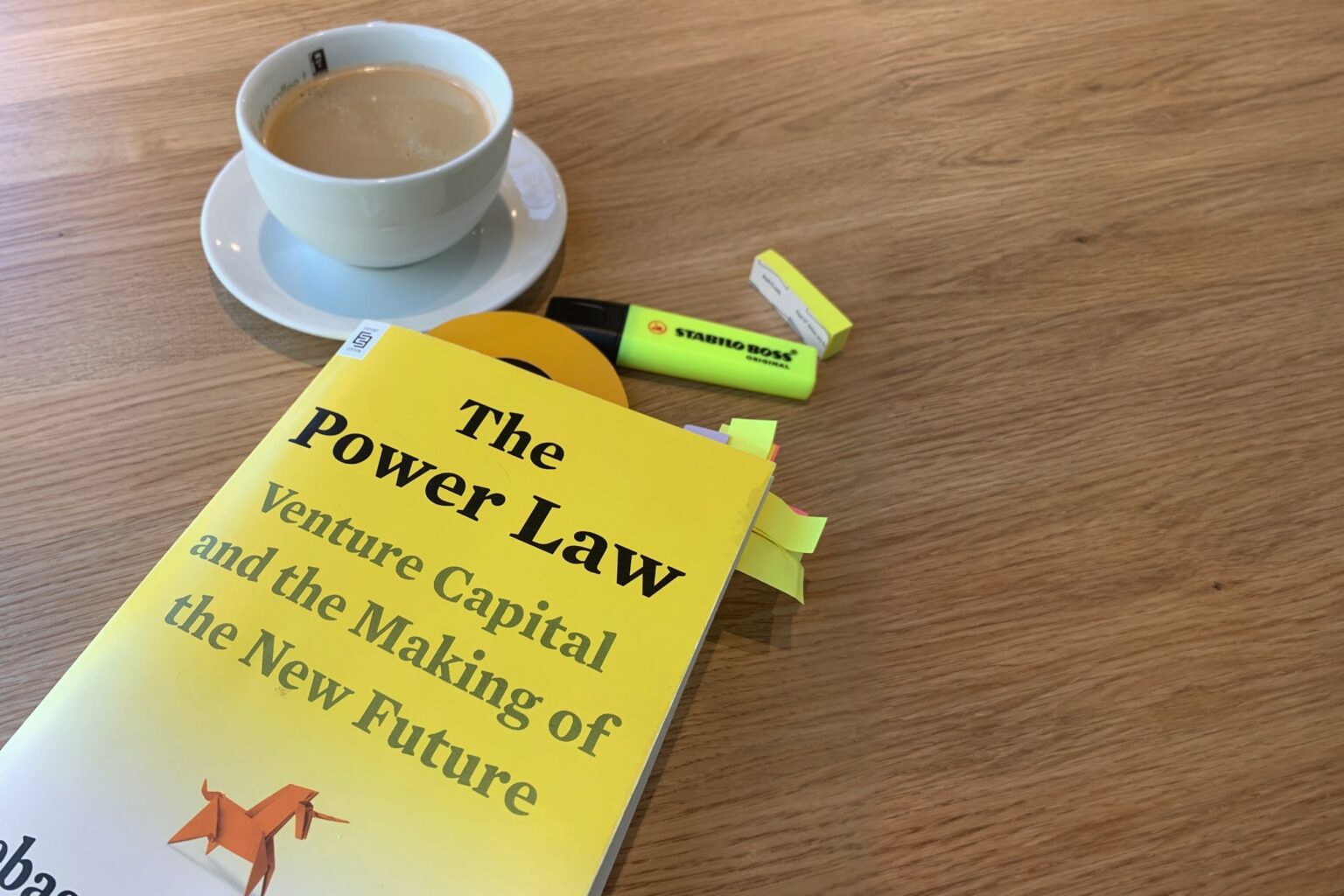
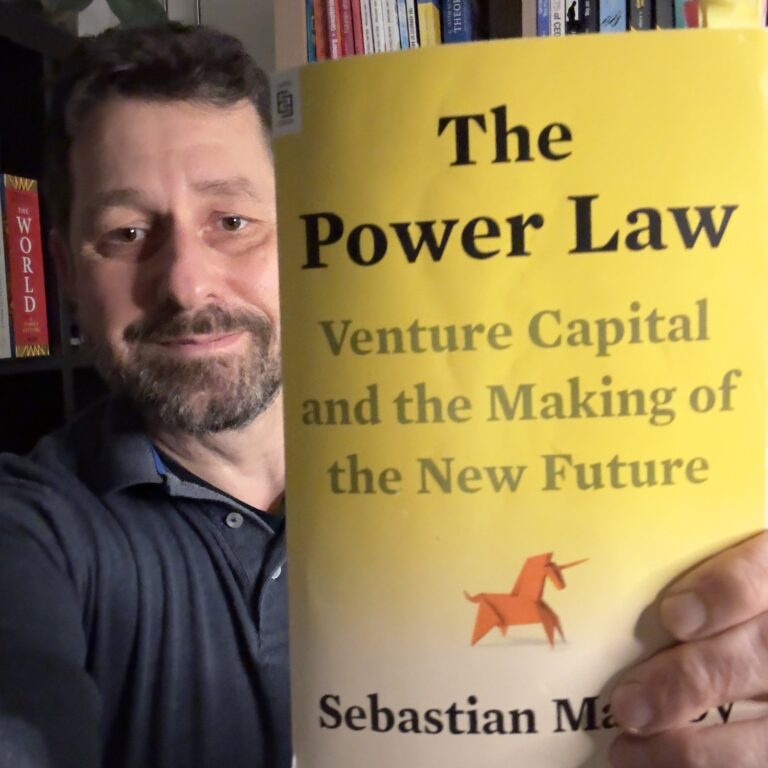
The Power Law: Venture Capital and the Making of the New Future, Sebastian Mallaby
Affiliate link: buying through it supports the show at no extra cost to you.
From my highlights
“Which is better: to try and fail, or to fail to try?”Sebastian Mallaby
“Most people think improbable ideas are unimportant. The only thing that’s important is something that’s improbable.”Vinod Khosla
“The biggest secret in venture capital is that the best investment in a successful fund equals or outperforms the entire rest of the fund.”Peter Thiel
“Silicon Valley is gripped by the cult of the individual. But those individuals represent the triumph of the network.”Matt Clifford
Listen
- My full review: EP 124 of Beginner’s Mind77 minutes, February 2024. The seven takeaways start at 08:33, then every chapter from Arthur Rock to Theranos and WeWork.
- Sebastian Mallaby on the show: EP 92How he researched the book, three moments that defined venture capital, and the future of Europe’s tech ecosystem.
- Alex Dang: Conviction beats consensusThe co-author of The Venture Mindset on how venture investors decide.
- Jensen Huang’s legacy: how NVIDIA made the AI age possibleThree decisions behind one of the largest power-law outcomes of our time.
- The BriefingDeals, guests and big questions in biopharma, AI and deep tech.
Sources
Sebastian Mallaby, The Power Law: Venture Capital and the Making of the New Future (Penguin Press, 2022). link.amazon
Hendrik Bessembinder, “Do Stocks Outperform Treasury Bills?”, Journal of Financial Economics 129 (2018). doi.org
Hingorani et al., “Improving the odds of drug development success through human genomics”, Scientific Reports (2019): overall failure rate in drug development above 96 percent. doi.org
Nabriva Therapeutics, €42 million Series A led by Nomura Phase4 Ventures. lisavienna.at
Intercell AG, IPO on the Vienna Stock Exchange, February 2005. wienerborse.at
FDA approval of lefamulin (Xenleta), August 2019. accessdata.fda.gov
Bessemer Venture Partners, the anti-portfolio. bvp.com