Articles › Leadership
Tribute · Leadership · 7 November 2026
Make it so: Sir Patrick Stewart and the calm way to lead
By Christian Soschner, 26 years building companies
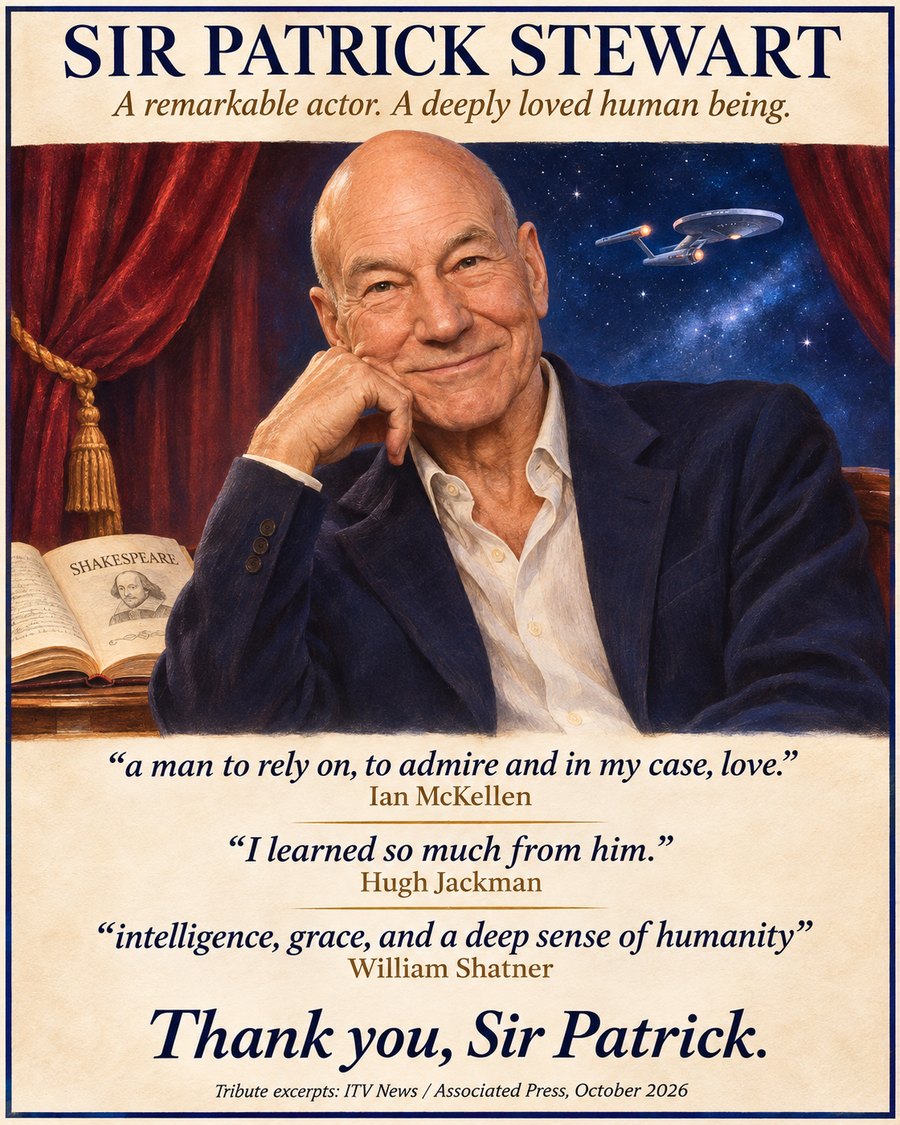
Sir Patrick Stewart died on 28 October at 86. As Captain Jean-Luc Picard he showed a generation a leader who asks first, decides once everyone has spoken and keeps his cool when tempers rise. Three decades on, his captain has lessons for the boardroom, for medicine and for social media.
When a new Star Trek series reached Austrian television in the early 1990s, I expected nothing. I had grown up with Captain Kirk and Mr. Spock. A new captain on a new Enterprise looked to me like a copy of a show I already loved, and I watched the first episodes with my arms folded.
A few weeks later I was waiting for the next one. The new captain did something I had seen few leaders do on screen. He listened.
Picard asks, then decides
The original series was a western in space. Gene Roddenberry pitched it in 1964 as “Wagon Train to the stars,” after one of the biggest television westerns of the day (CBR). Kirk led from the front and made his calls on instinct. Spock and McCoy argued at his shoulder. It was great television for its decade.
Picard led from the conference table. Whenever the Enterprise ran into trouble, he called his senior officers into the observation lounge and asked what they saw. He heard the engineer, the doctor, the counsellor and the android argue their cases. He decided after the last of them had spoken, and the decision came in three words: “Make it so.”
Sir Patrick Stewart died on 28 October 2026, at 86. Ian McKellen, who met him as a young actor at the Royal Shakespeare Company about 50 years ago, remembered a proud Yorkshireman whose honesty made him a man people could rely on. Hugh Jackman wrote that he had learned a great deal from him. William Shatner, the first captain of the Enterprise, praised his intelligence, grace and humanity on the bridge (AP via 1News).
Picard still has fans in boardrooms. Philipp Baaske, who co-founded NanoTemper and grew it to more than 200 people, told me he is “a big Jean-Luc Picard fan.” His favourite word from the captain is the order to go to warp: “Engage.”
A risk on a London street
The role came with a risk. In his tribute, McKellen recalled meeting Stewart on a London street after the Star Trek offer arrived. He asked whether his friend was ready to put his stage career in Britain on the line and get lost in Hollywood for years. Stewart took the offer despite the warning. “Thank goodness for us all that he did,” McKellen wrote (ABC30).
The decision paid off on both sides of the Atlantic. Stewart went on to the X-Men films and to Shakespeare, Ibsen, Pinter and Beckett at Stratford-upon-Avon, in the West End and on Broadway. Late in life he returned to Picard in the series that bears the captain’s name. Most leaders face a choice like his once or twice in a career, with a safe position on one side and an open question on the other. Stewart took the open question and kept acting on stage for the rest of his career.
One minute in March 2022
The most famous test of composure in recent years happened on live television.
On 27 March 2022, at the 94th Academy Awards, Chris Rock was presenting the award for best documentary feature when he made a joke about Jada Pinkett Smith’s shaved head. Will Smith, her husband, walked onto the stage and struck Rock in the face (NPR via KPBS).
Will Smith had spent three decades as one of the most liked people in entertainment. His career ran from The Fresh Prince of Bel-Air to the action hits of the 1990s. That same night he won the Oscar for best actor. One minute changed how people remember the evening and the years after it. Within days he resigned from the Academy, which on 8 April banned him from its events for ten years, a decision he said he accepted and respected (ABC13). In a statement the day after the ceremony he wrote: “I was out of line and I was wrong.” In July he apologised to Rock again, on video (KTLA).
Chris Rock had every reason to answer in kind, and nobody would have blamed him. He stood still, said a few words and finished presenting the award. He declined to file a police report. For close to a year, he kept his public comments to a minimum. Asked later why he had not hit back, he said his parents had raised him not to fight in public (ABC News).
Everyone who saw that minute remembers both men. One let his emotions guide his actions, whereas the other stayed as calm as Picard on the bridge. Rock’s calm won the night. Smith’s apology, written in his own words, is the second half of the lesson. Anyone can lose control for a minute, and Smith showed that the way back starts with admitting it in public.
Social media works the same way. A post written in anger takes a minute, though people remember it for years. Before you vent online, breathe and wait a day. If the point matters a day later, write a measured piece. All of us forget this from time to time, which is why Patrick Stewart’s seven seasons and four films as Picard are worth watching again.
Sickbay was a preview
Picard’s Enterprise also showed where medicine was heading. Its sickbay looked more like a consultation room than a hospital ward, since most patients left within the same episode. They came in with a problem and talked it through with the ship’s doctor, Dr. Beverly Crusher, played by Gates McFadden. Sensors in the biobeds and a handheld medical tricorder read their condition (Memory Alpha). The ship’s computer helped with the diagnosis.
In the original series the crew worked their tools by hand. In The Next Generation they talked to the computer, which helped them solve the problem. The show’s touchscreen tablets appeared more than twenty years before the iPad (Ars Technica). Today AI-assisted diagnosis is reaching hospitals, and drugs designed with AI are in clinical trials.
The replicator is the missing step. On the show, replicators produce food, objects and medicines whenever the molecular structure is on file. In our world a new medicine takes 10 to 15 years from discovery to approval on average, according to the industry association PhRMA (N-SIDE). Change has started. In 2025 a team at Children’s Hospital of Philadelphia and Penn Medicine treated a baby named KJ with a gene-editing therapy built for his single mutation. He received his first dose at about six to seven months old (News-Medical, on the NEJM report).
I think the full Star Trek version is centuries away. A computer that diagnoses one person, designs the right molecule or biologic for them, simulates the whole development process and replicates a medicine that works every time with no side effects belongs to Picard’s era, around the year 2400. Robotics and AI are moving us toward it. With execution at warp speed, the pace Elon Musk sets for his teams, I believe we can reach a large part of that vision by 2050. Since 2000 I have worked on bringing great minds together, and this news page, social media and the show continue that work today. I hope it helps bring the date forward.
Five minutes before you act
Special forces train calm under pressure with a technique called box breathing, which former Navy SEAL Mark Divine teaches in four equal counts (TIME). Climbing coaches teach the same pattern for moments of fear on the wall (Movement).
- Breathe out until your lungs are empty, then hold for a count of four.
- Breathe in through your nose for four.
- Hold the air for four, with your chest open and loose.
- Breathe out through your nose over a count of four.
Divine recommends at least five minutes. The next time a meeting heats up, or your thumb hovers over the post button, give yourself those five minutes before you act. That is all.
Thank you, Sir Patrick.
Your Next Move
When a big decision is on your desk, prepare it in one focused hour with an experienced outside view.
See Your Next MoveQuick answers
- When did Sir Patrick Stewart die?
- He died on Wednesday, 28 October 2026, at 86, his family announced.
- How did Captain Picard lead?
- He called his senior officers together, asked what they saw, heard every view and then decided, often with the words “Make it so.”
- What is box breathing?
- A breathing pattern in four equal counts: breathe out and hold, breathe in, hold, breathe out. Former Navy SEAL Mark Divine teaches it and recommends at least five minutes.
- Did Star Trek predict today’s technology?
- The touchscreen tablets of The Next Generation appeared more than twenty years before the iPad, and one of their designers later called the iPad the Star Trek dream come true.
Sources
Original post
Christian Soschner on LinkedIn, 7 November 2026: the tribute post this article grew from.
From the show
Philipp Baaske, co-founder of NanoTemper, Beginner’s Mind EP 109, from about 1:00:13. Sell It Before You Build It
Tributes
AP via 1News, 30 October 2026, on the tributes from Ian McKellen, William Shatner and others. 1news.co.nz
ABC30, on McKellen’s memory of the Star Trek offer and Shatner’s tribute. abc30.com
GMA Network, on the McKellen and Jackman tributes. gmanetwork.com
Star Trek
CBR, on Roddenberry’s “Wagon Train to the stars” pitch. cbr.com
Memory Alpha, on the sickbay, its biobeds and the medical tricorder. memory-alpha.fandom.com
Ars Technica via DigitalReviews, on the PADD and the iPad. digitalreviews.net
The 2022 Oscars
NPR via KPBS, 27 March 2022, on the incident and the LAPD statement. kpbs.org
ABC13, 8 April 2022, on the Academy’s decision. abc13.com
KTLA, 29 July 2022, on Will Smith’s apologies. ktla.com
ABC News, March 2023, on Chris Rock’s later comments. abcnews.com
Medicine
N-SIDE, citing PhRMA and BIO, on the time it takes to develop a new medicine. n-side.com
News-Medical, 15 May 2025, on the personalised gene-editing therapy for baby KJ (NEJM, Musunuru et al.). news-medical.net
Box breathing
TIME, on Mark Divine’s box breathing. time.com
Movement climbing gyms, on breathing techniques for fear on the wall. blog.movementgyms.com
This article is for information only and is not investment advice or a recommendation to buy or sell any security. The author may hold positions in the companies discussed.