Articles › Corporate planning
Article · Corporate planning · 12 November 2026
How to align a leadership team behind one goal: my corporate planning method, now as a free handbook
By Christian Soschner, 26 years in leadership roles

Planning season decides what next year will serve. A free handbook on the method behind the plan: one big vision, a few missions, the next six months in detail, and a monthly review that keeps every team on the same road.
November is planning season. In most companies, the board meetings of the coming weeks approve next year’s budget, and leadership teams spend long evenings on the numbers behind it.
The numbers matter. Few plans fail on a spreadsheet cell. Many fail when the people who execute them pull in different directions.
The pattern repeats at every stage of a company.
- Before a Series A, a science team can split in two. One half wants to stay in research, the other wants to move into development. Without a big goal both halves share, the team stalls, and the debate turns personal.
- In a scale-up, three experiments show promise, and nobody decides which one becomes the main business. Each gets a slice of money and people. The company pulls in three directions, and none of them reaches its goal.
- In a listed company, the same pattern appears at scale: a portfolio spread across so many priorities that none of them receives the full force of the organisation.
Good intentions are not enough. The people in these companies work hard. Their effort lacks a shared picture of where the company goes.
The hidden effect of planning
Corporate planning has a reputation for number crunching. Its real effect lies elsewhere. It aligns the board, the executives and every team behind one vision, a few missions and the work of this month. With that alignment in place, a leadership team can choose between good projects, and stop the ones that serve another road.
AstraZeneca shows what that choice can do at scale. From 2011, the company tied every research decision to five questions: the right target, the right tissue, the right safety, the right patient and the right commercial potential. Between 2005 and 2010, it had started 287 discovery programmes, 28 percent of them backups. Between 2012 and 2016, it started 76, with fewer than 7 percent backups. The share of drug candidates that went on to complete Phase III rose from 4 percent to 19 percent.
That alignment is the subject of my new handbook. It describes the method I use with leadership teams, from research organisations to listed groups, and it is free to download.
Start with the big thing you want to achieve
A product earns the money. A vision creates the movement that employees, partners and investors want to join. Many US teams lead with the change they want to bring to the world, while many European science teams lead with the product. Both need the product. The vision gives it a direction and a reason to grow.
Moderna began in 2010 to deliver on the promise of mRNA science. Its founders treated mRNA as an information molecule and built a platform that could produce many medicines from one technology. On 13 January 2020, two days after Chinese authorities shared the sequence of the new coronavirus, Moderna and the US National Institutes of Health finalised the sequence of their vaccine candidate. The platform behind it had taken a decade to build. Christoph Lengauer, co-founder of Curie.Bio, made the same point for young biotech companies on my show: a company needs a product engine, not a single bet.
Nvidia unveiled CUDA in November 2006 and opened its graphics chips to general computing. To build a base of users, it put CUDA into its GeForce gaming chips. Jensen Huang later called the added cost high: profits fell, and shareholders asked for a focus on margins. Tae Kim describes how Huang saw it as his mission to prepare Nvidia for an “Era of the GPU”, although nobody could know which opportunities it would bring. In 2012, a Toronto team trained AlexNet on two Nvidia gaming cards and won the ImageNet competition with a top-five error rate of 15.3 percent, against 26.2 percent for the runner-up. In June 2024, Nvidia became the most valuable company in the world.
Eli Lilly launched its first GLP-1 medicine in 2005. In 2021, it widened its focus from diabetes to a bigger goal: medicines that stop the cascade of diseases caused by obesity and type 2 diabetes. Chief executive David Ricks counts about 200 adult diseases linked to obesity, from heart risk to joint pain. Tirzepatide took that goal from diabetes into weight management. The US approved it for type 2 diabetes in 2022 and for chronic weight management in 2023. In 2025, its two brands combined made tirzepatide the best-selling medicine in the world. On 21 November 2025, Lilly became the first drugmaker to reach a market value of $1 trillion.
From the vision to this month’s work
Fabrizio Conicella described on my show how strong founders start from the future and plan back through every phase of development. The handbook turns that idea into three horizons, each with its own level of detail.
- The vision, five to ten years: one big goal, one focus for about four years, and one to three key figures that decide every close call.
- The missions, six months to five years: three to five milestones the whole company can recognise when it arrives.
- Operations, now to six months: tasks with one owner, one date and one result anyone can check. Months seven to twelve stay in rough lines and leave room for what the team learns.
Each team checks its work every day. At the monthly review, the team asks whether that work moved the next milestone, and decides what to continue, change or stop. Every task points to the big goal.
Try one question at your next planning meeting. Ask each executive to name the milestone their team’s work should serve over the next six months. If three executives name three milestones, the plan has found its first decision.
What the handbook covers
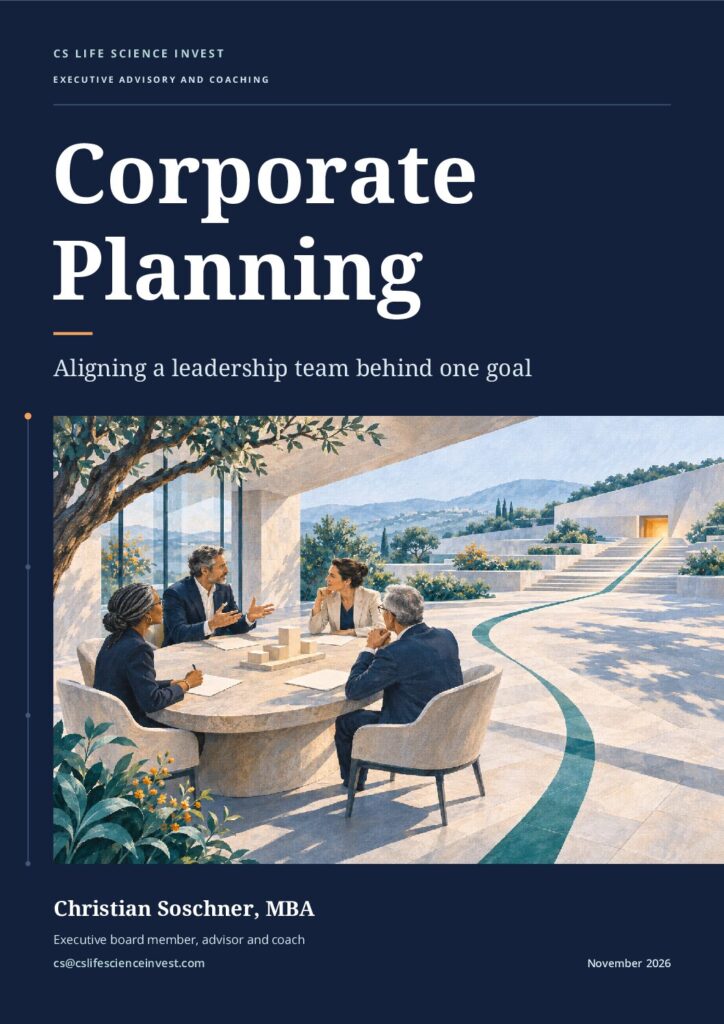
The Corporate Planning handbook has 29 pages in 14 chapters. It covers:
- why every plan starts from the vision, and why the business plan works as a thinking tool;
- scenarios, the pre-mortem and the work behind the numbers;
- how planning differs for listed companies, scale-ups, startups and research organisations;
- the planning year, from the summer offsite to the monthly review;
- how to build the plan with the whole organisation, and when to change the target;
- seven exercises, one page each, for your next leadership meeting.
Before your next board meeting
Is your company in the middle of planning season? Does the team pull in different directions? Then this is the moment to talk.
Your Next Move, EUR 500. Start right away: a preparation sheet within 24 hours of booking, a 60-minute session, and a written de-brief within 24 hours with one recommendation and a dated next step.
Book Your Next MoveA free 15-minute call. Bring one planning decision: what the team agrees on, what divides it, and what the board needs to decide.
Book a free 15-minute callQuick answers
- What is the Corporate Planning handbook?
- A free 29-page handbook by Christian Soschner on the planning method he uses with leadership teams. It covers the vision, the missions, the next six months in detail, the monthly review and seven exercises for a leadership meeting.
- Who is the handbook for?
- Boards, chief executives and leadership teams of science companies, from research organisations and startups to scale-ups and listed groups.
- What are the three planning horizons?
- The vision, five to ten years ahead, with one focus and one to three key figures. The missions, six months to five years ahead, with three to five milestones. Operations, the next six months, with tasks that have one owner, one date and one result.
- How many key figures should a company track for the long term?
- One to three. The chief executive sets one focus for about four years, matched to the stage of the company: growing revenue, building a new division or cutting cost. More key figures divert attention.
- How do I get the handbook?
- Download it free through the link in this article or from the Corporate Planning page under Advisory.
Sources
The handbook
Christian Soschner, Corporate Planning: Aligning a leadership team behind one goal. Handbook, Illustrated Edition, November 2026. Download the PDF
AstraZeneca
Paul Morgan, Dean G. Brown, Simon Lennard et al. and Menelas N. Pangalos, “Impact of a five-dimensional framework on R&D productivity at AstraZeneca”, Nature Reviews Drug Discovery 17 (2018), 167–181. nature.com
Moderna
Moderna, Our story. modernatx.com
Moderna, first participant dosed in NIH-led Phase 1 study of mRNA-1273, 16 March 2020, Business Wire. businesswire.com
Christoph Lengauer on Beginner’s Mind. cslifescienceinvest.com
Nvidia
Jensen Huang, commencement address at National Taiwan University, 27 May 2023. blogs.nvidia.com
Tae Kim, The Nvidia Way, 2024.
Alex Krizhevsky, Ilya Sutskever and Geoffrey Hinton, “ImageNet Classification with Deep Convolutional Neural Networks”, NeurIPS 2012.
Reuters, 18 June 2024, on Nvidia becoming the most valuable company. reuters.com
Eli Lilly
Eli Lilly and Company, Form 8-K on its December 2021 investor update: strategic focus widened to medicines that disrupt the disease cascade of obesity and type 2 diabetes. SEC filing via capedge.com
David Ricks at Goldman Sachs Talks, on obesity as the cause of about 200 adult diseases. goldmansachs.com
MT Newswires via MarketScreener, on Lilly’s first GLP-1 medicine in 2005 and twenty years of work. marketscreener.com
US Food and Drug Administration, approvals of Mounjaro (13 May 2022) and Zepbound (8 November 2023).
Eli Lilly and Company, Annual Report on Form 10-K for 2025.
Reuters, 21 November 2025, on Lilly reaching a market value of $1 trillion. reuters.com
Planning back from the future
Beginner’s Mind, EP 157, Fabrizio Conicella. buzzsprout.com