The show › EP 41
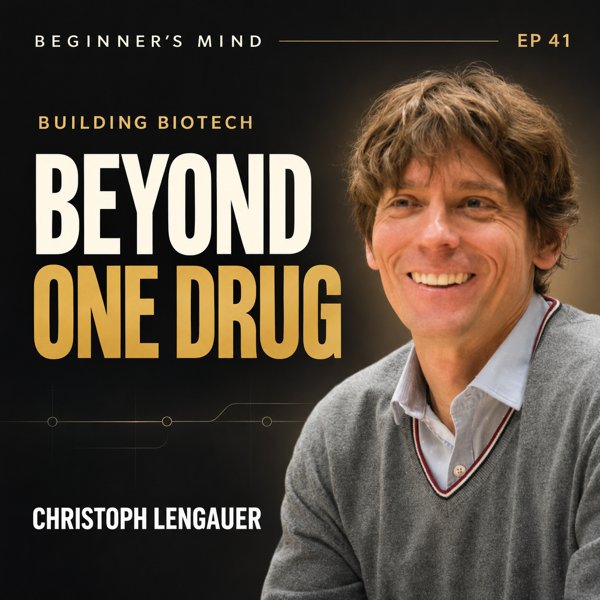
Beyond One Drug
Christoph Lengauer, then partner at Third Rock Ventures and today co-founder and chief scientific officer of Curie.Bio, on how to build a great biotech company: product engines, A teams, IPOs and exits, early-stage funding in Europe and the US, and fair access to medicine
About this conversation
In April 2021, Christoph Lengauer was a partner at Third Rock Ventures in Boston, the venture firm that only invests in companies it ideates, launches and builds itself. Born in Austria, he studied in Salzburg, earned his PhD in Heidelberg and spent twelve years in Bert Vogelstein’s cancer genetics lab at Johns Hopkins. He then led oncology drug discovery at Novartis and Sanofi and became founding CSO of Blueprint Medicines.
We walk through the value chain of a life science company, step by step: why a product engine beats a single-asset company, why investors pick the A team over the A idea, and what an IPO means for a company and for its investors. He explains why the first three to five million dollars are easier to raise in Europe than in the US while the Series A is harder, how Third Rock puts its own partners into the leadership of new companies, and why US founders often own one to five percent and still do well.
We close with the question that worried him most, access to medicine and drug pricing, and why he co-founded EQRx to change it. His outlook for the next 20 years: data, prevention and early detection.
Questions in this conversation
- 05:12 Why does Third Rock Ventures build product-engine companies instead of single-asset biotechs?
- 08:48 How important is the team in a biotech investment decision?
- 10:31 How do US and European biotech value propositions differ?
- 13:40 Why do biotech companies go public, and is an IPO an exit?
- 20:42 Is it easier to fund an early-stage biotech in Europe or in the US?
- 30:20 How does Third Rock Ventures build biotech companies from scratch?
- 36:28 How much equity do biotech founders keep in the US compared with Europe?
- 39:48 When should a biotech company sell to a larger company?
- 54:23 Why did Christoph Lengauer co-found EQRx to change drug pricing?
- 1:02:14 What will drive life science in the next 20 years?
Watch the full conversation
Plays on click. Only then does the video load from YouTube (youtube-nocookie.com). Privacy
Since this conversation
Where Christoph Lengauer and the companies from this conversation stand today.
- 10 September 2025 · Cancerguard launched
Exact Sciences launched Cancerguard, a blood test that looks for signals of more than 50 types of cancer. Its development drew on the CancerSEEK program of Thrive Earlier Detection, the company Christoph Lengauer co-founded and describes in this conversation.
Source: Fierce Biotech
- July 2025 · Sanofi completes the acquisition of Blueprint Medicines
Sanofi closed its acquisition of Blueprint Medicines, the company where Christoph Lengauer was founding CSO, at an equity value of 9.1 billion dollars. Blueprint’s Ayvakit is approved in the US and the EU.
Source: Pharmaceutical Technology
- 29 January 2025 · Curie.Bio raises a 340 million dollar seed fund
Curie.Bio raised a new 340 million dollar fund to double its investing over two years, with plans to back up to 25 biotech startups in 2026.
Source: STAT
- 22 August 2024 · Therapeutic Innovation board at Cancer Research Horizons
As inaugural chair, Christoph Lengauer welcomed new members to the Therapeutic Innovation board of Cancer Research Horizons, the innovation arm of Cancer Research UK, to speed up the development of new cancer therapies.
Source: Cancer Research Horizons
- 25 June 2024 · Curie.Bio adds a 380 million dollar Series A fund
A pro rata fund to carry Curie.Bio’s portfolio companies through clinical trials brought the firm’s capital to nearly one billion dollars.
Source: Business Wire
- 14 December 2023 · Board of Cancer Research Horizons
Christoph Lengauer joined the board of Cancer Research Horizons as inaugural chair of its Therapeutic Innovation board.
Source: Cancer Research Horizons
- 22 February 2023 · Curie.Bio launches
After Third Rock Ventures, Christoph Lengauer co-founded Curie.Bio with Alexis Borisy and Zach Weinberg and serves as its chief scientific officer. Curie.Bio launched with 520 million dollars to give biotech founders seed capital and drug discovery support, the hands-on model he describes in this conversation, now open to outside founders.
Source: CHEManager
The questions, answered
Why does Third Rock Ventures build product-engine companies instead of single-asset biotechs?
Because a single-asset company is a binary bet, and Third Rock puts 50 to 80 million dollars into a Series A. Christoph Lengauer defines a product engine as a concept inside the company that lets it start drug discovery programs again and again, not necessarily a technology. If the front-runner program fails, the company keeps going. His example is Blueprint Medicines: two approved drugs from its own labs within ten years, more molecules in the clinic and a multi-billion-dollar collaboration with Roche.
“producing one drug is difficult, two is very difficult, and three is close to impossible”
Christoph Lengauer
Watch from 05:12 on YouTube · Listen from 05:12 on Buzzsprout
How important is the team in a biotech investment decision?
It is the most important part. Given the choice between an A idea with a B team and a B idea with an A team, Third Rock picks the A team every time, because a strong team makes something out of a weaker idea or stops it in time. Through his work with the EIT Health Gold Track program he sees exciting science all over Europe, but fewer experienced serial entrepreneurs to lead it.
“I think that the team is the most important part.”
Christoph Lengauer
Watch from 08:48 on YouTube · Listen from 08:48 on Buzzsprout
How do US and European biotech value propositions differ?
As a stereotype with hundreds of exceptions: US companies lead with the benefit, to make blind people see, while European companies tend to lead with features, two extra features or a 3% gain. Christoph Lengauer also sees a different attitude to success. A US team commits to a North Star, raises the money it needs to get there and comes to the regulator with its own plan.
“Therefore, I think the attitude towards success is just a different one.”
Christoph Lengauer
Watch from 10:31 on YouTube · Listen from 10:31 on Buzzsprout
Why do biotech companies go public, and is an IPO an exit?
For the company an IPO is an evolutionary step: the public market is far larger than the private one and often the only way to fund a mature company in Phase 3. It brings scrutiny and less freedom in how a company sets goals and communicates. Many investors treat the IPO as their exit; for the entrepreneur it is one more step to raise money. Third Rock lists its companies on Nasdaq, close to US investors and comparable biotech companies.
“Therefore, for us it’s an evolutionary step, and with that comes sort of a certain valuation.”
Christoph Lengauer
Watch from 13:40 on YouTube · Listen from 13:40 on Buzzsprout
Is it easier to fund an early-stage biotech in Europe or in the US?
The first three to five million dollars are easier to raise in Europe, with public money and safety nets that encourage scientists to take a risk. In the US that first money is close to impossible to get, which forces discipline and a robust business plan. Europe’s harder test comes at the Series A and B, where small early investors can leave a “contaminated cap table” that is not set up for a 50 million dollar round. Christoph Lengauer would rather back one strong idea with 70 million dollars than spread the same money thinly.
“I’d rather give one company 70 million dollars and it’s a good idea”
Christoph Lengauer
Watch from 20:42 on YouTube · Listen from 22:23 on Buzzsprout
How does Third Rock Ventures build biotech companies from scratch?
It ideates the companies itself, from academic founders’ ideas or its own, and only in Boston and San Francisco. Partners work on a concept for two to three years and spend about two million dollars on it before launch, then invest 50 to 80 million dollars and step into the key roles themselves: CEO, CSO, chief business officer. After one to three years they hand over to a permanent leadership team and stay on as board members. Christoph Lengauer calls it training wheels for a young company.
“We’re bringing enormous experience and leadership.”
Christoph Lengauer
Watch from 30:20 on YouTube · Listen from 32:01 on Buzzsprout
How much equity do biotech founders keep in the US compared with Europe?
In Europe he often sees three founders holding 85 to 90 percent between them. In the US a founder might hold between one and five percent, because investors put far more money in. The slice is smaller, but the pie is often much bigger: Thrive Earlier Detection, which he co-founded, raised 265 million dollars and was sold to Exact Sciences for about 2.5 billion dollars 18 months later. When Third Rock is the sole investor, it often owns about 90 percent at the start and about half at exit.
“Now that makes as a founder your the slice of the pie much smaller in the US, but very often the pie is really big, right?”
Christoph Lengauer
Watch from 36:28 on YouTube · Listen from 38:09 on Buzzsprout
When should a biotech company sell to a larger company?
When the buyer gives the product the best chance to reach patients. Thrive had shown that an annual blood draw can detect cancer anywhere in the body. Bringing that test to people needed primary care physicians, a sales force and integration into medical records, which Exact Sciences already had. About half of Third Rock’s companies went public and about half were acquired, and Christoph Lengauer advises entrepreneurs not to plan for a sale.
“I mean, companies are not sold, companies are bought, right?”
Christoph Lengauer
Watch from 39:48 on YouTube · Listen from 41:29 on Buzzsprout
Why did Christoph Lengauer co-found EQRx to change drug pricing?
Because he sees access to medicine becoming the biggest problem in healthcare. Drug prices are set by reference to older prices, not by the value a medicine adds. EQRx set out to charge 10 to 20 percent of what others charge by working more efficiently in discovery, development and commercialization. Investors backed it with a 250 million dollar Series A and a 500 million dollar Series B, which made him optimistic.
“That medicines are not made for the rich, but medicines are made for everybody”
Christoph Lengauer
Watch from 54:23 on YouTube · Listen from 56:04 on Buzzsprout
What will drive life science in the next 20 years?
For the next ten years, the genomic revolution continues: personalized medicine changed oncology and has yet to reach autoimmune and cardiovascular disease. Looking 20 years ahead, Christoph Lengauer hopes for a revolution built on medical data, because today’s hospital IT was built for billing, not for learning. Better access to records and data will drive prevention and early detection, from catching cancer early to avoiding cardiovascular disease and obesity.
“the impact of that will be in prevention and early detection of diseases.”
Christoph Lengauer
Watch from 1:02:14 on YouTube · Listen from 1:03:55 on Buzzsprout
Best quotes
“If you have to choose between an A idea and a B team, and between a B idea and an A team, you always pick the A team.”
“It’s this North Star.”
“It’s like having training wheels on your bike.”
“We love disruptive companies.”
“This industry deserves investment and should be rewarded for that risk it’s taking.”
“Those are the real heroes, I think.”
Clips
Short moments from the conversation.

Show notes
Click a timestamp to listen from that moment on Buzzsprout.
- 01:30Christoph Lengauer’s path from Johns Hopkins to Third Rock Ventures
- 05:12Blueprint Medicines and the product engine
- 08:48Why the team matters most
- 10:31US and European value propositions
- 13:40What an IPO means for companies and investors
- 16:45Third Rock Ventures and Nasdaq
- 20:01Why the listing place still matters
- 22:23Early-stage funding in Europe and the US
- 27:21The contaminated cap table
- 32:01How Third Rock Ventures builds companies
- 37:05The role of technology in the investment decision
- 38:09How much equity founders keep
- 41:29Exit strategies: Thrive Earlier Detection and Exact Sciences
- 47:05Valuations along the value chain
- 51:27What the stimulus programs do to private valuations
- 54:30A decade of success, and the COVID-19 vaccines
- 56:04Access to medicine and drug pricing
- 58:10EQRx
- 1:01:30Medicine, poverty and education
- 1:03:55The future of life science in the next 20 years
Links
- Christoph Lengauer on LinkedInFollow Christoph
- Curie.BioThe firm he co-founded in 2022 and serves as chief scientific officer
- Third Rock VenturesWhere he was a partner at the time of this conversation
- Cancer Research HorizonsHis profile as chair of the Therapeutic Innovation board
- EP 41 on BuzzsproutThe full episode with the original show notes
Full transcript
Christian Soschner00:00:00
Welcome to a new episode of the Life Science Gets Together podcast with the recording today. I started in the life science industry with drug development in 2006. So I think it’s almost more than 15 years ago. And I came from other industries which were focusing on business to consumer and business to business in the value chain. And when I started out in the life science industry, let’s say it was very challenging to find out how the value chain in the pharma industry works. And I believe coming from the business side, it’s an absolute must before starting a company to know what’s possible on the business side, which company structures exist in the industry, and especially how financing is done and what possibilities are on the market to design an exit for the investors and how companies can be developed. To answer that question, I have looked into my network, and I believe one of the best experts in the field when it comes to developing life science companies is Christoph Lengauer from Third Rock Ventures. Christoph, welcome to the show.
Christoph Lengauer00:01:20
Thank you. Thanks for having me.
Christian Soschner00:01:22
It’s good to have you here. The first question from my end, Christoph. How did you start in the life science industry And what are you doing with Third Rock Ventures?
Christoph Lengauer00:01:33
I mean, I’m originally from Austria. You can see that in my background. Studied in Salzburg, then got my PhD in Heidelberg, Germany, in biology, and then was a postdoc at the IMP in Vienna. And then I had to make this big decision should I actually stay in science or not? And I got really frustrated about like everything is so complicated and slow and like painful, you know, typical postdoc sort of trauma. And I said, like, maybe I should go to the US and to the lab, what I consider the best lab in the world in oncology. And if I don’t like it, then like just forget it. And that’s how I ended up at Johns Hopkins in the lab of Bert Vogelstein. It’s a lab where we together then I stayed there 12 years, discovered some of the key oncogenes and tumor suppressor genes. And but publishing in science, nature and cell was kind of satisfying for a while. But then to answer your question, I had this urge of saying, hey, can that also result in some form of medication or tests that have real impact in terms of like yeah real patients rather than just sort of inventing core principles? That’s how I ended up at Novartis, where I built a target identification validation group and then became global head of oncology for Sanofi. And that big big pharma experience I think taught me a lot, but real impact you can have as you know, as a in in the biotech space, and became founding CSO of Blueprint Medicines, and we might talk about that later, which is now a public company, and learned sort of this coming from a chief scientific officer perspective, more and more into like a successful company is about that interplay between science, medicine, and business. And I had an MBA also, which I got at Hopkins with a focus on medical services management. And this entrepreneurial concept of founding ideas, ideating projects that become companies fascinated me, and that’s how I ended up as a partner at Third Rock, where we actually only invest in companies that we ideate and launch and build ourselves.
Show the full transcript
Christian Soschner00:04:07
So you basically know the industry from the scientific lab bench up to big pharma and also the environment in between when it comes to translating science into products and building companies, which basically was my starting point in 2006 with a Novartis spin-out in the antibiotics field. And in the industry in the last couple of years, especially in Europe since the economic crash in 2008, I learned a term which was a special purpose vehicle. So it was very popular, I think in the phase from 2008 around 2016 to 17 to focus in companies on moving a single asset forward. And I always wondered are there other approaches in the industry you mentioned before, Blueprint Medicines, and this company is listed on the market. Is this also a single asset company, or did you follow a different approach with that?
Christoph Lengauer00:05:12
Yeah, good question. I mean, Blueprint is now a five and a half billion dollar company. We just celebrated last week, its 10th anniversary. I to answer your question, it’s I think it’s like only the second company that from its initiation to its 10th year anniversary has two drugs on the market approved that are self-made out of the company. Therefore, whenever we talk about single asset companies, we need to be careful about what’s the alternative, right? Because and I’ll introduce you to the alternative in a moment, but we need to keep in mind that producing more than one, producing one drug is difficult, two is very difficult, and three is close to impossible, and that’s just the context that we are living in. But at Third Rock, we are not building companies that are single asset companies. All our companies have this component of what we call a product engine. And the definition of a product engine is not necessarily a technology, but is much more a concept within the company that allows you to initiate and then pursue drug discovery programs over and over again. To come back to Blueprint, part of its value lies also in the fact that Blueprint has now another set of molecules, a handful of set of molecules in the clinic. It’s a collaboration, a multi-billion dollar collaboration in the immuno-oncology space with Roche. Has several development candidates in its pipeline. And so it really has sort of like I mean, that’s as far away as from a single agent, single asset company as you can imagine, which is very important for investors because even if you work in targeted therapy, you do have attrition. And from a value proposition, it is much more effective to kind of work on company concepts that have that product engine. Why does it matter? Because we are talking about different levels of investment. At Third Rock, we invest usually in a series A, somewhere between 50 and 80 million dollars. Okay, therefore, this is serious, and this is just driven by the belief of a product engine that if your front runner program dies, it’s not over, as it were in a single asset company, but it’s a binary play. You’re betting on something, if not there, it’s over. But you’re not betting with something if it’s over or not with 80 million dollars.
Christian Soschner00:08:12
No, I absolutely understand that. I mean, the binary play with an SPV, you have a project, and if it fails, which especially in the early days, the likelihood is very high. I think basically the game is over. When you want to develop a company and bring it to the market, probably it’s a much smarter approach to build a portfolio, even if it’s difficult. Which leads me to the question what about a team? How do you build such a team and what role does a team play when you decide on an investment?
Christoph Lengauer00:08:48
I think that the team is the most important part. We always talk about it. If you have to choose between an A idea and a B team, and between a B idea and an A team, you always pick the A team. Because they can make something out of the bad idea or kill it, whatever, versus a B team will always screw it up. Okay, therefore that that’s that there’s no question about that. You always go for the good team, which is a challenge in Europe. I do quite some work in the context of Gold Track program with EIT Health and like you know, in Europe where we try to find gems and like you know, like nuggets that are somewhere there, those raw diamonds, anywhere in Europe, anywhere in Europe that is. And they do exist and they’re exciting. There’s exciting science, there’s exact, exciting value proposition to solve challenging problems. But the team component is a very difficult part in Europe because you don’t have those experienced, serial entrepreneurs, that expertise on that entrepreneurial side. Even it comes to management leadership team on the science or whatever, is it’s difficult to find. I think that’s where the US has an advantage. Team is super, super important.
Christian Soschner00:10:10
Is there really such a huge gap between Europe and the United States when it comes to understanding how companies can be built? What expertise should the people have if they want to pursue an approach which is more oriented towards building a portfolio within a company? What would you like to see?
Christoph Lengauer00:10:31
I mean, I think there’s some stereotypic differences. They are partially helpful, partially not, but I think they’re telling. One is of course the experience of the team, we just discussed that. The other component is that that the benefit focus, okay. Like, you know, why are we doing this? You know, to solve a problem, to make to make blind people see. That is a typical US value proposition. People who are dead can live again, right? That sort of the European value proposition, it’s of course is only a stereotype, but is more like my machine has two extra features, or I can do it like you know, in twice as fast, or there’s a 3% you know increase in X. Okay. And because we are very we are, and I’m part of that too, we are very feature oriented. We are, you know, and that’s just the way we think and the way we operate. And I think that that puts us down, holds us back. The opposite is the same true too. It’s this North Star. Okay, like this is just like so easy to like, you know, to like believe in a big idea and to go for it and and and and raise the money that’s needed in order to get there, rather than raising as much as you can and then see how far it gets you, or listening to the feedback for the regulatory agency as they are guiding you in the direction. No, you have to have a plan. You’re fighting for that. You’ll tell the agency what to do and hope that they will agree with you. Therefore, I think the attitude towards success is just a different one. Again, that’s super stereotypic. There are like hundreds of exceptions to that. But I think it it is helpful to acknowledge or talk about because it is a real thing, too.
Christian Soschner00:12:40
I think have I think having a sound vision is is a great thing for a company. It’s it’s not in the life science field, it’s coming from the digital world. With Shopify, this resonated very much with me because when I listen to the CEO at Shopify, he says we want to give everybody the possibility to become an entrepreneur, which I think is a it’s a great North Star. And I see the similar thing as you mentioned also in life science. I mean, we want to cure people, we want to cure cancer, for example. It’s a sound proposition, and I think ambition should should every company, every team should think about what North Star are they following. You mentioned with with Blueprint Medicines that one company from your portfolio that IPO, then I think did the research right, Relay Therapeutics also did an IPO in the past. Can you explain a little bit what an IPO is and what role it plays for you as an investor?
Christoph Lengauer00:13:40
Yeah, I mean, yeah, you mentioned Relay Therapeutics. I mean, I helped sort of develop the original portfolio and hired the first people in this company and did an IPO last year. I think it’s now a a three billion dollar company and for my market cap. And people look at IPOs, which is the you know, sort of the going like ask becoming a public company, right? To switching from private investment in a venture capital setting into like you know raising money from the public market, and and there are there are pros and cons to it. Like one is the public market is much bigger than a private market. Can raise a lot of money that way. But and that’s that’s maybe the only ideal way once you are a mature company in phase three or whatever, you can’t, it’s very difficult to do it otherwise. Therefore, for us it’s an evolutionary step, and with that comes sort of a certain valuation. There are disadvantages too. You’re very scrutinized, you can be less less flexible when it comes to goal setting and planning because you have a responsibility towards the public market. Therefore, it restricts you to a certain degree the way you message things, the way you communicate things, the risks you are taking. Therefore, it’s not always necessarily a good thing from a from a company evolution. From the second part of your question of what does it mean for an investor? Many investors see it as an exit to IPO, because that’s where they very often make a lot of money as they can get out of the company at that point and harvest sort of their fruits. And like, you know, Relay is a good example. A lot of people got a lot of money, you know. Can you imagine that once you now you’re when you start out with zero and your first round is a 50 million round, and you like a Third Rock own 90% of that. And then your company ends up after a couple of financing events and certain dilutions at a $3 billion company, there’s still an enormous sort of return on that. And that makes Third Rock also the most successful venture capital fund in the world, not only in life sciences. Therefore, IPO can be seen as an exit as an investor, I think, you know, from a from an entrepreneur and a company, it’s just another step to raise funds as you need them. And of course it comes with some you know financial reward for many people, but I at least for me that’s secondary.
Christian Soschner00:16:36
I think an IPO is a great thing. Your companies I believe IPO’d on the Nasdaq in the United States. Did I did I get it right?
Christoph Lengauer00:16:45
Yeah, that’s that’s what we do because that’s sort of I mean, first our companies on the US, and secondly, that’s you know, so so I mean this is very clear. You have sort of very clear comparisons in the in the in the biotech funds and like on the pharma side, and for the for us is just the best way of doing this, rather than London or Paris, for example.
Christian Soschner00:17:07
I mean I always wondered in I mean, we are now in 2021 and the world is connected, more connected than ever. When you think back in 80s, 90s, when I started getting interested into the stock market, it was a completely different world. The internet didn’t exist initially. Buying stock as a 16, 17-year-old man in in the mountainous area of Austria was was a little bit of a challenge. And now we have apps like Robin Hood. I think everybody meanwhile knows the Nasdaq in the world. When I open the newspaper, I see a lot of hero stories from Europe, from the United States. But one thing surprises me always thought when the world gets connected, the importance of putting a company on a certain market like a Nasdaq or like getting listed in London or in Paris becomes less of importance because basically it’s every company listed anywhere in the world gets a gets a number and you can buy it from via your broker. Why is it still so important where the company is listed? What is your opinion on that?
Christoph Lengauer00:20:01
I mean, we still have different currencies, right? I mean, there’s the euro, there’s the dollar. There’s of course like the Asian sort of opportunities. I mean, it’s just a question of access to investors. Certain investors sit in certain sort of geographies, and I think that makes somewhat of a difference. The the fluctuation in the market, the volume, right? You know, I think you know it’s very important, especially for smaller companies. So I’m involved in Hookipa, which is originally a company out of Vienna, but is listed also in the US now as a public company. I’m a board member there. There, of course, like it’s also incredible success. I mean, it’s a super success story being a you know several million, hundred million dollar sort of valuation. But of course, there the fluctuation in the market as you know the volume and your sales and buying sort of is can be smaller. And that has sort of some impact on your stability and your predictability, and therefore driving for that higher volume and for that kind of thing, especially when you’re a good multi-billion dollar company is not that important. But there are super successful companies are like also in European, like Evotec is listed here, Sanofi is listed in both, like there’s like many hybrids that you can imagine, and I think it’s maybe less important, it’s just like you know, geography drives it.
Christian Soschner00:21:24
The I mean developing a listed company always seem to tech, I mean there are technicalities, so it’s it’s it’s work and it needs expertise, but basically finding money for a company close to an IPO or that is on the market. I think there is there are sufficient funds on the market set up to buy stock from that company, like Cathie Wood’s ARK fund, for example. The problems that I see, especially in Europe, are the early stages of of a company when the technology spun out of an university, when the first team forms, when they think ideally about their North Star, their vision, what they want to achieve with that. And money scarce there. Lately in Europe, a lot of incubation and acceleration programs started that helped companies. How is the situation in the United States? What organizations can first-time entrepreneurs who want to get started, a company and want to tap in the field of expertise, whom can they approach?
Christoph Lengauer00:22:23
Yeah, it’s it’s interesting. I always say it’s nowhere as easy to raise your first three to five million dollars as it is in Europe. Okay, and you’re basically they throw it at you. My op my opinion. I think it has pros and cons. The pro is sort of it drives innovation and it gives, you know, it it encourages academic scientists, young entrepreneurs, whatever, to take some risk. It’s very well buffered, you know, many people don’t have to get paid back. And like there’s like incredible safety nets around those first five million, in my opinion. Very little accountability. I think that helps, that encourages. But of course, what happened afterwards? And that’s what you just described, Christian, right? You know, saying like, yeah, there’s the scarcity, and then actually that real series A or that series B, this is where it’s convoluted. Now, not difficult for companies that are successful in that, but then you have a lot of companies that like in those three million first funding, whatever, can’t get anywhere. And that creates sort of an assessment of. Neighborhoods, then people say, like, that’s a bad neighborhood, this is like not working, this is ineffective, this is inefficient. Why should I invest? What is my opportunity for an exit? You know, I can’t, it’s not predictable to me, like, especially like angels and so on. Therefore, I think it has also a somewhat negative effect, too. If you compare it to the US, getting a first three million is close to impossible. It’s really, really difficult. And that’s elect, that drives discipline, that you know, encourages you to have a robust business plan that makes you question things, go forward and backwards, you know, solidify your concept. And with that, maybe have a little bit more reliability as you grow up. Therefore, I think those are the pros and cons. They all have their reason. We also live in different political environments, you know, where maybe the US has less of responsibilities, like if they feel at least, towards you know, subsidize subsidizing, you know, ideas or innovation. They are you’re more left on your own. In the end, you know, I mean, of course, like, you know, the big the biggest successes now not in Europe, with the exceptions and yeah, great ones, Evotec, Genmab, BioNTech, you have it. Yeah, amazing success stories. They’re just a little bit like less and I’m worried about sort of this this almost careless distribution of money that feel might feel more like subsidizing bad ideas than it is actually to to encourage innovation. And I think we need to potentially rethink that a little bit in Europe. How can we be more selective? I’d rather give one company 70 million dollars and it’s a good idea, than I give 100 companies like 700,000. Okay, and they’re all and 95% of them are bad ideas, okay, because it doesn’t help anybody. And but I think that requires a willingness and a courage to be judgmental, to be subjective, to you know, call a dog a dog, and you know, and and maybe we are not bold enough to do that.
Christian Soschner00:26:22
It’s it’s awesome to hear that you see advantages in Europe when it comes to money in the early stages over the United States. You always thought it it’s a little bit different that there is more money on the United States over in all phases of development of companies. And I always thought we it’s only Europe that has a scarcity in that field. But probably you’re right, with Horizon programs and and and other public subsidies, they make that up, but probably also bring a different mindset into the development of a company, which is how should I call it? Without insulting anybody, would say it’s not very entrepreneurial because these people are not used to start companies. So, what you mentioned as a serial entrepreneur are not used to start companies, and maybe it shapes then the initial phase of the company towards a direction which ends up culturally at a different spot than the companies we see in the United States, which are driven to pre-entre entrepreneurial and focus solely on the market.
Christoph Lengauer00:27:21
Christian, we see this a lot. It’s a real problem, okay? It it it it really it bothers me because, as I mentioned, like Gold Track is one program that I’m very involved in, like in trying to help European companies. You get those early companies, and they’re already a little screwed up at that point, okay? Like, take the cap table as one example. We call it a contaminated cap table. That’s what we internally say. Because they have investors in there, like you know, the Kreissparkasse Tuttlingen or whatever.
Christian Soschner00:27:48
You know, I mean that’s a savings bank.
Christoph Lengauer00:27:51
Yeah, and like, and I’m not like this great that they are supportive and like you know, are like you know, helping innovation, but what’s their mindset? The mindset of those investors and then potentially board members is that they invest $500,000 and have an obligation to bring $700,000 back. Okay. If you then have a conversation with them and say, like, we are raising $50 million, the guy sort of freaks out. Doesn’t know how to handle it. He’s not even permitted to go there, okay? Therefore, because that’s a real risk then, okay? And this is but this is high risk, high return, right? I mean, this is where the mindset then becomes an issue, where the management teams with the bold ideas get stuck because they got themselves into a situation that’s surrounded with people who safeguard, and like, you know, and and and again, I’m not complaining about it because that’s those people’s job. It just makes it very difficult to then sort of go for, you know, where it matters. And like, Third Rock people would never invest in something for two million dollars because we don’t have no time for it. It’s like you like picking up like some bottles of empty coke bottles and sprite bottles, and you’re like, yeah, I can get like 20 cents for it. It’s like, why wouldn’t you pick it up? Why don’t you pick it up? Because you need to bring it home, you have to carry it, you have to wash it, you have to bring it to the store, and then you get 20 cents. I’m like, ah, forget it. Let’s just not go there. Okay. And I think that’s a very common thinking of an investor because it’s not worth it. They rather like, you know, sit on the board on 10 companies in Boston, because that’s the big life science hub, and they can do this within minutes. They have to travel to Europe to sit on a board, and then it only makes sense if they have a chance to invest 20 or 30 million dollars. Otherwise, it just makes no sense for them. But the Kreissparkasse Tuttlingen doesn’t allow for that, right? Therefore, I think it’s a real thing, and we forget that as young entrepreneurs, how much we get ourselves in problems that could be avoided if we start out on a different foot.
Christian Soschner00:30:11
Yeah, I I agree with that. I think it’s also the environment in Europe. The last years the digital world was very popular and also shaped an investment style which is very short-term oriented. So, as you said, you throw a few hundred thousand euros into a company and expect a return within six to twelve months or two or three X, which developing an app, it’s possible. Small app, put it on the market, you get some customers, and the job is done. The life science industry takes 10 to 15 years, I think, still to put a drug on the market, except the vaccines that we saw from BioNTech, they moved incredibly fast because they already had the 10 to 15 years behind them and brought their platform to a point where this is possible. And it I think it was one family offices that supported that because in the later stages there are almost no VCs that invest in that area. I think also a point that you expressed, which is life science important, is also the science and bringing the right people together. I completely agree to that. And when I look at your company, I hope I spelled the name right, probably with an Austrian pronunciation, MOMA Therapeutics. When I looked at this company, maybe I got it wrong, but I it it looked to me that there are many Third Rock venture partners on the board of MOMA Therapeutics. And my typical picture of a venture capital company is they invest money and that’s it. Sit on a board, come every other month to discuss with the with the executives, but don’t get their hands dirty. And I got the impression from Third Rock ventures that you go down a different route. Can you explain a little bit more with the example of MOMA Therapeutics, what your approach is?
Christoph Lengauer00:32:01
No, I think thanks for the question, because I think what Third Rock does is is very different. But it’s Third Rock happened to be the first to do it that way in the US, and now it’s a little bit more popular. I think Third Rock has cultivated this over the last 10 years a lot, and but it’s not uncommon anymore. And it is a very different way of approaching that as we we sort of generally know that. How does that look like? As I mentioned, is we invest in companies that we ideate ourselves. We only invest in companies in Boston and San Francisco because that’s where our offices are. And we take ideas from academic founders or self-created, and then sort of really play with that. We play with that for a long time, two, three years. Spend on average about two million dollars on that per company, for huge attrition and that kind of thing. Find the right teams, mull it over and over again, sort of this principle of group genius, and then two or three years later, then we launch a company. And that’s where we then invest. We invest very aggressively, usually between 50 and 80 million dollars. And but that’s not the end of it. We actually go in there as partners from Third Rock in the key leadership management functions CEO, CSO, chief business officer, chief people officer, whatever you have it. And usually two or three of us. And we really sort of with that can leverage the knowledge that we have, having built now 55 companies. We can leverage the infrastructure that Third Rock provides, and we provide the leadership to the company. It’s like having training wheels on your bike, and that gives it a more stable start. People can focus on the science. And we help with telling the story, we sort of build a company robust way, stay in this for one to three years in that leadership role, as we feel it’s then appropriate to take off the training wheels, bring in a permanent leadership team then at that time, and stay on in the company as board members. For that sort of the concept of building a company, Third Rock has a lot of experience with it, a lot of safeguards with it, a lot of cultural components with it, to warrant they they get it going on on the right foot. And that is a different concept. Therefore, to answer your question or comment, is we’re not only bringing money to the table, maybe that’s actually the least important part that we bring. We’re bringing enormous experience and leadership. We are bringing the passion towards that new company concept. Be it Celsius in single-cell RNA-seq, being MOMA in ATPases as molecular machines, both companies were co-founded. Both companies have been CSO. Celsius a year and a half, in MOMA now for a year, but then three years incubation prior to that. If we stay with those companies, and once we let go, once we have that permanent leadership team and the trust in that team to be the ones that can drive that forever, we go back and sort of provide more strategic guidance at board members that’s a very interesting approach.
Christian Soschner00:35:45
So basically, you cover the the whole value chain when it comes to investing in a company, you go in extremely early. So, in a situation where no team exists, bring your expertise and your know-how into that company as well as the money, then build the team around the idea, and then make the shift from being in the driver’s seat back to a more coaching or mentoring like approach, or like the typical investment approach, which is very amazing. From Europe, I I see different organizations at different different positions in the in the value chain, and you cover everything. When you look on the scientific side, I mean, now the mRNA vaccines are very very famous and very popular. How important for you still? I mean, we talked about the vision, we talked about the right team, getting the A team, but how important to you is also getting the A technology that nobody else is currently developing? Or do you think it’s also okay to say, okay, it’s a Me Too product, so now MR mRNA vaccines are on the market, now we also develop some. What is that position that’s that you pursue?
Christoph Lengauer00:37:05
Yeah, I mean, Third Rock, we we don’t like to be the follow-ons. I mean, that’s just a philosophical question. I think there’s an enormous value proposition in sort of being second. I mean, we see this a lot being in mRNA, being one example, like you know, but like in the antibody space, I/O, right? I mean, there was one IO company, one immuno-oncology company at one point, now there are a thousand, therefore, what’s wrong with it? That’s it’s okay. Yeah, but it’s just not what we do, okay? This is not the judgment, this is just the way we approach it. We want to be on that beginning of innovation. We love disruptive companies, we we want to take a lot of risk. Because I think you know that’s just but we want to do it always very much found found in a foundation that’s highly scientific. And that’s just our approach, but like it’s not necessarily the only the right approach, it’s just that we will like it because we want to be innovative and disruptive. And one question I just saw that came in, it was about like in the Third Rock second, I think, you know, you know, was like what type of ownership do we usually go in, right? Yes, also a big difference between Europe and the US. In Europe, I see often companies where founders have 90% of the company. They’re like three founders and together they have like you know 85, 90 percent, like each of them 30 or 40 percent. Like, like this this is totally like not the case in the US. Okay. In the US as a founder, you might have like between one and five percent. That’s that’s sort of the US because you put a lot of money in there, okay? And that’s just sort of that’s where the risk then is, and you’re not done when you start a company. Therefore, that’s very different. Now that makes as a founder your the slice of the pie much smaller in the US, but very often the pie is really big, right? You know, I mean I I co-founded like you know, Thrive Earlier Detection 18 months ago. We raised 265 million dollars, but sold this January the company to Exact Sciences for $2.5 billion. I thought that’s a pretty pretty big pie. It’s okay for a co-founder to like only have a percent or two. It’s still like a shitload of money. Okay. I think that’s better than having 50% in the company that in the end is is is worth nothing. Okay. I think that is a good thing to answer the question. With that in mind, we if we are the sole investor in it, we very often have then 90% of the company. Because we also ideated it. And then in exit, we very often still have about 50% of the company. And that, of course, from an entrepreneurial perspective, is a very good scenario in case you’re successful.
Christian Soschner00:40:01
And basically, you with your approach, you are the founders yourself. So basically, I mean you you bring a lot to the table, not only the money, but the discussion I have very often with companies in Europe. This this dilution problem that some people have, and which leads to interesting valuations on the other hand when somebody demands 50 million investments and wants to have 90% of the company as a founder. I like the example of Jeff Bezos with Amazon. I mean, I think he owned at the end 11% of the company and still was the richest person on the planet with one of the most valuable companies. So I completely agree to your example and I like it that it always depends on the size of the pie. So smaller chunk from a bigger pie is small than a big chunk of a small pie. When it comes, you mentioned the company Thrive Earlier Detection, which I think is very interesting. When we look now at the later phases of development of a company, what about the commercialization? How does that work in the industry? Is it what is your approach? Do you do you try to to cover also the value chain up to the patient that you bring the drugs yourself to the market? Or do you see more potential in really pursuing B2P approaches to say, okay, we just take the first steps in the development and then sell it off to the industry? How is the industry set up today?
Christoph Lengauer00:41:29
Yeah, I think it it depends. All those flavors exist. Depends also on the area, right? Like Thrive Earlier Detection is is a diagnostics company where we had this vision that on an annual blood draw we can tell people if they have cancer or not. It could be anywhere in the body. And we treated now, tested that now in 10,000 patients, and it works. Incredible valuable position because early cancer detection will save lives. This will change the way we think about cancer. It will take out the angst about cancer in a significant way, and Exact Sciences saw that. And it’s a good example to your question because why did we agree on the acquisition? I mean, yes, they paid $2.1 billion, like you know, straight up that day, $400 million sort of in future milestones. But there’s no biobucks in that, right? I mean, it’s like you know, a little biobucks, it’s $2.1 billion at closing this thing, which we did in January. Why did we agree on that? Not because of the money, because that’s unimportant. Okay, it’s like what is the biggest chance to bring this test to people? And in diagnostic space, this is tough. And you need to have all the primary care physicians, you have to have bit integrated on a medical record side, it’s a sales force question, whatever. Us as a young company thrived where it was 18 months old. We can’t stem that. We just cannot build this. We need to raise more money, the alternative would have been an IPO. This is this tricky. Exact provided that infrastructure. They established, they have Cologuard as a column cancer test, sort of out in the market, they have Salesforce, they have the primary care physician connection, they are integrated in Epic, you know, in the medical systems on their record side. This is what we need. We don’t need to build it, we can focus on our thing. It’s the best chance to bring it forward. I think that’s true for all companies. Like Third Rock, about half of our companies did IPOs, about half of them got into merchant acquisitions. As companies are just buying it, integrating it into their thing. Therefore, it exists in all flavors, also and drug discovery, some of them only do discovery or development, some of them go all the way, fully integrated, also commercialization. Totally depends. I mean, Blueprint is now a commercial company. I mean, and sells over all geographies, and other companies are not doing that, but stay more like on the discovery innovation side. Totally depends really on the market, on the field, on the concept of the company, and also how it happens. I mean, companies are not sold, companies are bought, right? You know, if I think as an empreneur, you never think about selling a company, in my opinion, okay? Because it happens on you. It’s not something that you, I think, should plan for. I know that’s very controversial, but that’s my opinion. But when you get bored, they get bored.
Christian Soschner00:44:47
I I was it it’s absolute, I agree to that, and I and I like it. I hear that’s so realities days that entrepreneurs build company, companies, and this is what we are doing. More and more often when I talk with first-time entrepreneurs or young entrepreneurs, the first thing they mention is I think after 10 minutes in the talk is the exit. That they want to build a company for three to five years and then exit the company. So it’s not entrepreneurial spirit. You don’t exit your company, you build it. And if the circumstances are right and if it makes sense for the technology and for the product, to hand it over to a bigger partner, it makes sense, but you don’t plan as an entrepreneur as as an exit, this is investor thinking. And I really like to to hear this been from your side that you say you build company and companies are bought, not sold. This is this is sound, the sound in my May years.
Christoph Lengauer00:45:42
Yeah, I think that’s it’s the truth.
Christian Soschner00:45:47
I think this is it comes back to the to the to the mindset thinking. But I do understand also this side when people start when when they see the money. It’s recently I wrote an article about valuations. I I wondered what the how many trillion dollar companies we have in the world currently. And the first five hit a couple of years ago, this trillion dollar market cap milestone. And interestingly, the first company was a Chinese company already in 2007-8, an oil company. And when we read these numbers in the newspapers and on the internet that this company has that market capitalization and what bought for billions of dollars, I understand that some people also want to have so much money on their bank accounts. So valuations sort of drive the expectations. And I was wondering how the valuations are in our industry. What do you see in the United States? What can investors in life science companies when they do the job right, expect on the valuation side? Is one trillion a reasonable valuation or are we in a different space? How do you see it?
Christoph Lengauer00:47:05
Yeah, I think there’s been a lot of changes over the last few years, actually, recently also. I mean, I give you a couple of examples. Diagnostics. We thought that’s just not a valuable position to invest in outside of the angel world, right? I mean, this is where VCs just didn’t go into because like they thought like the return is just not there. That I think was still a popular position, maybe I would say maybe two or three years ago. This has changed. I mean, I we just talked about example, I was involved in with Thrive, you know, $2.5 billion. Illumina offered to buy Grail, which is another diagnostics company, doesn’t have a product on the market, and the offer was $8 billion. We have Freenome out there, ArcherDX, we have Foundation Medicine, which is a company that we built at Third Rock, that was eventually bought by by Roche for whatever, a couple billion dollars. Therefore, we’re seeing now in the diagnostic space those billion dollar companies, and that’s not done. I mean, Exact Sciences has bought us is is a company that has you know a couple of tests on the market and it’s it’s it’s it’s its valuation right now is $22 billion. Therefore, I mean we are seeing there’s not a diagnostic space where we couldn’t see it before. I think we’ll see something also soon in the data side on the data side. Data companies right now, this was like jokes, right? You know, this changing. Flatiron being one example when they were bought by Roche. 23andMe, I mean, that you know, companies that tell you that they’re related to Genghis Khan, you know, are now billion-dollar companies. I mean, therefore, I mean, there is, I I think partially because there’s value in the data, okay? And there is important things that like stay with you, and like, you know, that therefore I will think we will see it there. And of course, in the drug companies, another good example. There it’s easy because you can predict your your sale, and it’s totally clear that the blueprints and relays of the world, like three to five billion dollar companies. But 10 years ago we didn’t expect that for the Genzymes of the world that work in rear genetic diseases, where there are only 100 people to be treated. We thought that’s a total joke, right? But those companies ended up being BioMarin, Alexion, Genzyme being you know multi-billion dollar companies. And I I as long as it relates towards benefit, and as long as it relates towards value-based medicine, I think it’s absolutely appropriate. Where it gets convoluted is if if this actually is driven by pricing only that restricts access to medicines, then I’m getting my problem with it. Okay, therefore, I I think we need to look at it carefully, differentiate, and hopefully there will be some sanity at one point to it that’s really sort of driven by yeah, value rather than by perceived value or like really sort of driven by the financial industry.
Christian Soschner00:50:36
Yeah, I wonder how how the future will look like. I mean, with the SARS-CoV-2 topic in the last year, I think the pharma industry got a lot of more attention from investors that are not familiar with the industry. And when you look on the political side, I think in the United States, one 1.9 trillion bailout program was signed off by Trump and the second one by Biden this year. And I think also the European recovery program is about $1.8 trillion. I wonder what effect this will have also on the valuation of the of the not listed companies. Do you see an impact in the industry because of the sheer amount of money that is currently flooding on the worldwide market?
Christoph Lengauer00:51:27
Yeah, I mean it’s like sometimes it scares me a little bit, right? I mean, of course, we are happy that innovation gets so much attention and there’s so much capital right now available. I mean, you see the IPOs rising, SPACs as a vehicle that was really seen as something that people don’t want to touch. It was like really something ugly and like, you know, not you want to be affiliated with it. Now it becomes just a thing. I mean, right now it’s I think partially the valuations are crazy and inappropriate. We will see that. Just had a conversation with an investor from the crossover side. Those are investors that invest in private companies right before they go public and they specialize in that space. And they are worried, right? Because we will see that will be a normal situation. And like a lot of money invested will get lost. Okay, that we’ll see that, and people are like, oh, it’s an unpredictable like space, and we shouldn’t invest in apartment complexes in China, because I know at least they’ll exist and you know when they are built, right? I mean, it’s like I think versus in drug discovery, you might not know that when life sciences. And therefore, I think that that we will get that clear idea again in the next five, six years, as many of those investments will not pan out. And I think it will reset. Maybe it resets earlier, we never know. Maybe it resets tomorrow. Okay. Right now that market is open, that market is like there’s capital is available, people should take advantage of it for a good idea. I think that’s okay. Just like, let’s be prepared for that. One day a reality will hit us again, and people are like, hey, not all of those ideas we invested in actually painting out. And I think it will shock some. Okay. And we have to see, it’s just part of the game.
Christian Soschner00:53:19
Yeah, as long as people understand that still also for portfolio companies, there is still a high risk, especially in the early stages of development. And that’s the odds of losing an investment is probably higher than in other industries. So it’s just scientific risk, besides if even if the team does everything right and has the vision set up, it might always be that the technology just doesn’t prove what they were hoping for in the clinical development. And most of the time, especially the smaller the companies, that might be the end of the investment. For the valuation reset, I’m waiting for it since the last market crash in 2008. I I I I hear it every year when you open the newspaper. Every year I heard valuation reset is coming. Now we are in 2021. Last year I thought that’s it. And then the market got an upward swing, which was incredible. What’s your expectation? Just look a little bit in the future. What’s your expectation? Well when will we see such valuation reset?
Christoph Lengauer00:54:30
I don’t know, and I think that’s the most appropriate answer. It’s very unpredictable. Now, having said that, over the last 10 years, right, to your point, Christian, we also had a lot of success as an industry, and I mean it’s absolutely fantastic. And if you think about it, like there’s a new disease showing up, which is one of the most aggressive viruses that we have ever seen. And we have no idea what it was on day one. And 18 months later, half of the European population, and like two-thirds of the American population is vaccinated, vaccinated against what we didn’t be able to describe a year and a half earlier. That is that is fantastic. This is this is this is insane. If I think what we can do today, and how much suffering we can take care of, and which diseases we are able to cure, I mean, this industry deserves investment and should be rewarded for that risk it’s taking. If I think it is actually appropriate, okay. Now, where that will get us to, I do not know because that influenced by a lot of factors. And a lot of people were wrong in 2008, and a lot of people were right. And a lot of people predicted that we will have 12 years to come that are fantastic and fruitful, and a lot of people predicted this will be like much shorter than that. If you have no idea, you know, prepare for all synetings. What worries me is a different question in that, which is something that I think we are not enough paying enough attention to, and it has to do with access to medicines, it’s with distribution of medicines, with pricing of drugs. There we are getting ourselves into a situation that I think is not sustainable. Pricing is done by reference to old pricing, it’s not done by value-added medicine, it doesn’t exist. ICER is trying to do this to a certain degree. But it’s a conversation that I think COVID is introducing to the normal people, which I like because people say, like, wait a second, there’s a there’s a small percentage of chances that there’s blood clotting when I take it. Why am I taking that? You know, I mean people should ask, by the way, how much is it compared to one that doesn’t do it? That pricing question, we are not having it. But at least we are starting to have a conversation about choices, about who is making for us a decision of which medicine to have or not. Interesting, that’s very often the government, which is like, you know, its own conversation. But that this you would never do this with your car. You would never accept that the government tells you which car to drive because it’s less polluting the environment, or because it’s a little safer, or because you would not tolerate that. You’re like, I’m buying the car that I want and I pay for this, what I think is appropriate. Why don’t we do this with medicines? Okay, I mean, it’s like it’s like very absurd, right? We still live in this world of like just like sucking it up and if I think we need innovation in that space. I started a company like with several other people who are much smart about that in that space on drug pricing. It’s called EQRx. We’ll try to revolutionize drug pricing in that and charge 10% to 20% of what everybody else charges on drugs by being more efficient in the drug discovery and development and commercializing process. We think that will disrupt the thing. And what makes me optimistic is that people say that’s a good idea, that people say access to medicine must be one of our most important priorities, that this is a global problem, that this is a societal problem, that it’s something we need to work on. That medicines are not made for the rich, but medicines are made for everybody, and that our system is not set up to do that right now. That access is becoming the biggest problem that we have in healthcare, and that the cost regulation of that is intimately related to it, and somebody needs to do something. And I’m extremely thankful, like you know, we raised the series A $250 million last January. This January we raised the series B $500 million on that concept that I described, and that makes me optimistic because that means that investors, and we talked a lot about money today, but investors see that value-based medicine, that access, that fair distribution, that this might be as important as anything else we do in that space, and that they are willing to take risk and financial risk, you know, on top of that in order to help companies that want to change that.
Christian Soschner00:59:44
It’s it’s a sound vision. I think in the last year, I mean, I was not planning for a pandemic, so it came out of nowhere. And what you said at the beginning of the last five minutes, the level of collaboration internationally in the last 12 months that was just astonishing. So, I mean, I I think I I never saw that before that Chinese and European companies and US companies are working together to solve the problems around these threats to get a better understanding how how severe it really is to develop vaccines in an amazing speed. I mean it’s just as you said, it’s just one year. But what scares me a little is not only the distribution of medicine worldwide, so that it’s not a medicine for the rich only. What scares me a little bit is also when I opened the newspaper that with the pandemic also poverty starts rising again. And usually poverty hits the young people very hard. And I think besides this solving the distribution of medicine, we should also think a little bit on how how solving the poverty problem. And I think it’s a it’s it’s it’s a problem of education and financial literacy, so that people also get proper training, which I even don’t see it in the Western world, so especially in Europe, I think financial literacy is is still a problem, and which at the end of the day also leads to the beginning of of health problems. How do you see the the connection between medicine and and poverty and and education?
Christoph Lengauer01:01:30
Well, I think it’s it’s very direct and it’s extremely important. I think there’s a lot of room for improvement in that, and it’s super necessary. And I think you know, as you mentioned, it’s like I think some of that we are learning when it impacts us. And if there’s a good thing about COVID, that that’s one of them, that I think it raises awareness and gets us a better understanding of how important the work is, how heroic the efforts of our scientists and entrepreneurs in that space. They’re not just people who want to make money, they’re not just people who are crazy scientists and have like, you know, silly ideas that potentially one day could those are the real heroes, I think. And if we can now facilitate that actually access and distribution is fair, I guess that’s our next challenge for the next 10 years. And in that finance, literacy, social awareness, education is super, super important. We have our work cut out, I tell you.
Christian Soschner01:02:48
Yeah, that’s true. Let me ask you one final question. So, as I said, we were talking a lot about money, we were talking about the impact our industry makes on the world, and that more and more people got aware of how important it is. I mentioned the ARC fund earlier of Cathie Wood, and she has put out her big ideas report in January, where she’s saying that, in her opinion, I mean, you mentioned how important the vision is and the team is, and in her opinion, the area that thrives the most in our industry might be she calls it the genomics revolution. So she talks about gene editing, everything around that, and believes that this will shape the next 10 years. What is your opinion when you look at the technology that we are aware of today? In which direction should these entrepreneurs look when they put together their vision? What might drive our industry in the next 10 years or what might drive it forward?
Christoph Lengauer01:03:55
Yeah, no, I agree with that assessment. I think for the next 10 years, it’s pretty predictable. I continue to believe that we’re not done with the genomic revolution. If you want an example, we have not brought personalized medicine to autoimmune diseases. We have personalized medicine because of our genomics understanding in oncology made dramatic differences. It has not hit cardiovascular, it’s had not hit autoimmune. Those are big drivers. And I think they will see a lot. I’m interested in like 20 years, because the 10 years are all impacted by things that we are already having, right? Okay, okay. But that’s pretty clear and pretty easy to predict. I think it’s much harder to think about it and more fun to think about it 20 years from now. And I think there will be significant impact by a better access to medical records and and data. I think there we are like nowhere because our medical records are built on IT systems that we are made for reimbursement, for billing. Okay. That’s why we have them as hospitals, because somebody needs to charge for their medicine. And that’s really how we are set up from an IT infrastructure, not because of learning from data, understanding, you know, things, tax talks, toxicity of drugs, proneness for things, prediction of diseases, early detection. I think they will see a lot based on data. And that is so important because the impact of that, data themselves are worthwhile, the impact of that will be in prevention and early detection of diseases. Yeah and I think in the next 20 years, I think that’s where it’s going, that we detect cancer early, that we are avoiding cardiovascular and obesity, that we are you know working on sort of you know catching psoriasis prior to having it. And like I think, you know, this I think will is the next big revolution, at least that that’s the one I’m hoping for.
Christian Soschner01:06:12
I was hoping it it’s faster than 20 years. So when I see another industry, what’s already possible when we start connecting data? I think it will be heaven for for scientists to get big, big, big data on a big scale to understand and learn better how how diseases work and how they develop and how we can stop that.
Christoph Lengauer01:06:33
But if we say this in German, Dein Wort in Gottes Ohr.
Christian Soschner01:06:37
Yeah, I hope you speed up. Christoph, thank you very much for this very interesting talk. I wish you and your team of Third Rock Ventures all the best, and hope that you keep picking up great ideas, putting together great teams, and help also the medicine to develop worldwide and being available to everybody on the planet. It it’s a sound vision. I like it.
Christoph Lengauer01:07:07
Thank you very much. I was saying, inshallah, for having so God will. Thank you. Thanks for the conversation.
Christian Soschner01:07:13
Have a great day. Bye. Thanks for listening. Please, please share the podcast and make sure you’ve subscribed. Have a great day.
Based on the Buzzsprout transcript, with filler words removed, names and speech-recognition errors corrected and the meaning kept as spoken. Timestamps follow the published audio; click one to listen from that moment.
More conversations on this topic
- Alex Dang: Conviction Beats ConsensusHow venture investors decide, and what it means for companies choosing their capital
- Philipp Baaske: Sell It Before You Build ItHow NanoTemper grew from a university spin-off into a global life science tools company
- Alex Zhavoronkov: Can AI Fix Drug Discovery?How Insilico Medicine took an AI-designed drug from target to Phase III
Your company’s story in this format
Leadership teams who want their story told in this format work with me through my PR process.
See the PR process