Articles › Biopharma deals
Article · Biopharma deals · 11 November 2026
Why would a venture firm sign a $2.16 billion deal with a nine-month-old Chinese biotech?
By Christian Soschner, 26 years building companies
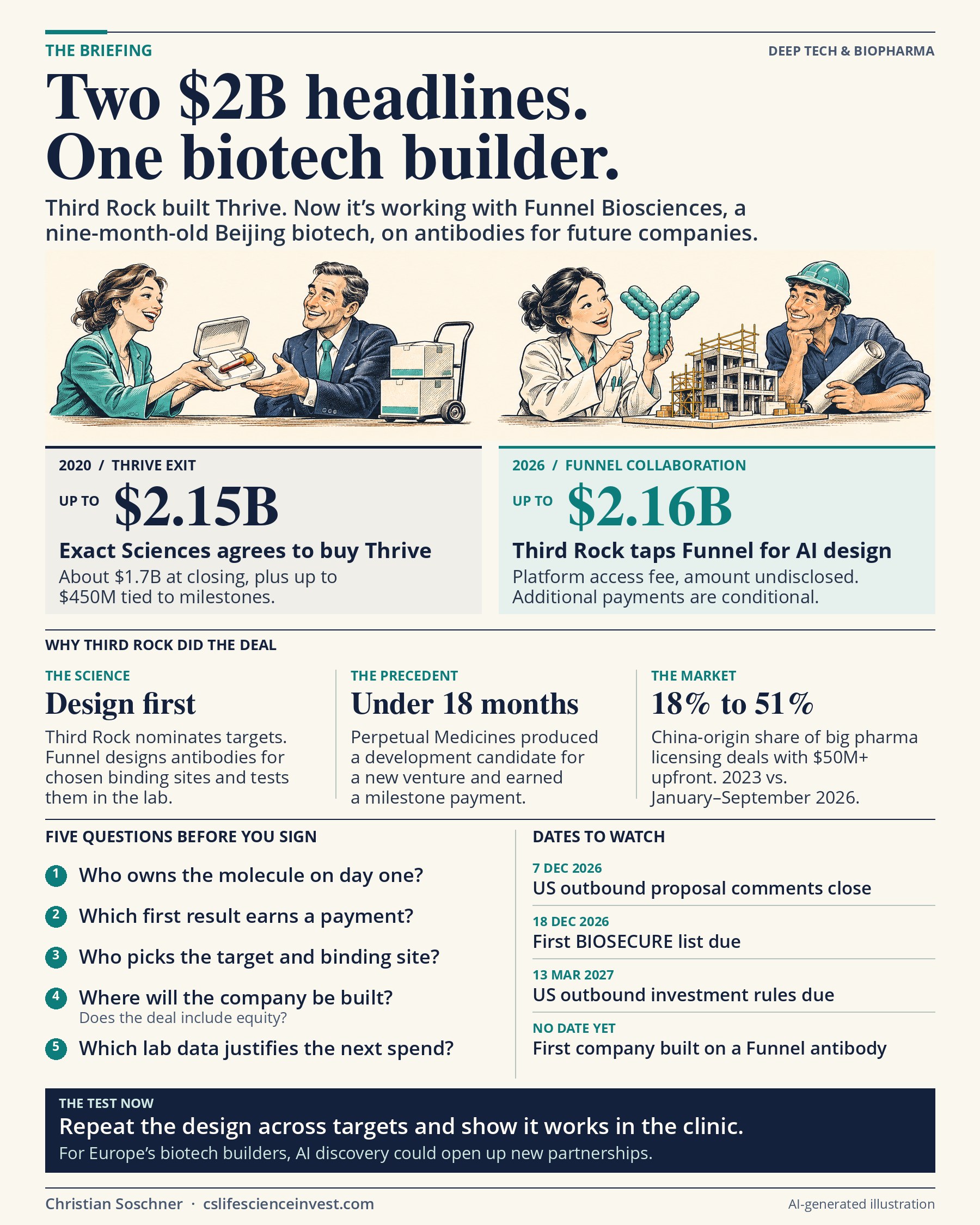
Third Rock Ventures sold one company for up to $2.15 billion in 2020. Last week a Beijing start-up announced a collaboration with the same firm worth up to $2.16 billion, for something much earlier: antibodies that new companies can be built on.
27 October 2020. Exact Sciences announced that it would buy Thrive Earlier Detection, a cancer blood test company that Third Rock Ventures had launched seventeen months before, for up to $2.15 billion.
6 November 2026. Funnel Biosciences, a Beijing company founded in February, announced a research collaboration with the same venture firm worth up to $2.16 billion.
The two numbers look like twins. The deals behind them run in opposite directions. In 2020, Third Rock’s company found a buyer. In 2026, Third Rock is securing the raw material for companies that do not exist yet. The timeline between those two dates explains why a venture firm put its name on a billion-dollar headline from China, a role usually played by pharma groups.
May 2019
Third Rock works differently from most venture firms. Creating companies in-house is its core model. Its partners come up with the company, build it and run it in the early years.
Christoph Lengauer, a Third Rock partner at the time, described the model on Beginner’s Mind. The firm invests in companies “that we ideate ourselves”. It spends, in his words, “on average about two million dollars” on the work before a company launches. Then its partners step into the key leadership roles for one to three years. “It’s like having training wheels on your bike,” he said, “and that gives it a more stable start.”
Thrive was built this way. The science came from Johns Hopkins, where Bert Vogelstein, Kenneth Kinzler and Nickolas Papadopoulos developed CancerSEEK, a blood test designed to find several cancers at an early stage. Thrive licensed the test from the university. Third Rock led a $110 million Series A on 30 May 2019. Steven Kafka, a Third Rock partner, became chief executive at launch. Christoph Lengauer became co-founder and chief innovation officer.
27 October 2020
Seventeen months later, Exact Sciences signed, and announced the deal the next morning. The terms: about $1.7 billion payable at closing, 65% in Exact shares and 35% in cash, plus up to $450 million more in cash, tied to milestones that Exact described as FDA approval and Medicare coverage and pricing. The deal closed on 5 January 2021.
Christoph explained the logic of the sale when he spoke with me on the show. Thrive had a test in development. Exact had the doctors, the sales force and the reimbursement experience to bring a test to millions of patients. “Exact provided that infrastructure,” he said. “We just cannot build this.”
His point about the money was just as clear: Thrive’s shareholders received the large part of the price at closing. “But there’s no biobucks in that,” was how he put it. The filing shows the proportions: $1.7 billion of the $2.15 billion was due at closing, and the rest depended on regulators and payers.
That detail matters for everything that follows.
February 2026
Nine months ago, in Beijing, Liu Jintan and Mingchen Chen founded Funnel Biosciences. Liu is a cancer researcher who previously worked at MSD in the US. Chen is a computational biophysicist who works on AI protein design. In China the company is known as Fangnuo.
Funnel’s idea starts where classic antibody discovery ends. The usual route immunises animals or screens large libraries, then runs rounds of screening and optimisation until a candidate binds well enough. Funnel reverses the order. It starts from a chosen binding site on the target, called an epitope. Its AI generates antibodies for that exact spot, and physics-based energy functions refine the fit between antibody and target.
The company reports picomolar affinity, a very tight grip on the target, without a separate lab step to improve binding. It also reports favourable developability and low immunogenicity on the first pass. These are Funnel’s own results, and Funnel validates its designs in the lab. Its founders describe the approach as combining “AI design with experimental validation”.
Why would that interest a company builder? Some of the most attractive targets in biology are hard to reach with classic methods. Funnel names complex membrane proteins as one application. Choosing the binding site first lets a team aim at the mechanism of the future drug from day one. Lab work then has to confirm how the candidate really acts.
June 2026
Third Rock had tested this kind of partnership before. In June, Perpetual Medicines, by then part of TandemAI, with teams in Boston and Shanghai, announced that its collaboration with Third Rock had produced a development candidate in under 18 months. Reaching that candidate triggered a milestone payment. The candidate went to a newly formed venture whose name stays confidential. Jigar Raythatha, a Third Rock partner, said the platform helped the team “navigate a challenging design space with remarkable precision”.
The Perpetual deal shows the pattern. A computational partner designs the molecule. A new company gets built around the result.
China is also familiar ground for Third Rock. In August 2024, Third Rock and Two River co-founded TRC 2004, a US company that licensed GB261, a bispecific antibody from China’s Genor Biopharma, for rights outside Greater China. That deal used the classic NewCo structure: shares in the new US company for Genor, an upfront payment in the tens of millions, up to $443 million in milestones and royalties.
Funnel moves the same sourcing decision one step earlier. TRC 2004 licensed a molecule that already existed. Funnel designs molecules for targets Third Rock nominates.
6 November 2026
Funnel’s announcement names two kinds of money. Funnel receives a platform access fee, whose amount has not been published. It is also eligible for “total potential economics of up to approximately US$2.16 billion”, subject to conditions in the contract. Fee timing, payment triggers and equity terms have not been published.
The fee is the fixed part. The rest is what the industry calls biobucks: payments that depend on conditions being met, usually programme milestones. Across the whole licensing market, J.P. Morgan’s latest data put disclosed upfront cash at 6% of announced deal value through the third quarter of 2026. Headline numbers are ceilings.
The size of the ceiling tells a second story. Third Rock’s largest fund to date, Fund VI, closed at $1.1 billion in 2022. Fund VII, filed in June, targets $750 million. A $2.16 billion ceiling is larger than any single Third Rock fund. My read: whatever is paid will come over many years, as programmes succeed, and much of it is likely to flow through the companies built on these antibodies.
Compare that with Thrive. In 2020, most of the price was paid at closing. In 2026, the announced terms combine a fee with payments that have to be earned first.
The case for the deal
Speed comes first. Perpetual went from concept to development candidate in under 18 months. If Funnel can design strong antibodies for chosen binding sites, Third Rock’s next companies start with a molecule instead of a search.
Structure comes second. The announced terms name a fee and potential payments. That matters in 2026, because both governments are writing new rules. On 22 October, the US Treasury proposed adding biotechnology to its outbound investment programme. The draft covers certain equity, joint-venture and fund investments, and Treasury’s guidance treats ordinary contracts differently from some arrangements that transfer technology or know-how. On 16 October, China published a draft catalogue of technologies under export control and started interim registration for listed technologies, including some licences abroad, with faster approval proposed for certain licences. The public Funnel terms are too brief to say how either draft applies. They do show a structure built around fees and milestones.
The market comes third. In my patent cliff report I followed the shift: China-origin assets made up 18% of big pharma licensing deals with at least $50 million upfront in 2023, and 51% from January to September 2026, with 65% of the upfront cash in those deals. Big pharma has been sourcing in China for three years. Third Rock now sources earlier in the chain, at the level of design.
Ahead of BIO-Europe in Cologne this week, the former Teva chief executive Jeremy Levin urged big venture funds to back young, science-based companies, with Europe’s early-stage funding gap in mind. Third Rock just backed one, in Beijing.
The case for patience
In nine months, the Funnel team built a platform that won one of the best known company builders in the US as a partner. The open questions are about conditions, and each of them can turn in Funnel’s favour.
A ceiling describes the maximum. A 2025 analysis by Recon Strategy of 229 preclinical licensing deals signed between 2010 and 2015 estimated that licensors realised less than 20% of total deal value within nine years, and only 5% to 7% where the target was novel or not named in the deal. Company builders model the probable value, and negotiate hard on the fixed fee and the first milestones.
First-pass binding in the lab is one step. The designed antibodies still have to work in animals and then in people. Perpetual’s candidate shows the speed for one molecule. Repeating it across several targets, and reaching the first clinical data, is the test still ahead.
The rules are drafts. Comments on the Treasury proposal close on 7 December 2026, and the law sets 13 March 2027 as the deadline for Treasury’s final regulations. Final texts can widen or narrow the space for licensing.
Executives also keep a measured view of AI. In BIO-Europe’s survey of 81 senior executives, including 50 chief executives, published in October, 22% said AI’s impact is currently overstated, and the largest gains so far came in back-office and operational work. At the same time, 57% expect AI to improve R&D productivity within the next 12 to 24 months.
If Funnel’s designs reach the clinic at the speed Perpetual showed, the upside is large for both sides: a new kind of discovery partner for Third Rock, and a reference deal for every AI design company in China.
What it means for company builders in Europe
Money in drug development is moving toward AI-designed molecules, in China and in the US. On 22 June, Insilico Medicine and South Korea’s SK Biopharmaceuticals announced an AI discovery collaboration with a potential value above $2.5 billion, and up to $18 million upfront and in near-term milestones. Funnel’s announcement followed four and a half months later. In BIO-Europe’s survey, executives in Europe named competition from Chinese assets among the barriers to closing deals, behind access to capital and valuation gaps.
Europe is moving too. On 10 November, at BIO-Europe in Cologne, France’s DeepLife and South Korea’s 3billion signed a co-development agreement that combines genomic data with DeepLife’s AI virtual-cell platform to find targets and design drug candidates.
I believe the company builders who put AI into their discovery work now will find partners faster, and those who wait will find the conversation harder each year. The tools exist. The partners exist. The capital is already following them.
Five questions help any company builder, from tech transfer to IPO, prepare for a deal of this kind:
- Who owns the molecule on the day it is designed? Agree it before the first design run.
- Which first result earns real cash? Perpetual’s development candidate triggered a payment within 18 months. Know which result pays enough to fund the next programme.
- Who picks the target and the binding site? That choice points the future drug at its mechanism.
- Where will the company be built, and does the deal include equity? In 2026 the answer decides which rules apply.
- Which lab data proves a design before the next budget is spent? Set the test before the first molecule arrives.
Dates to watch
- 7 December 2026: comments close on the US Treasury’s outbound investment proposal.
- 18 December 2026: deadline for the first US government list of biotechnology companies of concern under the BIOSECURE Act, which governs federal contracting and procurement.
- 13 March 2027: deadline set by law for Treasury’s final outbound investment regulations.
- No date yet: the first Third Rock company built on a Funnel antibody. When it launches, the $2.16 billion headline turns into a company with a name, a team and a first programme.
Your Next Move
Weighing a platform deal, a licence from China or the next step for your company? Start with one prepared hour on that decision.
See Your Next MoveQuick answers
- What did Third Rock Ventures and Funnel Biosciences agree?
- A research collaboration announced on 6 November 2026. Funnel applies its AI antibody platform to several targets that Third Rock nominates. Funnel receives a platform access fee, whose amount has not been published, and is eligible for potential payments of up to about $2.16 billion, subject to conditions in the contract.
- Who founded Funnel Biosciences?
- Liu Jintan, a cancer researcher who previously worked at MSD in the US, and Mingchen Chen, a computational biophysicist who works on AI protein design. The company was founded in Beijing in February 2026.
- How does Funnel design antibodies?
- It starts from a chosen binding site on the target, generates candidate antibodies with AI and refines the fit with physics-based energy functions. Funnel reports picomolar affinity without a separate lab step to improve binding, and it validates designs in the lab.
- Is the $2.16 billion paid upfront?
- No upfront payment figure was published. The fixed part is a platform access fee. The rest depends on conditions in the contract and would be paid over years, if programmes succeed.
- How does this compare with Thrive Earlier Detection?
- Exact Sciences agreed in October 2020 to buy Thrive, a Third Rock company developing a multicancer screening test, for up to $2.15 billion, with about $1.7 billion payable at closing. The Funnel collaboration pays for design work behind companies that have yet to be built.
Sources
Original post
Christian Soschner on LinkedIn, 11 November 2026: “Up to $2.15 billion in 2020. Up to $2.16 billion last week. Same venture firm. A very different bet.” The post this article grew from. Read the post
The Funnel and Third Rock collaboration
Funnel Biosciences announcement, 6 November 2026, via VCBeat. vcbeathealth.com
Endpoints News, 9 November 2026, on the deal. endpoints.news
pharmaphorum, 10 November 2026, on Funnel, its founders and the Perpetual Medicines precedent. pharmaphorum.com
Perpetual Medicines and Third Rock Ventures, 9 June 2026, Business Wire. businesswire.com
Genor Biopharma announcement on the GB261 licence to TRC 2004, 5 August 2024, HKEX. hkexnews.hk
Thrive and Exact Sciences
Thrive launches with a $110 million Series A, 30 May 2019, Business Wire. businesswire.com
Exact Sciences Form 8-K on the Thrive merger agreement, October 2020, SEC. sec.gov
Exact Sciences third-quarter 2020 call, on the $450 million milestones. roic.ai
Fierce Biotech, 27 October 2020, on the acquisition. fiercebiotech.com
Christoph Lengauer on Beginner’s Mind, the conversation quoted above. cslifescienceinvest.com
Third Rock Ventures funds
Third Rock Ventures raises $1.1 billion Fund VI, 15 June 2022, Business Wire. businesswire.com
Third Rock Ventures VII, L.P., Form D filing, June 2026. formds.com
Deal values and the market
J.P. Morgan, Q3 2026 Biopharma Licensing and Venture Report. jpmorgan.com
Axios, 19 October 2026, on upfront cash at 6% of announced deal value. axios.com
Recon Strategy, 2025, on the realised value of preclinical licensing deals. reconstrategy.com
Insilico Medicine and SK Biopharmaceuticals, 22 June 2026, PR Newswire. prnewswire.com
The $300bn pharma patent cliff: who fills the gap by 2030? Big Questions #2. cslifescienceinvest.com
The rules
US Treasury, 22 October 2026, proposed rule under the COINS Act. home.treasury.gov
US Treasury, Outbound Investment Security Program. home.treasury.gov
China’s Ministry of Commerce, spokesperson’s remarks on the draft catalogue of export-controlled technologies. english.mofcom.gov.cn
BIOSECURE Act timeline and the list of biotechnology companies of concern. congressonchina.com
BIO-Europe 2026
BIO-Europe C-Suite Survey, 7 October 2026, GlobeNewswire. globenewswire.com
BIOXconomy on the survey’s deal barriers in Europe. bioxconomy.com
BIO-Europe 2026 programme release with Jeremy Levin, 27 October 2026, GlobeNewswire. globenewswire.com
3billion and DeepLife co-development agreement, 10 November 2026. 3billion.io
This article is for information only and is not investment advice or a recommendation to buy or sell any security. The author may hold positions in the companies discussed.