The show › EP 180
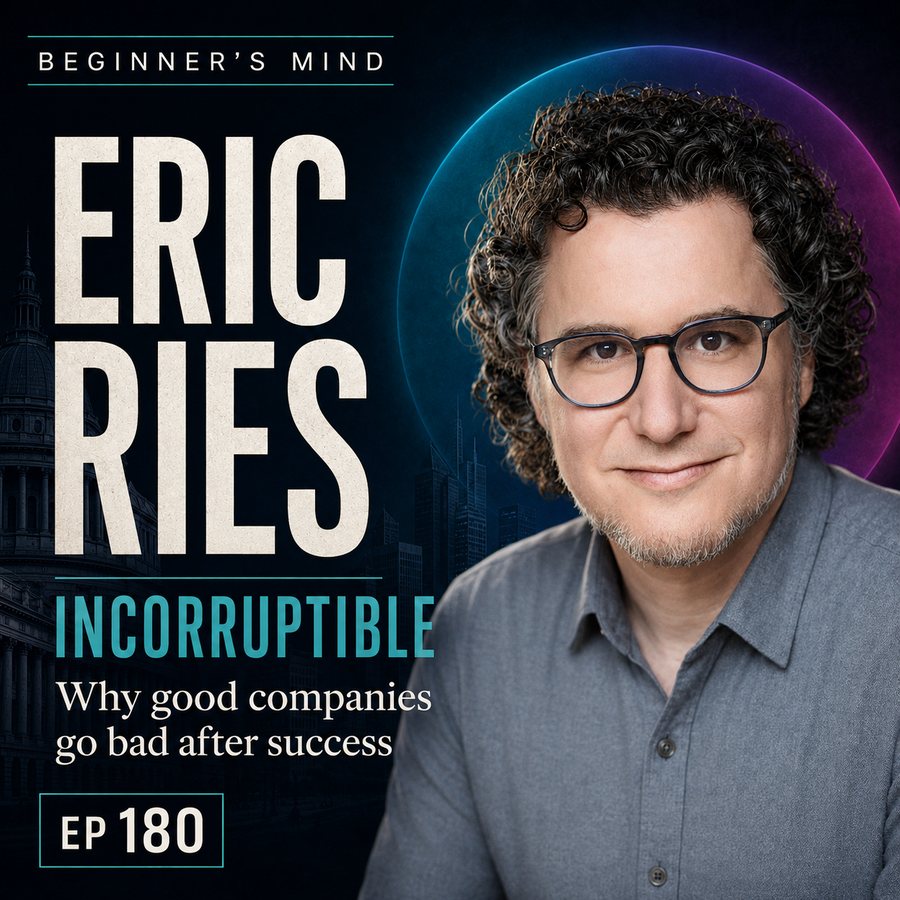
Why Good Companies Go Bad After Success
Eric Ries, author of The Lean Startup and Incorruptible, founder of the Long-Term Stock Exchange
About this conversation
What happens when the moment a company finally succeeds is the moment it becomes most likely to be destroyed? Most founders assume the market rewards the better product and protects what they built. The legal reality runs the other way. The dominant theory of the corporation treats a company as a financial instrument designed to enrich its shareholders, and treats everything else as optional.
That theory has a name, shareholder primacy, and nobody voted for it. It hardened in courtrooms and boardrooms about forty years ago. Founders sign it into their own charter on day one without reading the line, and by the time the gap between the mission statement and the legal purpose becomes visible, the exit has been engineered.
Eric Ries, founder of the Long-Term Stock Exchange and author of The Lean Startup, explains how corporate purpose disappeared out of the legal documents and what can be put back in its place. He shows why protection alone makes an extractive company worse, why independent directors are not neutral, and why a mission guardian belongs above the board rather than inside it.
Beginning with the pattern he watched destroy company after company, the conversation becomes a practical guide to governance: the three-legged stool of 19th century corporate law, what actually killed Sears, why Novo Nordisk, Patagonia, IKEA and Grundfos outlive their competitors, and how the Public Benefit Corporation restores something far older than it looks. It ends on the question neither of us could fully answer. If a guardian protects the mission, who guards the guardian?
Questions in this conversation
- 02:43 Why did Eric Ries write Incorruptible?
- 06:17 Does shareholder primacy really reduce a company to a financial instrument?
- 12:40 When did companies shift from creating value to extracting it?
- 24:19 Is Incorruptible a critique of capitalism?
- 28:08 Which companies keep their mission alive for generations?
- 36:50 How can a purpose-driven company protect its mission from the start?
- 43:14 Who is responsible for keeping a company’s mission alive?
- 49:44 What should you look for in a board director?
- 53:54 Who guards the mission guardians?
- 56:40 How will AI change the way companies are governed?
Watch the full conversation
Plays on click. Only then does the video load from YouTube (youtube-nocookie.com). Privacy
The questions, answered
Why did Eric Ries write Incorruptible?
He had watched too many good companies be destroyed by their own success, and he wanted to help people build great companies that last. His research led him to shareholder primacy, the legal theory that a company is only a financial instrument to enrich itself and its shareholders. Ries calls it an aberration from the historical norm, and one that nobody ever voted for.
“I’ve seen so many companies be destroyed and undone by their own success. And I got sick and tired of it.”
Eric Ries
Watch from 02:43 on YouTube · Listen from 02:43 on Buzzsprout
Does shareholder primacy really reduce a company to a financial instrument?
Yes, and Ries quotes the legal doctrine word for word in the book to prove it: a company may consider your health and well-being only insofar as that benefits its shareholders. Most of the time, he says, this destroys value in the long run. It also locks managers and investors into a prisoner’s dilemma in which whoever defects first makes the most money.
“If I stay in for the long term, I’m going to be the sucker at the table.”
Eric Ries
Watch from 06:17 on YouTube · Listen from 06:17 on Buzzsprout
When did companies shift from creating value to extracting it?
The problem is old and the shift is recent. Ries documents cases going back to 1800, yet most of the US court cases that established shareholder primacy date from the 1980s, after a century of growing financialization. In the 19th century, a company had to show the state legislature that its purpose served the public interest, and its directors acted as trustees of that purpose.
“And the point of institutions is to help correct these psychological mistakes.”
Eric Ries
Watch from 12:40 on YouTube · Listen from 12:40 on Buzzsprout
Is Incorruptible a critique of capitalism?
Ries points out that the word capitalism hardly appears in the book. He lays out the facts, and readers split: some read a scathing critique, younger readers a defense of capitalism. His example is Sears, which an insider drained long before disruption finished it. On his book tour, nobody can name a favorite brand that got better after an acquisition or a private equity takeover.
“One very young reader told me, this is the first book I’ve ever read that defends capitalism.”
Eric Ries
Watch from 24:19 on YouTube · Listen from 24:19 on Buzzsprout
Which companies keep their mission alive for generations?
Ries names Novo Nordisk, Costco, Patagonia, the John Lewis Partnership, Vanguard, IKEA and Hershey. Their cultures and values differ widely. What they share is a structure that breaks today’s best practice, such as the industrial foundation at Novo Nordisk, where a nonprofit foundation acts as mission guardian over a publicly traded company. Modern finance theory predicts that such companies would fail, and they have been around a long time.
“So my question in this book is, what is the organizational equivalent of stainless steel?”
Eric Ries
Watch from 28:08 on YouTube · Listen from 28:08 on Buzzsprout
How can a purpose-driven company protect its mission from the start?
By writing the purpose into the legal charter. Ries tells the story of a CEO who signed the standard documents and later watched his mission statement and his company’s legal purpose drift apart. His way back was the Public Benefit Corporation, available in Delaware and, Ries believes, 44 US states, which lets the charter name a public benefit beyond maximizing shareholder value. Ries sees it as a return to the purposeful incorporation of the 19th century.
“He actually read his own corporate charter, which is very unusual.”
Eric Ries
Watch from 36:50 on YouTube · Listen from 36:50 on Buzzsprout
Who is responsible for keeping a company’s mission alive?
A mission guardian: a person or body whose job is to look after the mission, with careers inside the company tied to its success. Without one, Ries says, the mission stays words on paper, and the incentives decide what actually happens. In the strongest structures he has seen, the mission guardians appoint the board of directors.
“If the organization does not have what I call a mission guardian, somebody whose job it is to look after the mission, it won’t happen.”
Eric Ries
Watch from 43:14 on YouTube · Listen from 43:14 on Buzzsprout
What should you look for in a board director?
Accountability to the mission, which Ries ranks above any personality trait. He questions the current practice of filling boards with independent directors: indifference is the wrong quality in a mission guardian, and directors without a stake in the company still follow incentives, usually loyalty to the financial system that hands out board seats. He looks for people whose reputation or position depends on the mission succeeding.
“It just means somebody else does the incentivizing.”
Eric Ries
Watch from 49:44 on YouTube · Listen from 49:44 on Buzzsprout
Who guards the mission guardians?
Every position of power has a succession problem, and organizations solve it in different ways. Patagonia’s perpetual purpose trust adds a mission protector who keeps the guardians accountable. At Grundfos, a foundation board of twelve, with four family members, four long-serving executives and four outside business experts, elects its own successors, and the evidence suggests this works because stewardship is their one job. Ries calls an emperor for life at the top the worst solution.
“Human beings, I think, have an innate understanding of what it means to be a steward of a thing.”
Eric Ries
Watch from 53:54 on YouTube · Listen from 53:54 on Buzzsprout
How will AI change the way companies are governed?
Ries is worried about the way many companies rush to adopt AI, and he also sees a tool for mission guardians. Their hardest problem is span of control: knowing what really happens inside a large company. Large language models are excellent at summarizing, and a constitutional agent that checks whether a company stays true to its mission could make directors and leaders far more effective.
“The really nice thing about LLMs, the thing that they are best at in the world, as far as I can tell, is summarizing.”
Eric Ries
Watch from 56:40 on YouTube · Listen from 56:40 on Buzzsprout
Best quotes
“A company is just a financial instrument, designed to enrich itself and its shareholders.”
“If you go to your local park, you'll find trees older than shareholder primacy.”
“Somebody took over Sears and managed to extract for himself $1.5 billion, at a time when the company lost $11 billion.”
“Who would you rather die than betray?”
“Being a leader is much more like being a mother than a slave owner. We birth these things. We do not own them.”
“It's turtles all the way down. Every time we have any kind of role of power, we have a succession problem.”
Clips
Short moments from the conversation.
What happened at Sears?
Plays on click. Only then does the video load from YouTube (youtube-nocookie.com). Privacy
Show notes
Click a timestamp to listen from that moment on Buzzsprout.
- 00:00Why Good Companies Go Bad After Success
- 02:43What Made Eric Ries Write Incorruptible
- 04:10A Company Is Just a Financial Instrument
- 07:03The Pill You Swallow and the Shareholder Calculation
- 15:48The Three-Legged Stool of Corporate Law
- 19:31How "Any Lawful Act or Activity" Erased Purpose
- 25:28What Actually Happened to Sears
- 30:38Stainless Steel for Organizations That Last
- 34:39Why Foundation-Owned Companies Outlive the Rest
- 37:59The Public Benefit Corporation Explained
- 44:40Why Every Company Needs a Mission Guardian
- 50:22Why Independent Directors Are Not Neutral
- 53:11Who Guards the Mission Guardian
- 56:18What AI Changes for Governance
- 59:58Closing Thoughts
Links mentioned
- Incorruptible: Why Good Companies Go Bad and How Great Companies Stay GreatEric's new book
- Incorruptible communityWhere Eric suggests founders get in touch
- Eric's mailing listUpdates from Eric
- Long-Term Stock ExchangeThe exchange Eric founded
- The Lean StartupEric's first book
Companies named in the conversation: Novo Nordisk and Novo Holdings, Grundfos, Carl Zeiss, Patagonia, IKEA, Anthropic, Sears.
Full transcript
Christian Soschner00:00
Success can destroy a company before failure ever gets a chance. This recording asks why strong products, trusted brands, and principled founders become vulnerable once serious money arrives.
Eric Ries00:14
So I have lived through this devastation over and over and over again.
Christian Soschner00:20
The common explanation for why companies fail is very often greed. Eric Ries, the speaker on this episode, argues that the deeper problem is structural. Corporate purpose disappeared from legal documents. Shareholder value took its place. Boards learned to treat the company's sale as an auction, even when the product, employees, or mission paid the price.
Eric Ries, from the conversation: You are betting your life that I have calculated that keeping you alive after you…
And that calculation becomes urgent in healthcare, artificial intelligence, and every field where a company asks society for trust. The answer is not another mission statement. Eric names specific structures, including public benefit corporations, industrial foundations, purpose trusts, and mission guardians with real appointment power.
Eric Ries, from the conversation: Because of the vast financial resources of the new acquirer of the product.
Eric is the founder of the Long-Term Stock Exchange, the creator of the Lean Startup method, and the author of Incorruptible. I wanted to understand what makes a company worthy of long-term trust, who should guard its purpose, and what happens when the guardian fails. This is a conversation about how good companies go bad and how founders can build differently before pressure arrives.
It's really good to see you, Eric. I love your books. I read The Lean Startup years ago, and it's fantastic. I heard from friends that it's still used here in Europe in MBA programs.
Eric Ries: Yeah, absolutely. They love it. They love it.
I spoke with them about the chance to have a conversation with you, and they immediately brought it up and said, "Hey, this is still in our MBA program, a must-read for everybody starting a company."
I'm in the pharma industry and work with biotechs. And when your team sent me the manuscript, it was really amazing. At first I thought, a book about governance, okay, it's like a finance book, so it must be pretty boring. But you really nailed it right at the start. You named the problem in companies, which I have experienced so often in the last 25 years: that there is something deeper going on. Companies become successful and then suddenly it breaks. What motivated you to write the book Incorruptible?
Eric Ries02:43
Gosh, what motivated me? Yeah, this comes from my personal experience. I have lived through this devastation over and over and over again. I've seen so many companies be destroyed and undone by their own success. And I got sick and tired of it. It's really very straightforward if you think about it. I've been trying to help people create great companies for a long time.
And if you ask most people, what is a great company? What does that mean? People don't find that question hard at all. They're like, oh, it's a company that has tremendous success. Is it any kind of success? No, no, no, no, no. A great company competes in the marketplace by making its product better, not worse. It's eager to create value, more value than it captures. It takes care of its customers, it takes care of its employees, it takes care of its shareholders, because its success is powered by some ethos, some philosophy about business that is consistent over time.
And I think that's a very naive view. I used to have that view too. Isn't that what we all want? Well, it turns out that no, there are a lot of people who think that view is silly. They would even go so far as to say that a company is not even about that. Like, that's an incidental part of what it means to be a company. What is a company? A company is just a financial instrument designed to enrich itself and its shareholders. That's all.
And if it makes a product worse, but it gets away with it, if it treats its employees badly, but it gets away with it, if it finds ways to compete in the marketplace not by trying to create value, but by trying to steal it, extract it, trick people, regulatory capture, crony capitalism, then any way of making money is equally good. This idea is called shareholder primacy, and it is the dominant legal theory of the corporation in the world today. Isn't that wild? We're so used to it now that we're like, oh, I guess that's just how it is. But it's actually completely crazy.
Most people don't agree with this. They think it's terrible. And they say, "Well, when did we vote for this? I don't remember enacting this." No, it was never voted on, ever, in the history of the world. So this is like a trick that's been played, not just on founders, not just on board members, but on all of us as citizens, as employees, as customers, as investors. We've been tricked into thinking this is a pillar of capitalism when in fact it is an aberration from the historical norm.
So I didn't know all that when I started getting into this idea, started writing the book, doing the research. I really was like, look, I see this phenomenon. I want to help people avoid it. To me, it's a straightforward extension of what I've been trying to do this whole time: help people create great companies. But I think this naivete is antithetical to building a great company. You just can't do it unless you are really willing to grapple with these forces and protect yourself from them.
Show the full transcript
Christian Soschner05:46
That's an interesting view of companies. I'm probably one of the naive people that you mentioned. I always thought it's a core function of the company to guarantee survival, and didn't see it as detrimental to the success of the company, and always thought we also have other functions. Does your data really confirm that this has reduced every company to one financial function, to a financial instrument that extracts value from society and redistributes it to shareholders?
Eric Ries06:17
Again, I know this sounds unbelievable. So I want to recognize that it seems like too much, but I am not exaggerating. And I felt that in order to make this credible, I was gonna have to be extremely careful. So if you look in the book, I'm very careful not to paraphrase. I quote the actual legal doctrines and theories.
So the people who advocate for shareholder primacy literally say things like this: a company is only permitted to consider externalities, meaning you, your health and well-being, is an externality, insofar as it benefits its shareholders economically. And think about what that means. I make a pill. I'm a healthcare company, I make a pill. I ask you to swallow it. You are betting your life that I have calculated that keeping you alive after you swallow this pill is better for my shareholders than the alternative.
And some people say, well, of course it is. What a scandal it would be if somebody died. But I tell a lot of stories in the book of companies that faced that choice and chose the scandal. And some of them got away with it for quite a long time. So were they wrong to choose it? Not according to the theory of shareholder primacy, but according to any kind of moral or common sense logic, they were wrong.
First of all, because it's evil to do that. I document a lot of situations in which the people who were asked to make this decision suffered what I call moral injury. That's a term that we have in the psychology literature for people who are forced or coerced to do something that goes against their own conscience. But secondly, most of the time that this is done, the result is value destroying. Eventually, in the long run, this is not the path of value creation.
Now, most managers these days, and frankly, most shareholders, have calculated that they can get in, do the deed, and get out before the value destruction comes. And they're often right. But what this does is it locks everybody, managers and investors alike, into a prisoner's dilemma. Whoever defects first makes the most money. If I stay in for the long term, I'm going to be the sucker at the table. So it's creating these second and third order effects that are just absolutely wild. And again, it takes our economic system away from value creation.
And what's hilarious to me is that if you criticize our financial system, its rabid defenders will rush at you. And there are basically two stories of our financial system that are in competition. One is the story I told before about what makes a great company: competition on the basis of product innovation and quality, the innovation story of the economy. But there's this other story, the financial extraction story. It's really just about everyone being dog eat dog, doing what you can to make as much money as possible by whatever means necessary. The weak are devoured by the strong.
And when you talk about what should be allowed to happen, people really like story two. They're like, everything should be allowed. Any encroachment on our freedom as leaders is tantamount to communism. But if you question them and say, well, okay, given that you have absolute freedom to do whatever you want, shouldn't you be morally accountable for your choices? They're like, oh, no, no, no, you don't understand. In order to get the beautiful product innovation that you so crave, it has to be this way.
See, when we need to justify our economic system morally, we always retreat to story one, the innovation story. I call it the moral bedrock of our economic system, because when you start digging down through the justifications and the layers and the BS and whatnot, you eventually slam into the bedrock of this simple moral calculus. So long as companies are competing for voluntary, uncoerced, quality transactions, that is, transactions that leave both parties better off, so long as that is the basis of competition, then whenever a transaction occurs, we know that it is value creating. Net new value is created. Therefore, the world is better off.
So this "create more value than you capture" is core to the story of our economic logic. But those same people will use that as the moral justification, and then if you say, okay, therefore, shouldn't we stop doing these other things that break that formula? For example, the moral logic requires an uncoerced, fully informed transaction. So shouldn't we do everything we can to eliminate misinformed transactions? Oh, encroachment, encroachment on our freedom. It's totally circular.
So all I'm asking is that we take the moral logic of our own economic system seriously, as our grandparents and great-grandparents did, and build companies and organizations, and eventually, I hope, regulatory systems and civic systems that have fidelity to those ideas. And you wouldn't believe how simple this is, how common sense it seems to most people, and yet how radical it is. Because the people who have formalized these rules, the so-called governance class of our society, have absolutely lost the plot.
Christian Soschner11:35
That's very interesting. I grew up in the 70s and 80s and went to commercial school and university back then, and my understanding of the economy and companies was basically what you describe. First, a company serves its customers and finds where it creates value. The transaction, of course, is financial. At the end of the day, a company also needs to survive and improve its quality, but it then reinvests the capital into being better at providing a service or a product to its customers.
And when I look at the public markets, I see it in Nvidia and Tesla, for example. Those are, for me, the examples where I say, okay, they seem to be healthy at the end of the day. And I always knew there were also some other ideas, corrupt people, people who try to extract value, but I always thought it's a minor part of society that you can never rule out.
When I listen to your words, it now feels to me that in 2026 you see a different economy globally, where value extraction has grown from a minor part into a major part. In your opinion, when did it change?
Eric Ries12:40
You've got to avoid reductive stories about these things, because in this history, two things can be true at the same time. On the one hand, this is a very old problem. I document this specific turn that companies go through going back more than 200 years. I think the earliest case study in the book is from 1800. So it's been going on a long time. This fallacy that we make as leaders, as entrepreneurs, where we assume that the market rewards value creation and will therefore protect what we've created when we create a true innovation: people have been making that mistake a long time.
It's an example of the simple Aesop's fable of the goose that laid the golden egg. We're just reenacting that story over and over again. There's a reason that story is thousands of years old. There's a reason why human beings have been telling it for such a long time. There is something in human nature that makes us make this mistake very regularly. And the point of institutions is to help correct these psychological mistakes. That's what they're for. So again, I think it's very sad to see this as an inevitability.
That said, it's been going on a long time, but it is getting worse and worse and worse and worse. Why? In the book, I trace the history. A lot of this has to do with the rise of financialization over the course of the 20th century. The idea of shareholder primacy is the main intellectual villain of the story, of course, but it's a late arrival on the scene. What's wild is that if you go to your local park, you'll find trees older than shareholder primacy. Most of the key court cases that established it in the United States happened in the 1980s.
So how can both things be true? How can this be a late arrival and yet be the culmination of this degradation? The answer has to do with how humanity has seen the joint stock corporation from a philosophical perspective. For the majority of the hundreds of years we've had joint stock corporations, most people who looked at this problem viewed it as completely obvious that corporations should only be incorporated to do a specific thing. Make a railroad, dig a canal, provide fire insurance: do a thing. And they also believed that that thing had to be in the public interest.
So, for example, in the 19th century, if you wanted to incorporate a new company, you had to go to your local state legislature and get permission. And in your filing and your application, you had to say why what you were doing was in the public interest. And when companies deviated from that public interest charter, it was considered a great scandal. Of course, it did happen. We know the era of the robber barons and all that. Of course, people will try to evade these restrictions.
But society viewed a deviation from this idea of creating more value than you capture as a form of corruption. They couldn't always figure out how to legislate it or make it illegal. There were policy issues that they had to grapple with, but the culture understood that corporations exist to make the world a better place. Corporations that simply try to enrich themselves are dangerous. They're like a cancer on our economy.
Okay. So this was fine. In the 19th century, this worked okay. We had a three-legged stool. First, this thing I was talking about, what I call beneficial or purposeful incorporation. Second, you then have to ask: okay, well, what are the duties of the corporation then? If you've been incorporated to dig a canal or to build a railroad, what is the relationship of the board of directors to the corporation?
The second leg of the stool drew on the common law tradition of trust law. The conception was that directors are trustees of the corporation. If you've ever been a trustee, or you know someone who's been in an inheritance situation, a trustee has a very particular kind of mandate. A trustee preserves and protects the thing that they are the steward of. So the directors were seen as stewards of the mission of the company. They were there to preserve and protect. That's the second leg of the stool.
But when shareholders enter the picture, it gets complicated. The shareholders are giving their money for a specific purpose, and the board also has an obligation to the shareholders. The 19th century solution, the third leg of the stool, drew on the common law tradition of agency law. In agency law, if you are my agent, then I expect you to do your best for me, right? So that's a very different relationship than a trustee. An agent is a maximizer.
So the courts and the legal scholars of the 19th century carved this out very narrowly. First of all, this was the tertiary responsibility. This is the third leg of the stool. And they said that fundamentally, the agents have a negative duty. The trustee has a positive duty to do as much of the mission of the company as possible. The agent is there to make sure that the investors' interests are represented, to prevent fraud. The overwhelming concern was: if I give you money to create a railroad and you decide to go do something else with that money, that's a violation of our contract, of your responsibility.
So that was the three-legged stool: purposeful incorporation, the trustee duty, and the agency duty. This worked over the course of the 19th century, but it had a pretty major problem. I'm sure some people listening have already figured it out. Going to your local state legislature to get your company approved was a disaster. It was fine in the 18th century, when there just weren't very many corporations, but industrialization brought lots of innovation and new products to market, and people were creating companies left and right. And so legislatures became the choke point, and there was cronyism and corruption there.
I tell a bunch of funny stories in the book, some of these hilarious stories where both sides of some corporate dispute would go to the state legislature and start bribing legislators. And the state legislators would take bribes from both sides. They'd be like, "Great, we're open for business," and they'd just suck in the bribes, and then they'd vote with one side or the other, depending on who bribed them the most. It was absurd.
So this caused a lot of scandals. Of course, there was a reform. The reformers worked on an idea they called general incorporation, which was the idea that anyone should be allowed to incorporate a company without needing special permission. This was a big fight, statehouse by statehouse, over the course of the 19th century here in the U.S. It didn't come to Delaware in its current modern form until 1899. So this is not ancient history.
Anyway, in 1899, Delaware adopts a new corporate law that says anyone can create a company for basically any reason. But note that they still believed companies had to be incorporated for a reason. If you look at the statute, it says that in order to incorporate a company, you need three people, a president, a secretary and a treasurer, and you need to say what the purpose of the company is. So you would file that with the state of Delaware, and the courts tried to keep this three-legged stool going.
But over the course of the 20th century, lawyers started to advise their clients that in your corporate documents, where it says what the purpose of your company is, you can just write down this special phrase. The special phrase is "any lawful act or activity." So whereas you used to say, "I'm going to incorporate a company to make a railroad," if you look at all modern companies, their charter says the ACME Corporation is hereby incorporated. It's like a Mad Lib. There's a blank line, you fill in the line, and the line says "any lawful act or activity."
And this seemed like a great improvement. Now we're moving away from purposeful incorporation and giving managers maximum latitude. But there was a hidden problem. The problem is that now, when people have a dispute over what is allowed to be done, they can't resolve the dispute, because it's like having a constitution that says anything goes. So over the course of the 20th century, the courts are increasingly asked to weigh in again and again and again and again. What are managers allowed to do and not do? All this stuff.
At the same time that this is happening, financialization is underway. Investors are becoming the new dominant class in society. What our grandparents saw as separate spheres of influence, the political sphere, the civic sphere, the social sphere, the entertainment sphere, the sports sphere, are collapsing into the modern world we have today, where we have only one sphere. Money is politics, is power, is celebrity, is money. It's all just one thing. And we now assume that investors will get to do whatever they want. They can buy their way into any sphere because they have the money. Again, our grandparents would have seen that as a very corrupt way of looking at it.
So as this happens, the courts find it very convenient. And a lot of directors and investors and legal academics, and people being funded by the very people this was going to benefit, find it very convenient to simplify these corporate disputes. They say, "Listen, actually…" And again, this sounds like I'm making this up, but you can read the legal papers to see that I'm telling you the truth. They say, "Actually, when it says 'any lawful act or activity,' that means maximize shareholder value. I know it doesn't literally say that, but that's what it means. Everyone agrees that that's what it means."
And they formed what they called a normative consensus. Not through an act of legislature: general incorporation was a big battle, statehouse by statehouse, but this was done in the back rooms and in the courts. This was done at legal conferences and in boardrooms, very quietly, very simply. The purpose of a corporation is just to enrich its shareholders. That's our new mantra. That simplifies decision making.
It basically drops out two of the three legs of the stool. The purposeful incorporation leg is obliterated. It's replaced with shareholder primacy. The trustee duty is narrowed to compliance. So long as the directors make sure the company complies with any applicable rules and regulations, they have fulfilled their trustee duty. There's no mission for them to defend as trustees. And the agency duty expands. What was before a negative duty to protect investors from fraud is now an absolute positive duty to maximize their returns.
Again, I quote so many theorists in this book to make sure people really understand that I am not making this up. They literally say managers not only can but should break the rules if it is profitable to do so. In the Revlon ruling in the Delaware Chancery Court, they say that in the case where someone tries to buy your company, the role of the directors changes: they become auctioneers, there to get the highest price for the shareholders. This is their legal duty, and they started to see it as an ethical or moral obligation. This was done 40 years ago, not 400 years ago. And it's been an absolute, unmitigated disaster ever since.
Christian Soschner23:28
Your thesis is that the companies we currently see on public markets have put creating shareholder value at the top of their list and direct practically all their activities toward maximizing it, while all the other virtues we saw, and still see, in companies, like creating value for customers, are secondary in decision-making. Yes. Okay.
And when you play it through in your mind as a worst-case scenario, this nudges the entire economy, not just a single company, toward becoming an extractive economy that pulls out capital at scale and redistributes it to very few people at the end of the day. Is this your perception?
Eric Ries24:19
I think it's unequivocally true. Which part is even up for debate at this point? I think if you ask people to defend this state of affairs, they either have to deny the facts… I've had quite a few people who read the book give me feedback and say, look, this seems like a scathing critique of capitalism. It's interesting that you see it that way, because the word capitalism hardly appears. All I do is lay out the facts of what is happening according to the research, and you perceive it as a critique. Isn't that interesting?
By the way, younger readers perceive it as a defense of capitalism. One very young reader told me, this is the first book I've ever read that defends capitalism. So I think the fact that people have had this polarized reaction to it tells you a lot about what's going on in our world today.
Anyway, I think this is unequivocally clear. So people who deny this either have to deny the facts, or they have to make this very convoluted argument to explain away all the extractive behavior we see with our naked eyes. And I give dozens of examples in the book. This is not some weird thing. Think of a retailer like Sears. People ask, whatever happened to Sears? I'll tell you what happened to Sears.
People say it must have been technological disruption. Yes, at the end, the final illness was, of course, the disruption, but it had an autoimmune disorder before that. It was taken over by a parasite. Somebody took over Sears and managed to extract $1.5 billion for himself at a time when the company lost $11 billion. So this was not a natural act of creative destruction. This was an unnatural failure, a failure that was engineered to the benefit of an insider. And we see that across the board.
As I go around on my book tour, I have been asking people: tell me a story about a time that a favorite company or brand of yours got a lot more money, either because it went public, got acquired by a public company, or got taken over by private equity. I've been asking the crowd, does anyone have a story where that happened? Has anyone had that happen to them? Everyone raises their hand. Everyone's had this happen to them now. Okay. Does anyone have a story where, because of the vast financial resources of the new acquirer, the product got better? The food got tastier, the restaurant service improved? No one has a story like that. Every story is a story of devastation. Every story.
The most recent one I heard was about a tortilla company. I was like, oh, what? Yeah, there's this tortilla company that just got taken over, and now the tortillas are disgusting. I said, I can't believe people could get so worked up over tortillas. Oh, my friend, you don't understand. And what's funny is that every one of these brands has a subreddit. You go on Reddit, and you can read post after post after post of people saying, what happened to my favorite brand? It's been destroyed.
It's gotten to the point where, when people see a brand they admire, they often say things like this. Someone said to me the other day, I really hope they're successful. And then, no, actually, I hope they're successful enough to make money, but not successful enough to be acquired. That's our wish. That's our modern-day wish: may you not be so successful as to be acquired. Because we all understand that in an exit, we're often talking about the exit of the company's values, the exit of the product's quality, what Cory Doctorow calls enshittification.
Christian Soschner27:39
That's an interesting perspective. That's a very interesting perspective. I think it has changed a little in the last 50 years. With my priming, I still assume that we are back in the 70s and 80s, and you obviously did your homework very well, which I admire.
What are the positive examples? I understand your criticism of the current system, but is there a company that stands out for you, where you say they do it right, they are on the right path?
Eric Ries28:08
Okay, this is a very tricky question to answer, and I'll try to do it, because we live in a very polarized age. Okay. And as a business author, polarization is a bit of a problem, because I've noticed that if I praise any company, people think I'm saying that it's perfect, God's gift to humanity. And people consider it a gotcha if any company I praise ever does anything bad: see! Or if I say something negative about a company and it ever does anything good: see, a gotcha. It's like, no. So I don't say that companies are perfect, and I would never say that any company is doing everything right. That's too much.
But here's what I will say. Ask most people, normal people, civilians, not people in the business like us: why does this happen? Why is there this corruption everywhere in our economy? They will often say that it's inevitable. They'll say, well, what do you expect? There's so much money involved, it's human nature. Investors are this, people are greedy, public pressures, quarterly returns, whatever. There'll be a just-so story, a cultural story. You know how Americans are. What do you expect? The Americanization of our economy, I hear that all the time now. People have a just-so story about why it's the way it is.
The problem with this theory is that if it were inevitable, there would be no exceptions. And yet there are exceptions. Now, when I say they're an exception, I don't mean that they're perfect, only that they seem to have been able to achieve surprising mission longevity in situations and economic circumstances that others have succumbed to. It's as if there are certain bridges that collapse and others that don't.
And say you ask an engineer, hey, I've got this bridge that collapsed, could you come help me out? Oh, yeah, sure. He comes over, looks at your bridge, and says, I see what happened here. Gravity. You're going to be annoyed. Dude, that is not a very helpful explanation. Of course there's gravity. And he's like, what? That's why it fell down. Gravity pulled it down. And you're like, I know. But if gravity is the reason it fell, how come that bridge didn't fall? Oh, I see, I see, I see. Well, let's look a little closer. Oh, see, all the metal parts, the bolts, the bars, they've all corroded. That's your problem.
Would we then say, oh, I guess it's impossible to build a bridge? No. We'd say, why don't we build the next bridge with stainless steel? Why don't we study those bridges to see why they're still up? So my question in this book is, what is the organizational equivalent of stainless steel? What are the materials and structures we can build companies out of that seem to create the architecture of institutional longevity?
And when you look at it through that lens, you find these companies all over the place. Novo Nordisk or Costco, Patagonia, John Lewis Partnership, Vanguard. They've been around a long time, these companies. Why? IKEA. Look at these companies and ask, what do they have in common? Why has Hershey chocolate endured while Cadbury was destroyed? Why?
If you look at these companies, you'll notice that they all have one thing in common. It's not culture or values. They have very different values. Think about Costco versus Novo Nordisk, right? They couldn't be more different. It's not that they have similar cultures. One is Danish, one is American. They come from different time periods. They're very different. They have very little in common. But what they have in common is that they violate our modern ideas, our modern best practices, about how companies should be structured.
And this is really interesting because, again, people say, well, all right, maybe this is selection bias. You're just cherry-picking examples of companies that have made it and asking what they have in common. But that's not the point of this exercise. Because, yes, at the end of the day, people have to be able to reason for themselves about what makes sense in their circumstances, and just sampling won't get it done. The point is that our modern finance theory predicts that these companies would fail, that they are impossible, because they would be at a tremendous competitive disadvantage.
I remember the first time I met a company that has what's called the industrial foundation structure. This is the structure Novo Nordisk has, where a nonprofit foundation acts as the mission guardian, overseeing a for-profit subsidiary. Novo Nordisk is a publicly traded company, but it still has a nonprofit mission guardian. I met a company in Denmark called Grundfos that makes most of the water pumps in the world. I was doing a Lean Startup workshop for them, meeting with their CEO and all their top executives.
And I was asking them questions in the Q&A: hey, I want to learn a little bit more about your company. And they explained, we have this structure. And I thought, oh, I'm so sorry. That must be really hard for you. And they said, what are you talking about? I said, well, you're run by a nonprofit. I guess you can't compete on a global scale. I guess you won't be able to raise money from investors. You won't have the discipline of the market to help you be more efficient. You probably have a lot of virtue-signaling nonsense, because nonprofit people have no profit motive.
I was just spouting off what most of us have internalized as the facts. We treat these like they're facts: we must have these things to create a globally competitive enterprise. And they just laughed at me, because I had just said the dumbest thing they'd ever heard. Like, you've got to be kidding me. We wouldn't trade this structure for the so-called best practices for any amount of money. And that's really wild. How can these be the best practices if these violators are everywhere?
When I'm advocating for startups to do this, most investors, most accountants, most lawyers, all these experts look at it and say, that sounds completely unworkable. What is this newfangled thing Eric is advocating for? And I'm like, with all respect, the German optics company Zeiss had this structure in 1887. It's not exactly new. And there are so many of these companies that there are academics who study them for a living.
And guess what they've found? Companies with this structure are five times more likely to live to year 50 compared to regular companies. Again, I'm not saying that companies with this structure are magically perfect, only that they have, on average, exceptional longevity and exceptional financial performance. That should not be true. If all the theories that support shareholder primacy were true, these companies would all collapse. Why haven't they? That's what we have to grapple with.
Christian Soschner35:16
Why haven't they? In my opinion, it's because, at the end of the day, they focus more on customer value than on shareholder value, and of course because they found a good balance. I like the example of Novo Holdings. My business network is basically from the pharma industry, and I'm very used to getting backlash when I say pharma, because there's always this idea that it's evil. So I understand this notion that the industry is evil. Some people think that.
And I understand your point that, at the end of the day, it's a fight: is the company and its management staying on the side of virtue, or are they starting to gravitate toward becoming an extractive entity that just maximizes shareholder value, then winds the organization down and moves on to play the same game with the next thing?
A question about how you advise startups, because everybody I have met in the startup world, in my opinion, tries to be a virtuous company, tries to maximize customer value, and doesn't think so much about shareholder value initially. They play around, they find their product or service, they find their first customers, they keep going, and suddenly it becomes a complete mess because many, many more shareholders come on board.
What advice do you give them to protect their purpose, to put it first in their company? To say: we are a purpose-driven company, we want to protect that, and everybody who comes on board has to work under this top premise. Of course, we need to survive financially, but that is not our driving force. How can they set it up so that it really works long term?
Eric Ries36:50
It's interesting. I don't have his permission to tell the story publicly, so I'll be a little vague about the CEO in question. But I met a CEO who really embodies what you're talking about. He was very mission-oriented, very principled. But when he started the company, it was kind of an experiment. He said, "I don't really know if it's going to work." He didn't really think of himself as an entrepreneur. He thought, "I'm just going to try this thing, and we'll see how it goes."
When he incorporated the company, his lawyers said, "Look, just do the standard thing." And he asked, "Well, what is the standard thing?" He actually read his own corporate charter, which is very unusual. And he said, "This doesn't seem right to me. This says that we're going to have to maximize shareholder value, right?" And they said, "Yeah, yeah, but that's how everybody does it. When you're older, you'll see." Like he was a child: when you're older, you'll understand this is the right way. He said, "Fine." So he signed the standard documents. He didn't give it much thought, because he figured, "I'm just going to get product market fit, and we'll see what happens."
Then, as the company got more and more successful, he started to notice this problem between the company's mission statement and its actual legal purpose. There was a divergence. It started to bother him, and he kept saying to his investors and others, "We've got to do something about this." And they'd say, "Well, it's too late now. You signed the papers, right?" He thought he was stuck. But even very late in the company's life, he discovered one of the ideas I recommend in the book, called the Public Benefit Corporation, or PBC.
This is something you can do in Delaware and, I think, 44 American states, and many countries have adopted a version of this statute. Although the PBC is something new, it's about 20 years old, to me it's actually something old. It is just a restoration of purposeful incorporation like we had in the 19th century. We're just getting it back. The nice thing about the PBC is that it allows you to write into the corporate charter something other than maximizing shareholder value: the public benefit that your company is designed to create.
Now, the way it's done in the US, you still also have to deliver shareholder value. So this is a balancing test. You're saying, "We're going to do this and shareholder value," which is better than nothing. But of course, we could imagine even better systems than that in the future. And he did it. He forced his board and his investors to go along. He said, "Look, I insist that we do this." And it's been really positive for them.
So that's one thing to do: simply bring things back into alignment. Now, by itself, writing something in the corporate charter is not a magic silver bullet. I think a lot of people have this kind of magical thinking where they assume that you do one thing and then you're done. That doesn't get it done. But it is very important. So that's the first step.
A lot of the book is about this blueprint of how to actually manage and lead a company in a mission-driven way, and then how to structure it to protect that ethos. First of all, protection by itself doesn't do anything. If you take an evil company and structure it to be protected, all you've done is make it more evil. It doesn't help. But if you take a company that is virtuous, that is actually doing the right thing, that has an economic engine that is working, and you want to protect that, that's where these protections are super useful.
So, very quickly, the inner alignment stuff, the ethos stuff, is this. Establish the corporate purpose, like we were just talking about. Establish the fiduciary hierarchy. Who is the company committed to serve? What are its extra-financial benefits? I would ask: who would you rather die than betray? Most people won't say, "Well, shareholders only, I don't care about anybody else." No, probably you'll say customers, or quality, or the environment, or something. Unless you're a sociopath, you'll have something you care about.
So write it down, and then integrate that into the management system of the company. Make it so that the business model can only profit by accomplishing the things you're committed to, and make sure the culture is aligned to those values, so that employees know what to do even if no manager is there to tell them. If you do that, you'll have an ethos, a character that will allow people to trust you. Trustworthiness is a really valuable and underrated asset.
You can then use that inner alignment to power all these other solutions: things like the Public Benefit Corporation, and things like, I think, boards of directors having to take an oath, the equivalent of the Hippocratic oath that doctors take. I think we need mechanisms to bind directors to be agents not just of shareholders, but of the mission. To do that, we need some kind of outside trustees who hold the board accountable.
You could do that with a nonprofit foundation, like we've been talking about. You can do it with a purpose trust, like at Patagonia. You can do it through what's called a Long-Term Benefit Trust. That's what they have at Anthropic, and it has helped Anthropic navigate these very difficult times. So there are these structures. And of course, you could do it through employee ownership trusts and cooperatives. There are a lot of models out there for how this can work. But in general, that's the blueprint.
Christian Soschner41:41
Yes, and I like that you mentioned Anthropic. It's a great product. It sounds so strange to me, because in my world, from my education, this is all a given. When you talk about it, I think, hmm, isn't that how it is supposed to be at the end of the day? I grew up with the notion that when you are a director in a company, you have to protect the mission of the company. You have to protect the company, the customers, the employees, and also the shareholders. You have to sit down and do your work.
And then suddenly, in 2020, when I look at Europe, Wirecard happened. I thought, hmm, how can that be? How can it be that there are audit reports, that banks issue loans, and suddenly 1 billion euros is missing at the end of the day, and the company goes bankrupt and goes down?
My question to you is this. You can write everything on paper. That is very easy, especially now with products like Anthropic, ChatGPT, Gemini and others: you get walls of text back and can write everything down in sound words. What advice would you give a company that says, "Okay, we have it written down"? Because when you look around, you see Wirecard and other companies that went bust even though they also had good governance rules. What must the management, the board or a founder do? Who is responsible, in your opinion, for protecting that mission and really making it alive, so it is not just an artifact written somewhere, filed with a lawyer, that nobody reads anymore?
Eric Ries43:14
Yeah, that is a very common problem: these are just words on paper. That's obviously a big part of the OpenAI story. So at the end of the day, this is a human choice. Human beings have to be accountable here. This is elementary political philosophy. Checks and balances, faction balances faction: read the Federalist Papers. This is not really that new. What we have to do is take it seriously.
Governance, at the end of the day, is the study of power relations between people. A corporation is a little bubble of utopia, okay? It is a little like a spaceship: it carries its own atmosphere inside. And that atmosphere is somebody's idea of how human beings should share power with one another. That's why there are so many different valid solutions. Think about how many political philosophies there are that work. There are quite a few. Human beings have been experimenting with our own political forms for as long as there have been human beings. That's what we like to do.
When you see an organization that way, it starts to make sense. Some organizations are super hierarchical, others are more egalitarian. Some are very ruthless, others are very kind. Some are compassionate, some are uncaring. Some are efficiency-oriented, some are innovation-oriented. There are so many different ways. In business, we talk about the economic realities of those differences. I don't think we talk enough about the power differences. At the end of the day, it's human beings, and humans are still primates. So who's in charge? Who gets to decide?
If the organization does not have what I call a mission guardian, somebody whose job it is to look after the mission, it won't happen. If the careers of people in the organization are not tied to the success of the mission, it won't happen. Whatever you reward will ultimately be what is incentivized. And again, this is hard for people to think about, because typical leadership texts will say things like, "We need to align people, so make sure you have the right rewards." Okay. People say that's a leadership problem: the leadership should choose the rewards. True, that is a leadership problem. But who chose the leaders? What were the incentives of the people who chose the leaders? If their rewards are not aligned, then they will choose leaders who are not aligned, right?
Where do these reward systems come from? People say, "Well, it's the shareholders who did it." But who chose the shareholders? In a lot of cases, the company itself chose the shareholders. It chose to raise money from them. So these things are alive. They're complicated. They have a lot of inertia, momentum, a sense of moral compass to them. And once you see it that way, at first it's disorienting. You say, "Oh, it sounds impossible."
But to me, this is like something most of us, when we became adults, had to grapple with at some point: the philosophical question of what am I? I'm alive, but what does that mean? I think, therefore I am. I have a body and I experience sensations, therefore I am. I think a lot of us go through a phase where we say, "I'm not a mind in a body. I am a body, and I control my body. How do I know? I think the thought, 'My arm should go over my head,' and look what happens. I'm in charge."
If you've ever had a late-night philosophy conversation, maybe at a certain age in your life when you had a lot of time for that, a friend of yours might say, "Oh, really? You're in charge, are you? Then why don't you command that cut on your arm to heal? Can you do that for me?" Oh no. "Can you command your body to be healthy?" No. There's a lot more going on here than your nervous system, right? So what are you?
And people sometimes fall into despair: "Oh, if I'm not in charge, who is? What am I?" And some people say, "I guess since I can't command my body to be healthy, I can eat all the Doritos I want." Nope, that's not how it works either. Over time, the choices you make through your voluntary actions result in a certain long-term consequence: a character, an ethos. That's where those ideas come from. It's very old-fashioned to think that your choices have consequences. We live in a very libertine culture where we're supposed to pretend that our choices don't have consequences. But they do.
Organizations are the same way. I meet so many managers, and I ask, "Who's in charge of this company?" "Me." "How do you know?" "I give commands and they're obeyed." "Oh, really? Congratulations, you have a functioning nervous system." But you can't command your organization to be healthy. You can't command it to have a certain culture. You cannot command it to follow a certain mission.
But that is not a reason for despair. People say, "Oh, I guess there's nothing I can do." No, there's everything you can do, but you have to realize that this is something that can be cultivated, not commanded. These are what are called emergent properties of the emergent intelligence that is the superorganism you temporarily steward. Being a leader is much more like being a mother than a slave owner. We birth these things; we do not own them. We nurture them, care for them, raise them and influence them. And if we do it well, we produce a thing with a really outstanding character. And that character is not some empty virtue signal. It is the engine of high performance, as I document extensively in the book.
Christian Soschner48:38
Yes, it's a great point. It's always the sum of all parts, and it depends on which parts you let participate in the company, especially when we look at the board of directors and which people are on it. I often observe in startups or scale-up companies, before they go public, that they bring VCs on board and grant them a board seat, and then they don't get the managing partner, but the intern or someone who just graduated, who then sits on the board and makes decisions at the end of the day.
When we talk about board composition, let's play a game. Assume I hired you, brought you into my company and said, "Look, Eric, can you help me select the right members for the board of directors, so that we really stay a mission-driven company?" What character traits would you look for? What would be your checklist, where you say, "Okay, these are the five points I would want to emphasize, that a person brings into the company, to make sure that this company stays really focused for the long term"?
Eric Ries49:44
Okay. This is an important question, and I will answer it, but the most important traits of a director are actually not personality traits at all. They are traits about what that person values and how they themselves are incentivized. Unfortunately, today the best practice across almost every governance context is to load up boards with independent directors. The idea is that you find people who are like mandarins in their field: experts, people of high stature and prestige, who have no financial stake in the outcome of the company. They'll be like indifferent judges.
First of all, I don't understand why indifference is seen as that good. That's a huge problem, because indifference is actually not the attribute you want in a mission guardian. It's like, "Wait a minute, you're my mission guardian? No, you're indifferent." Secondly, if you don't incentivize people, it doesn't mean they have no incentives. It just means somebody else does the incentivizing. And for most independent directors, their overwhelming incentive is to have fealty to our current financial system and its values. Why? Because that's how you get independent director gigs.
So the most important thing is to have people who are accountable to the mission. That can happen in a variety of ways. Of course, I think the best way is to have that be formally what's going on. In a representative democracy, the legislators are elected by the people. They're accountable to the people. You need to have that mechanism. If you have people who are just independently selected and serve indefinitely at their own prerogative, you can have a huge misalignment problem.
But that's not the only way it can be done. You can find other people who will be accountable to the mission, maybe because their position in society depends on the mission being a success: people whose reputation would suffer greatly if the company failed or was destroyed, or people with whom you have an extremely high degree of personal trust. But I think people overestimate the bonds of trust quite frequently.
And today, generally speaking, most for-profit companies have only one board. So we have to combine mission guardians, investor representatives, and people who are business savvy and have technical expertise all into one group. That's very unstable. The research shows that having the trustees, the mission guardians, be a separate body that holds the directors accountable is better for mission protection, and it also frees up the board to be more commercially minded. Anyway, that's far more important than the individual personality traits. Although, of course, you do want the personality traits: you want people who care about the mission deeply. That's by far the most important attribute.
Christian Soschner52:38
Did I understand it right? You see the mission guardian a little bit outside of the board of directors, on the side, basically monitoring. Above it.
Eric Ries52:46
I think the best structure seems to be one in which the mission guardians appoint the board of directors.
Christian Soschner52:51
They appoint the board of directors, okay. And the mission guardians then also sit above the founders at the end of the day. So it's really a foundation structure above the company.
Eric Ries53:02
That's perfectly fine. Okay. But yeah, somebody who is deeply invested in the outcome, but on a long-term basis. You want them to be the mission guardian.
Christian Soschner53:12
This was something I was playing around with when reading the book. We are talking about humans failing at the end of the day, so it always pulls back to the human being. When does a human decide to become corrupt, leave the path of virtue and do something else, just using the system for his own benefit and forgetting about the mission? But who guards the mission guardian at the end of the day? Who guarantees that this body or this person really stays mission-aligned?
Eric Ries53:46
I'm sorry, can you say that again?
Christian Soschner53:48
Who guards the mission guardian at the end of the day? The mission guardian is also a human being.
Eric Ries53:54
Oh, I see what you're saying. Yeah, yeah, yeah. No, it's turtles all the way down. Every time we have any kind of role of power, we have a succession problem, a "who selects?" problem. Different organizations solve this in different ways. The worst way is when the founder is the emperor for life. Then we always have a huge problem with succession.
So although founder control is one valid solution to the mission guardian problem, as I discuss in the book, it has significant problems that need to be solved. If you choose the structure called the perpetual purpose trust, which is a relatively new structure here in the US, the PPT has a role in it called the mission protector, which is an extra person who has the power to hold the trustees, the guardians, accountable. So you have the protector, who holds the guardians accountable, who hold the board accountable. That seems to work pretty well. That's what Patagonia has.
And then in a lot of cases, the trustees simply elect the trustees. In the case of a nonprofit foundation, for example, the trustees of the foundation have that responsibility. Going back to Grundfos, if you read the charter that the founder set up for the board of the foundation, I think it's 12 people, if I remember right. Four of them are members of his family. So he wanted his family to have a role in the governance of this thing, even though they don't own it anymore. So four family members, four current long-tenured executives of the company, so four employees, and then four outside business experts. And the charter lays out the criteria: they have to be eminent business people who really know what they're talking about.
And that's it. Those 12 people elect their successors, and it's a closed group. And that doesn't seem like enough. You're like, gosh, it seems like they could become corrupted, right? But the evidence seems to show that this is a very common setup, and that it seems to be enough just by itself, because these are people who have nothing else to do. They have one and only one job: to be the mission guardian. Human beings, I think, have an innate understanding of what it means to be a steward of a thing. It's only when we mix in these other motivations and all this money and all this other stuff that people seem to get confused. So, yeah, you can build more elaborate structures, and there are others that are more complicated, but that simple structure seems to be very effective.
Christian Soschner56:18
So your solution, your vaccine for the company, is basically a structural matter as well as a character trait, to make sure that this thing moves forward. We are now in the age of artificial intelligence. How do you see AI affecting the structural problems? Is there anything that you are worried about?
Eric Ries56:40
Who's not worried about it? Are you kidding me? Look, AI can be a tremendous tool here, or obviously it can be a huge problem. I'm on record many times saying that I think the way that many AI products are being built today, and the way that companies are rushing to adopt AI, is going to lead to a lot of problems. And we should be so lucky that the problems are only financial in nature and don't involve the loss of human life. Although we've already seen terrible, terrible examples. The US bombed a school on the basis of an AI model just the other day. Oh, really? Yeah, that's terrible. Sorry to hear that. Terrible stuff, terrible stuff going on. And there's every reason to be concerned.
But AI could also be a tremendous asset. Think about the difficulty of being a mission guardian, or really any kind of leader. One of the most difficult challenges is the issue of span of control, meaning: how can you be sure that you know what's going on in your own company? You're like, well, I'll read the reports from all my managers. But how do you know those reports are accurate? And plus, as a company gets bigger, there are too many. You can't even read them all. Or, I'm going to talk to the customers. But if you have millions of customers, who are you going to talk to? A representative sample, but how can you be sure?
The really nice thing about LLMs, the thing that they are best at in the world, as far as I can tell, is summarizing. They're just incredible summarizing machines. They're not as good at creative work, but they're really good at summarizing things. So I think the ability to summarize just what is going on in my company is so valuable and so useful. Imagine if you're like, look, I have an agent, a constitutional agent. It's like, here is your responsibility: help me figure out if I'm being true to my mission, analyze this for me. I just think that's going to create super-empowered managers, or could make directors, mission guardians, leaders and executives much more effective at what is today seen as a very nebulous project.
But yes, I am very concerned that the path we're on at this exact moment is not looking great. So we've got some work to do if we want to see a different outcome made manifest.
Christian Soschner58:45
Eric, when a founder wants to approach you, what's the best way to reach you?
Eric Ries58:50
Oh, to get in touch with me? Yeah. I'm very easy to get hold of. My email address is floating around the internet. People can just email me, and obviously they can find me on LinkedIn and all the social media platforms. But if you want to engage with me, not just to pitch me, because I get pitched a lot and so your success rate is not likely to be too high, the best way is to join a community with other like-minded people.
In the book, there's a QR code you can scan: community.incorruptible.co. You can join our community and be in touch that way. That's one way. And of course, people can reach out to me through the other founders and investors that I'm affiliated with. There are quite a few of them. If you want to follow me by email, you can join my mailing list at incorruptible.co. That's the best way to be in touch. Through that you can see what I'm up to, and there'll be lots of opportunities to connect for those who are interested.
Christian Soschner59:37
Eric, thank you very much for this fantastic conversation. I enjoyed reading your book. I wish you all the best and a lot of success, and make the world a better place.
Eric Ries59:48
Same to you. I really appreciate it. Thanks for your time and thanks for the kind words about the book.
Christian Soschner59:51
Super, have a great day. See you soon.
Eric Ries59:53
All right, everybody, like and subscribe. Don't forget.
Christian Soschner59:55
Take care. Bye-bye. Bye-bye.
Three things I take from this conversation. First, shareholder primacy is not ancient law. It hardened about 40 years ago in courtrooms and in boardrooms, and most founders sign it into their own charter without reading the line.
Second, structure protects. It does not create. Eric is very direct about this. Protect an extractive company, and all you get is a more efficient extractive company. The ethos has to be real first.
And third, the part nobody has solved. Put a guardian above the board and you have a human being holding the mission. Succession stays the hard problem.
Eric's book is Incorruptible. The link is in the show notes, along with his community. If this conversation was useful, send it to one founder or board member who holds that responsibility. One share does more for this show than any algorithm, and it makes the next conversation like this one easier to arrange. Follow the show to get the next episode. I will see you there.
Edited for readability: filler words and false starts removed, meaning unchanged. Timestamps follow the published audio; click one to listen from that moment.
More conversations on this topic
- Alex Dang: Conviction Beats Consensus, The Venture MindsetThe co-author of The Venture Mindset on Amazon’s Day One mentality and how companies keep reinventing themselves
- Christoph Lengauer: Beyond One DrugWhat it takes to build companies that develop new therapies, vaccines and diagnostics
- Suzanne Heywood: From Shipwreck to BoardroomThe COO of Exor on how a childhood at sea led to a career in the boardroom
Your company’s story in this format
Leadership teams who want their story told in this format work with me through my PR process.
See the PR process